
Stock Market News Today: Why Bonds Are Setting the Tape

 Prefer us on Google


Most stock market news today will tell you the indexes fell. Far fewer will tell you why the same headline stack keeps producing the same result — and almost none will tell you what happens to those headlines after 4:00 p.m. ET, when US cash equities shut and the news does not.
Here is the short version, as of the August 19, 2026 session. The S&P 500 cleared 7,800 for the first time on August 13. Five sessions later it was on a three-day losing streak. Nothing broke in corporate earnings during that stretch. What changed was the price of money: the 30-year Treasury yield pushed above 5.3% on August 18, its highest since 2007, and the 10-year climbed toward 4.75%. When the long end moves like that, the equity market re-prices whether or not anything happened to profits.
This piece does three things: gives you the dated facts from the current session, ranks the drivers actually moving the tape rather than listing them, and shows what still trades once the closing bell removes your access to the underlying.
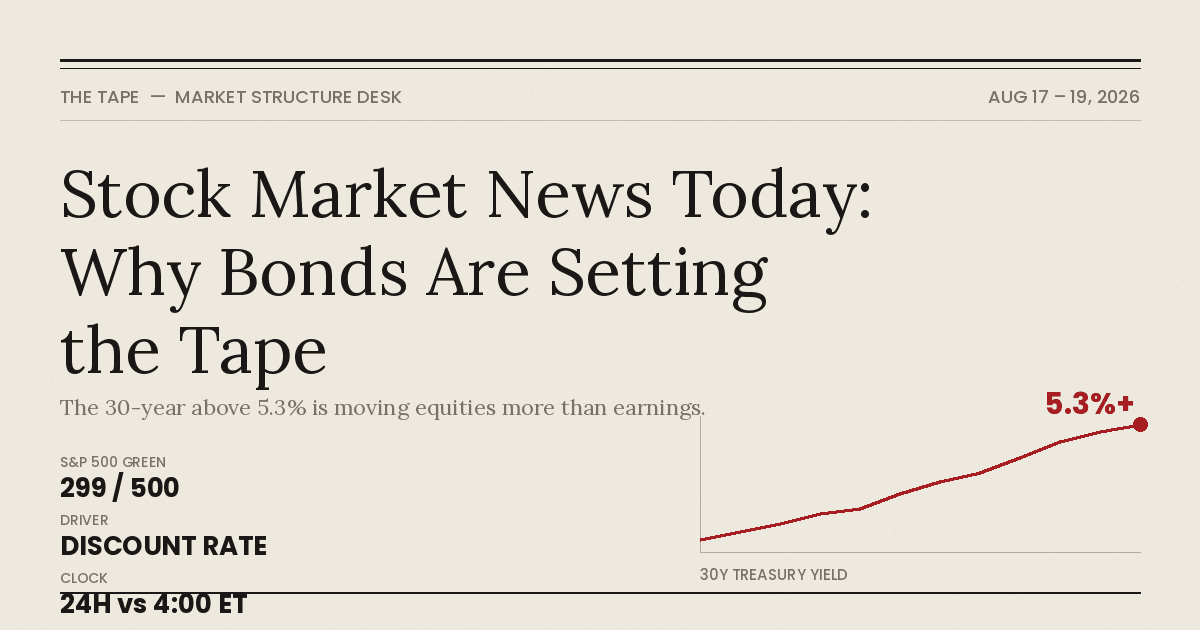
Stock market news today: what actually moved, August 17–19, 2026
The week began with the US–Iran memorandum of understanding lapsing on August 17. Asked whether he would seek an extension, President Trump said no. Oil bid, yields ran, and equities gave back a record.
| Instrument | Level (Aug 18, 2026) | Move | What it signals |
|---|---|---|---|
| S&P 500 | 3rd straight down day | −0.6% | Index weakness ≠ broad weakness |
| Nasdaq Composite | Session laggard | −1.3% | Long-duration growth repriced |
| Dow Jones Industrial Average | Best relative performer | −0.2% | Value/defensive bid holding |
| 30-year Treasury yield | Above 5.3% | Highest since 2007 | The actual driver |
| 10-year Treasury yield | Toward 4.75% | Multi-month highs | Discount-rate pressure |
| Brent crude | $90.71 | −0.18% early | Hormuz risk premium |
| WTI crude | $84.84 | +0.40% early | Same, US benchmark |
| Gold futures | $4,452.70 | −0.47% | Not behaving as the fear trade |
| Silver futures | $65.24 | −1.50% | Industrial drag |
| Bitcoin | ~$64,135 | +2.7% vs Monday's open | Decoupled, and not upward |
Levels as reported August 18, 2026; oil, gold and silver are early-session prints, index moves are for the full day.
One detail from that session is worth more than the headline number. At 11:18 a.m. ET on August 18, the S&P 500 was down 0.58% — while 299 of its 500 holdings were green. Health care and biotech printed all-time highs the same day. A semiconductor gauge fell 5.5%, with Western Digital off 7%, SanDisk 9%, and Seagate more than 9%. That is not a market falling. That is a market rotating, with the index dragged by a handful of very large, very expensive names.
Wednesday, August 19 brings two live catalysts: FOMC minutes from the July 28–29 meeting at 2:00 p.m. ET, and second-quarter results from Target, Lowe's, TJX, Analog Devices and Estée Lauder.
Why stocks fell days after a record high
Because the discount rate rose, and nothing about earnings offset it.
This is the mechanic that most daily coverage skips. A stock's price is a claim on future cash flows, discounted back to today. Raise the rate you discount at and the price falls — mathematically, with zero deterioration in the business. The further out a company's cash flows sit, the harder that math bites. Which is exactly why the Nasdaq lost roughly twice what the Dow did on August 18, and why the most extreme casualty was CoreWeave, down 8.3% as a heavily leveraged AI infrastructure borrower.
Note what is not driving this. Traders had pulled odds of a September rate hike to under one-third. The pressure is coming from the long end, not the policy rate — persistent inflation risk, heavy government borrowing, and the debt issuance financing the AI capex boom all competing for the same capital. Daniela Hathorn of Capital.com put the consequence plainly on August 18: financial conditions can tighten even without the Fed doing anything.
For readers used to the 2020–2021 regime, take a second look at that. This is a market pricing the possibility of hikes, with three FOMC dissenters in July voting for exactly that. The reflex of "bad news is good news because the Fed will cut" does not apply here.
Ranking the drivers: what to read first in today's stock market news
Every daily wrap lists the same five factors. Almost none of them tell you which one to weight. Here is our ranking for the current regime, with the evidence from this week.
| Rank | Driver | Why it ranks here | This week's evidence |
|---|---|---|---|
| 1 | Long-end yields | Moves every equity simultaneously via the discount rate; no earnings offset available | 30-year >5.3%, highest since 2007 |
| 2 | Oil and Hormuz risk | Feeds inflation expectations, which feeds back into rank 1 | Brent ~$91, single-digit strait crossings |
| 3 | AI capex pricing | Concentrated in the index's largest weights; a sector story with index consequences | Semis gauge −5.5%; CRWV −8.3% |
| 4 | Consumer and retail earnings | Real economic signal, but slower-moving and already partly priced | Target, Lowe's, TJX on Aug 19 |
| 5 | Single-stock headlines | Loud, tradable, rarely index-relevant | BIO −32.4%, TRGP +6.7% |
The practical use of this ranking is triage. If the bond market and the equity market disagree in the same session, the bond market has been winning. If a stock market news headline does not touch ranks one through three, it is probably not the reason the index did what it did.
-- Price
What today's stock market news means for bitcoin and crypto
Bitcoin traded near $64,135 on the morning of August 18 — up 2.7% from Monday's open, and going nowhere over a much longer window. Over roughly the preceding month, the S&P 500 added about $2.1 trillion in market value while BTC sat around $64,600.
That decoupling is the more interesting signal, and it cuts against the lazy version of the correlation story. Bitcoin's 30-day correlation with the Nasdaq is not a constant — it swung from −0.68 in February 2026 to +0.74 in March 2026. Correlation in crypto is a regime, not a property.
The transmission channel that has held up is the one running through rank 1 above. Bitcoin produces no yield. When a risk-free 30-year pays above 5.3%, the opportunity cost of holding a non-yielding asset rises, and marginal capital that might have bought the asymmetry buys the coupon instead. That is a slower, more grinding headwind than a correlation spike — and it is why "stocks made a record so crypto should follow" has been a poor trade this summer.
The honest reading: right now, watch the long bond for crypto direction more than you watch the S&P 500.
When the US stock market closes — and what still trades after 4:00 p.m. ET
The US equity session runs 9:30 a.m. to 4:00 p.m. ET, Monday through Friday, excluding market holidays. The news cycle does not observe those hours. FOMC minutes land at 2:00 p.m. and get digested overnight. Middle East headlines print on Gulf time. Asian chip supply chains move while New York sleeps — as they did on August 18, when chip strength stalled in Asian trade overnight and the losses extended through Europe before the US open.
That gap is a structural problem for anyone outside US market hours or outside a US brokerage relationship, and it is the reason tokenized equities and TradFi perpetuals exist as a category.
WEEX TradFi is one implementation. Verified parameters, as published on the product page and in WEEX's own July 2026 figures:
| Parameter | WEEX TradFi |
|---|---|
| Asset classes | Tokenized stocks, gold, silver, crude oil, commodities, global indices |
| Instruments | ~300 TradFi perpetuals; 70+ tokenized-stock spot pairs (July 2026) |
| Trading hours | 24/7, with thinner liquidity during TradFi market closures |
| Margin asset | USDT only |
| Account | No separate TradFi account; trades from spot or futures balance |
| Max leverage | 100× tokenized stocks; 400× XAUT/XAG; 100× PAXG |
| Fees | Zero fees on gold, stocks and oil |
| Brokerage needed | None |
Two caveats belong next to that table, because the product page will not lead with them. First, "24/7" and "liquid 24/7" are different claims — WEEX says so itself, and weekend spreads on an equity perpetual are where inexperienced traders get filled badly. Second, 100× leverage on an instrument tracking an underlying that gaps at the Monday open is a fast way to be liquidated on a move you were directionally right about. The recent pair listings skew toward names that move on exactly this kind of news — KOSPI, MTSI, FTNT, SCCO, GILD, WDAY, RIOT — which is the appeal and the hazard in the same sentence.
If you want the mechanics before the trade, WEEX's guide to how pre-IPO perpetuals work covers index pricing, funding settlement and tracking deviation — the same machinery sits under the TradFi contracts, and the concepts transfer directly. Live pairs and volumes are on the WEEX markets page.
How to read stock market news without getting whipsawed
Four habits separate people who use daily coverage from people who get traded by it.
Check breadth before you accept the headline. An index down 0.6% with 299 constituents higher is telling you something completely different from an index down 0.6% with 450 lower. Most wraps report the first number and skip the second.
Separate the driver from the decoration. Single-stock moves are the most quotable part of any market recap and the least useful. Bio-Rad falling 32.4% on August 18 was dramatic and told you nothing about the tape.
Watch what did not move. Gold slipped 0.47% on a day of Middle East escalation and record long-end yields. Gold not rallying into that is information — it suggests the yield move, not the geopolitical one, was the dominant force.
Respect the clock, in both directions. A perpetual on a US equity keeps quoting a price at 3 a.m. That does not mean the underlying has repriced; it means a thin book has. Traders lose more money to weekend liquidity than to being wrong about the news.
What matters most in this market
Strip the week down and one thing is doing the work. Earnings held. Breadth held. Health care printed records. The S&P 500 still sits within a few percent of an all-time high set on August 13. What fell apart was the price of long-duration money, and every equity in the index pays that tax at the same time.
Read stock market news today with that hierarchy in mind and most sessions become legible: check the 30-year first, oil second, the AI complex third, and treat single-stock headlines as texture. If your access to those markets stops at 4:00 p.m. ET while the headlines keep coming, that is an execution gap worth solving deliberately — WEEX TradFi is running a $100,000 prize pool on gold and stock trading through August 31, 2026, which is a reasonable moment to learn the mechanics on small size before you need them.
FAQ
1. Why did stocks fall today when the S&P 500 just hit a record?
Because long-term interest rates rose, not because earnings deteriorated. The 30-year Treasury yield pushed above 5.3% on August 18, 2026, its highest since 2007. Higher discount rates cut the present value of future cash flows, which hits every stock at once — hardest on the long-duration growth names that dominate the Nasdaq.
2. What time does the US stock market open and close?
The regular session runs 9:30 a.m. to 4:00 p.m. ET, Monday through Friday, excluding market holidays. Tokenized stocks and TradFi perpetuals on crypto venues quote continuously, but liquidity thins substantially outside those hours.
3. Does stock market news affect crypto prices?
Through the rate channel, consistently; through direct correlation, only in certain regimes. Bitcoin's 30-day correlation with the Nasdaq swung from −0.68 in February 2026 to +0.74 in March 2026. As of August 2026 the clearer link runs through yields: BTC sat near $64,135 while the S&P 500 added roughly $2.1 trillion in value over the prior month.
4. What is the biggest thing to watch in this week's stock market news?
Two dated catalysts: FOMC minutes from the July 28–29 meeting, released 2:00 p.m. ET on August 19, 2026, and retail earnings from Target, Lowe's and TJX the same day. Three FOMC members dissented in favor of a hike in July, so the minutes carry more signal than usual.
5. Can I trade US stocks without a brokerage account?
Tokenized stock products and equity perpetuals on crypto exchanges give price exposure without a brokerage relationship, settled in USDT. They are not shares: no voting rights, no direct dividend entitlement, and pricing depends on the venue's index and funding mechanism rather than the exchange order book you would get through a broker.
Risk Warning
Crypto assets and leveraged derivatives are highly volatile and may result in partial or total loss of capital. Tokenized stocks and TradFi perpetuals carry risks that do not exist in traditional share ownership: you hold no equity, no voting rights and no direct claim on the issuer; the contract price can deviate from the underlying because it references an index rather than the primary exchange; and funding payments accrue as a carrying cost regardless of whether your directional view is correct. Leverage of 100× on tokenized stocks means a roughly 1% adverse move can liquidate a position — and equity underliers gap at the Monday open after weekend news, which no stop order can protect against. Liquidity during traditional-market closures is materially thinner than during US hours, widening spreads and slippage. Levels cited in this article are dated to the August 17–19, 2026 sessions and will be stale by the time you read them. Nothing here is investment advice.
This content is provided for general informational purposes only and doesn't constitute financial, investment, legal, or tax advice. Any events, rewards, online promotions, or related information mentioned herein should not be considered a recommendation, solicitation, or invitation to purchase, sell, trade, or otherwise deal in any crypto assets. Crypto assets are highly volatile and may result in loss. The availability of WEEX services, products, and related events may vary by region. You are responsible for ensuring that your participation is in accordance with applicable local laws and regulations.
You may also like
Bio Protocol Coin Price Prediction & Forecasts: Will It Rally to $0.45 by Q4 2025? +12% Surge Amid Market Recovery

How to Earn WXT Rewards with WEEX Trade to Earn S6 Event

How to Earn WXT Rewards with WEEX Trade to Earn S6 Futures Event

Roblox Stock Price Prediction 2026-2027: Can RBLX Recover After Falling From $142 to $38

Roblox Stock Is Down 68% in the Past Year: What Age Verification and Sands Capital's Exit Actually Signal
Pakistan Stock Exchange Performance in 2026: What Is Driving the KSE 100 to Record Highs

The XSolut (XST) Contract Address: How to Identify the Real XST Token on Solana 2026
Nvidia's $105 Billion OpenAI Data Center Backing: Could It Push the IPO Toward a $1 Trillion Valuation? 2026
How Do Pre-IPO Perpetual Futures Allow On-Chain Exposure to OpenAI Stock? 2026

Can XST Crypto Reach $0.10? XSolut Price Prediction 2026

Is XST Crypto a Long-Term Opportunity or Short-Term Hype?
USDT vs BTC Settlement for Crypto Broker Partners: Which Currency Is Better for Your Business
Master Account vs Sub-Account: What the Difference Means for Crypto Broker Partners

Crypto Broker vs Stock Broker: What Is the Difference and Which Do You Need
XSolut Company: What Is the Team Behind XST Coin and What Do They Actually Disclose
Is OPAI.PVT OpenAI's Real Stock Symbol? What Investors Need to Know Before the IPO 2026
Meta Stock Price Is Down 30% From Its 52 Week High: Is META a Buy After the Child Safety Trial Drop
Meta Stock Falls as 29 States Begin Federal Child Safety Trial: What the "Big Tobacco Moment" Warning Actually Means
What Is NIULAI Crypto? Why the Token and the Film Are Two Completely Different Things
Google Stock and the 199% EPS Beat: What Earning $9.11 Against a $3.04 Estimate Actually Reveals
Adobe Stock Jumps After BlackRock Raises Stake to Over 10%: What an $8.4 Billion Bet Actually Signals
Is OPAI.PVT OpenAI's Real Stock Symbol? What Investors Need to Know Before the IPO 2026
CoreWeave Stock (CRWV): The Debt Math Behind the AI Trade — and How to Trade It 24/7
Buy Crypto With JazzCash and Easypaisa, Now Live on WEEX
MSTR Stock Trades Below Its Bitcoin. Here's the Catch
Before Swapping XSolut (XST): How to Check Liquidity, Price Impact, and Failed-Trade Risk 2026
Is Niulai Coin a Good Investment? What the Film Story Cannot Tell You About NIULAI Risk
Niulai Coin Price Prediction: What Happens to Meme Tokens After a Viral Peak on BNB Chain
SK Hynix Stock Price Has 43% Upside According to Wall Street: What the $245 Consensus Target Actually Requires
Tesla Stock Price Is Down 30% in 2026: What the Q2 Earnings Miss and 1.4% Operating Margin Actually Signal
Bio Protocol Coin Price Prediction & Forecasts: Will It Rally to $0.45 by Q4 2025? +12% Surge Amid Market Recovery
How to Earn WXT Rewards with WEEX Trade to Earn S6 Event
How to Earn WXT Rewards with WEEX Trade to Earn S6 Futures Event
Roblox Stock Price Prediction 2026-2027: Can RBLX Recover After Falling From $142 to $38
Roblox Stock Is Down 68% in the Past Year: What Age Verification and Sands Capital's Exit Actually Signal
Pakistan Stock Exchange Performance in 2026: What Is Driving the KSE 100 to Record Highs


