
CoreWeave Stock (CRWV): The Debt Math Behind the AI Trade — and How to Trade It 24/7

 Prefer us on Google


CoreWeave stock (NASDAQ: CRWV) closed at $106.00 on August 18, 2026, inside a 52-week range of $60.55 to $153.20. That is a stock that has roughly halved from its high and roughly doubled from its low inside twelve months — and the most recent earnings print did nothing to settle the argument. Revenue more than doubled. The shares jumped double digits. The net loss also more than doubled.
Most coverage of CoreWeave stock stops at the growth headline. The more useful number is buried in the guidance table: for Q3 2026, CoreWeave guided to $860–940 million of interest expense against $200–260 million of adjusted operating income. The company expects to pay its lenders roughly three and a half times what its operations are guided to earn, in the same quarter. Everything else about CRWV — the backlog, the customer list, the volatility — is downstream of that single relationship.
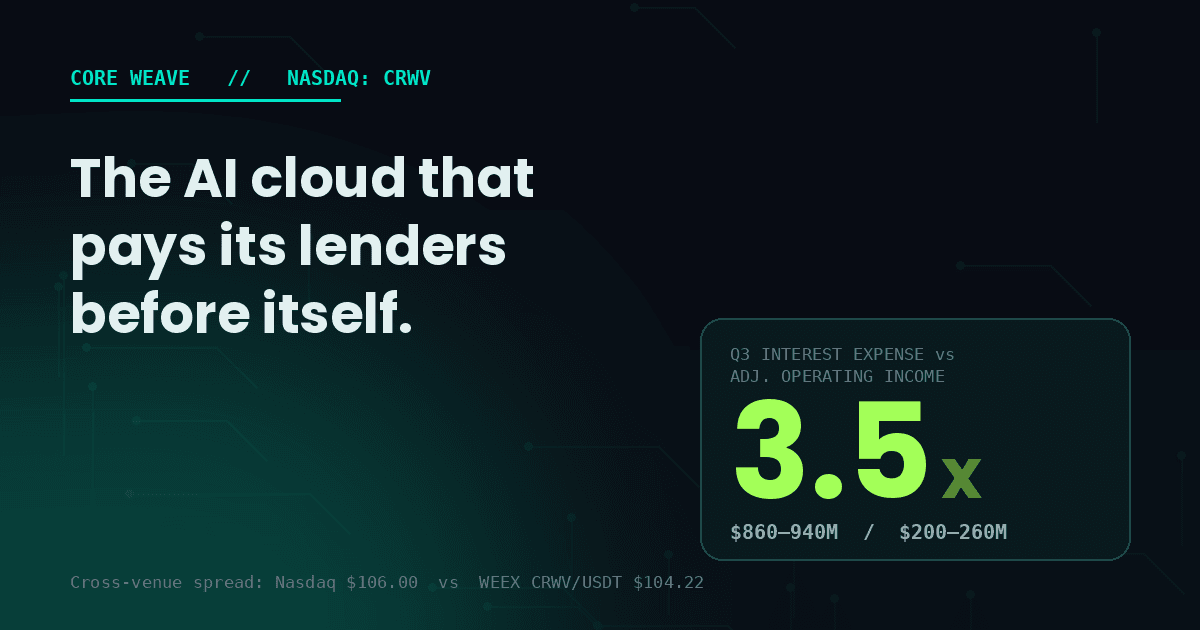
Here is what the numbers actually say, and how traders are getting CRWV exposure outside Nasdaq hours.
CoreWeave stock price and the Q2 2026 numbers that moved it
CoreWeave reported Q2 2026 on August 11, 2026. The stock rose sharply on the print.
| Metric (Q2 2026) | Reported | Context |
|---|---|---|
| Revenue | $2.6B | +112% YoY, +24% QoQ; beat ~$2.56B consensus |
| Adjusted loss per share | -$1.03 | Better than the ~-$1.20 expected |
| Net loss | $626M | Widened from $290M a year earlier |
| Revenue backlog | $104B | +246% YoY, before Q3 additions |
| Post-quarter commitments | >$25B | Net new, added early in Q3 2026 |
| Debt on balance sheet | ~$35B | Largely GPU and equipment financing |
And the forward guidance, raised at the same time:
| Guidance item | Q3 2026 | Full-year 2026 |
|---|---|---|
| Revenue | $3.45B – $3.6B | $12.4B – $13.2B |
| Adjusted operating income | $200M – $260M | $960M – $1.15B |
| Interest expense | $860M – $940M | — |
| Capital expenditure | $11.5B – $13.5B | $35B – $39B (raised from $31B – $35B) |
| Year-end active power | — | >1.85 GW (raised from >1.7 GW) |
Read those two tables together and the business becomes legible. CoreWeave is guiding to spend roughly three dollars of capex for every dollar of revenue in 2026, funded substantially by debt, to build power capacity it has largely pre-sold. That is not a software company's financial profile. It is closer to a utility build-out with a technology company's depreciation schedule.
What CoreWeave actually sells — and why the customer list is the whole thesis
CoreWeave rents GPU compute. It buys Nvidia hardware, racks it in data centres, wraps it in networking and orchestration software tuned for AI training and inference, and sells capacity under multi-year contracts. Founded in 2017 as a crypto-mining operation, it pivoted to AI infrastructure and IPO'd in March 2025.
The contracts are the asset, and they are extraordinarily concentrated:
| Customer | Commitment / share | Note |
|---|---|---|
| Microsoft | ~67% of FY2025 revenue | Share declining as backlog diversifies |
| Meta | Up to ~$35.2B total | Original ~$14.2B deal through 2031, plus ~$21B extension through 2032 |
| OpenAI | Up to ~$22.4B total | Built across three expansions from March 2025 onward |
| Anthropic | Added in Q2 2026 | Newest large-name addition |
CoreWeave has genuinely reduced its Microsoft dependence. It has not reduced concentration — it has redistributed it. Meta and OpenAI together account for close to two-thirds of contracted backlog. Over 75% of 2027 capacity is already sold.
That cuts both ways, and the direction depends entirely on your view of AI capex durability. If the hyperscalers keep spending, CoreWeave has visibility almost no company its age can match. If one large counterparty renegotiates, defers, or builds in-house instead, the backlog number that makes the bull case becomes the concentration number that makes the bear case — and it happens to the same dollar.
The second-order risk is subtler and rarely priced: several of CoreWeave's largest customers are also building their own AI infrastructure. Today's anchor tenant is tomorrow's competitor, and the transition does not require anyone to breach a contract. It only requires them not to renew.
The number CoreWeave stock coverage keeps skipping
Return to the interest expense line, because this is where the equity story is actually decided.
| Q3 2026 guidance | Low end | High end |
|---|---|---|
| Adjusted operating income | $200M | $260M |
| Interest expense | $860M | $940M |
| Interest as multiple of adj. operating income | 3.3x | 4.7x |
CoreWeave carries roughly $35 billion of debt against a business guided to produce $960 million to $1.15 billion of adjusted operating income for the full year. Adjusted operating income sits above interest, depreciation and tax in the income statement — it is not cash available to shareholders. Which is why the net loss widened to $626 million in a quarter when revenue grew 112%.
This is not a scandal, and it is not hidden. It is the deliberate structure of the business: borrow against contracted revenue, build capacity, service the debt from the contracts. It works as long as the contracts perform and refinancing stays available.
The practical consequence for anyone trading CoreWeave stock is that CRWV is a credit-sensitive equity wearing a growth-stock costume. Its beta to AI sentiment is obvious. Its beta to funding conditions is less obvious and probably larger. A move in credit spreads, a downgrade, or a difficult refinancing window will move this stock harder than a modest revenue miss would. Watch the debt calendar with at least the attention you give the earnings calendar.
-- Price
Is CoreWeave stock a good buy in 2026?
Analysts do not agree, and the spread of price targets is the honest answer. As of mid-August 2026, roughly 26 to 32 covering analysts hold a consensus Buy with an average 12-month target around $139–143, against a $106.00 close. But the dispersion matters more than the average: Citi raised to $159 while Barclays sat at $105, and Goldman Sachs held a Hold rating on the view that the growth is real and largely priced.
| Bull case | Bear case | |
|---|---|---|
| Demand | $104B backlog, >75% of 2027 capacity sold | Backlog is contracted, not collected — concentrated in 3–4 names |
| Growth | Revenue +112% YoY; FY26 guide raised | Net loss widened to $626M in the same quarter |
| Capacity | Year-end target raised to >1.85 GW | Requires $35–39B capex, largely debt-funded |
| Financing | Contracted revenue supports borrowing | Interest expense ~3.5x guided Q3 operating income |
| Position | Scarce neutral AI-infrastructure capacity | Largest customers are building their own capacity |
The more useful framing than "good buy or not": CoreWeave stock is a high-conviction, high-financing-risk expression of the AI capex cycle. It is not a diversified way to own AI. If the cycle extends, few names have more torque. If it pauses, CRWV has less balance-sheet slack than the hyperscalers to absorb the pause. Size accordingly, and do not confuse a large backlog with a durable moat.
How to trade CoreWeave stock exposure when Nasdaq is closed
Crypto traders who want CRWV exposure generally have three routes, and they are not equivalent:
| Route | What you get | What you don't get | Hours |
|---|---|---|---|
| Broker shares (CRWV) | Real equity, voting rights | Crypto-native settlement; USDT margin | Nasdaq hours |
| Tokenized CRWV stock | 1:1-backed price exposure, on-chain settlement | Shareholder or voting rights | ~24/7 |
| CRWV/USDT perpetual on WEEX | Long or short exposure, USDT-margined, leverage | Any ownership of CoreWeave | 24/7 |
The perpetual is the route most crypto traders default to, and the mechanics are worth understanding before you use it. WEEX lists CRWV/USDT as a USDT-margined perpetual under its TradFi contracts — as of July 2026 WEEX listed nearly 300 such perpetuals alongside more than 70 tokenized-stock spot pairs. The listing page advertises leverage up to 100x; confirm the tier actually available to your account in the app before sizing anything.
You are not buying CoreWeave stock when you trade the perpetual. You are buying a cash-settled contract referencing its price. No shares, no votes, no dividends, no claim on the company. The same structural logic that governs pre-IPO perpetuals — index pricing, funding, and tracking deviation applies here, with one important difference: CRWV has a continuous public market during Nasdaq hours, so the index has something real to track. For 118 hours a week, it does not.
What traders usually miss: the weekend gap and the funding drag
Here is a live example of the mismatch, using the exact figures on screen.
| Reference | Price | Timestamp |
|---|---|---|
| CRWV close (Nasdaq) | $106.00 | August 18, 2026, US close |
| CRWV/USDT perpetual (WEEX) | 104.22 | August 19, 2026, 03:42 UTC |
| Spread | -1.68% | Nasdaq shut, Asia hours |
That 1.68% gap is the instrument doing exactly what it should — pricing overnight sentiment while the cash market is closed. But it is also where two specific traps live.
The weekend gap. From Friday's US close to Monday's US open, the CRWV perpetual keeps trading and your leveraged position keeps living, with no cash equity market to anchor it. If CoreWeave announces a contract, a downgrade, or a financing on a Saturday, the perp absorbs the entire repricing on thinner liquidity than a weekday. A stop that is comfortable at 20x on a Wednesday is a different instrument on a Sunday. This is the most common way traders lose money on stock perps, and it has nothing to do with being wrong about the company.
The funding drag. Perpetual funding is exchanged on a recurring schedule and is separate from trading fees. Hold a directionally correct long through a crowded, persistently positive-funding stretch and the carry can eat a meaningful share of the move. That matters more on a name like CRWV, where the fundamental thesis plays out over quarters — earnings, capex execution, refinancings — while funding is charged in hours. Check the live funding rate and countdown on the contract page before you commit to holding through a catalyst. The same discipline applies to WEEX's other AI-linked contracts, such as the ANTHROPICUSDT pre-IPO perpetual referencing one of CoreWeave's own customers.
One more operational note: liquidity in stock perpetuals is not uniform across the clock. Spreads and depth on CRWV/USDT during Asian hours are not what they are during the US session overlap. Size entries and exits against the book you can actually see, not the one you saw yesterday afternoon.
The bottom line on CoreWeave stock
CoreWeave stock is the cleanest listed proxy for AI infrastructure demand and one of the most leveraged balance sheets expressing it. The $104 billion backlog is real; so is the $35 billion of debt and the interest bill that runs several times guided operating income. Those two facts are the same fact viewed from opposite ends — the debt bought the capacity that won the backlog.
Rank your inputs accordingly. Demand signals (new commitments, power targets, capacity sold forward) tell you whether the thesis is intact. Financing signals (interest expense, refinancing terms, credit spreads) tell you whether the company gets to keep expressing it. Most CRWV coverage tracks the first and ignores the second.
If you want exposure without a US brokerage account, the CRWV/USDT perpetual on WEEX trades around the clock — but review the funding schedule, the leverage tier and the weekend liquidity profile before you size a position, not after.
FAQ
1. What is CoreWeave stock trading at right now?
CoreWeave closed at $106.00 on August 18, 2026, within a 52-week range of $60.55 to $153.20. The WEEX CRWV/USDT perpetual referenced 104.22 at 03:42 UTC on August 19, 2026, roughly 1.7% below the last Nasdaq close, with the US market shut. Both figures change continuously — check a live source before trading.
2. Why did CoreWeave stock jump after Q2 2026 earnings?
Revenue came in at $2.6 billion, up 112% year over year and ahead of the ~$2.56 billion consensus, and the adjusted loss of $1.03 per share was narrower than the ~$1.20 expected. Management also raised full-year revenue guidance to $12.4–13.2 billion and lifted the year-end active power target to more than 1.85 GW.
3. Is CoreWeave profitable?
Not on a net basis. CoreWeave posted a $626 million net loss in Q2 2026, wider than the $290 million loss a year earlier, despite revenue doubling. The company guides to positive adjusted operating income of $960 million to $1.15 billion for 2026, but that measure sits above interest expense, which alone is guided at $860–940 million for Q3.
4. How much debt does CoreWeave have?
Roughly $35 billion as of the end of Q2 2026, largely raised against contracted revenue to finance Nvidia GPUs and data-centre equipment. Full-year 2026 capital expenditure guidance was raised to $35–39 billion against $12.4–13.2 billion of expected revenue.
5. Who are CoreWeave's biggest customers?
Microsoft accounted for roughly 67% of FY2025 revenue. Contracted backlog has since diversified toward Meta (up to ~$35.2 billion in total commitments through 2032), OpenAI (up to ~$22.4 billion), and Anthropic, added in Q2 2026. Concentration has shifted rather than disappeared — Meta and OpenAI together represent close to two-thirds of contracted backlog.
6. What is the analyst price target for CoreWeave stock?
As of mid-August 2026, consensus was a Buy with an average 12-month target around $139–143. The dispersion is wide: Citi raised its target to $159 while Barclays sat at $105 and Goldman Sachs maintained a Hold. Analyst targets are opinions, not outcomes.
7. Can I trade CoreWeave stock 24/7 as a crypto trader?
You can trade CRWV exposure around the clock through the CRWV/USDT perpetual on WEEX, which is USDT-margined and cash-settled. You are not buying shares — there are no voting rights, no dividends, and no claim on CoreWeave. The underlying equity itself trades only during Nasdaq hours.
8. What is the biggest risk in trading a CRWV perpetual?
Weekend and overnight gap risk. The perpetual keeps trading when Nasdaq is closed, so news breaking outside market hours is absorbed entirely by the contract, on thinner liquidity and with your leverage still live. Recurring funding payments are the second cost most traders underestimate on multi-day holds.
Risk Warning
Trading CoreWeave stock exposure through leveraged derivatives carries substantial risk of partial or total loss of capital. CRWV is a high-volatility equity — it has traded between $60.55 and $153.20 over the past 52 weeks — and the company operates with roughly $35 billion of debt against a net loss, which adds credit and refinancing risk on top of ordinary equity risk. Perpetual contracts amplify this: leverage means a small adverse move can liquidate a position and cost your entire margin, funding payments accrue as a carrying cost regardless of direction, and liquidity in stock perpetuals thins outside US market hours, widening spreads and worsening fills. Because the contract trades when Nasdaq does not, price gaps around earnings, financing announcements and weekend news can move against you with no cash market available to hedge into. A perpetual gives you price exposure only — no shares, no shareholder rights, no dividends, and no claim on CoreWeave. All figures in this article are dated to their reporting period and will change. Nothing here is investment advice; assess your own risk tolerance and local regulatory position before trading.
This content is provided for general informational purposes only and doesn't constitute financial, investment, legal, or tax advice. Any events, rewards, online promotions, or related information mentioned herein should not be considered a recommendation, solicitation, or invitation to purchase, sell, trade, or otherwise deal in any crypto assets. Crypto assets are highly volatile and may result in loss. The availability of WEEX services, products, and related events may vary by region. You are responsible for ensuring that your participation is in accordance with applicable local laws and regulations.
You may also like

Roblox Stock Price Prediction 2026-2027: Can RBLX Recover After Falling From $142 to $38

How Do Pre-IPO Perpetual Futures Allow On-Chain Exposure to OpenAI Stock? 2026

Master Account vs Sub-Account: What the Difference Means for Crypto Broker Partners
Is OPAI.PVT OpenAI's Real Stock Symbol? What Investors Need to Know Before the IPO 2026

Buy Crypto With JazzCash and Easypaisa, Now Live on WEEX

How to Earn WXT Rewards with WEEX Trade to Earn S6 Event
How to Earn WXT Rewards with WEEX Trade to Earn S6 Futures Event
Roblox Stock Is Down 68% in the Past Year: What Age Verification and Sands Capital's Exit Actually Signal

Pakistan Stock Exchange Performance in 2026: What Is Driving the KSE 100 to Record Highs

The XSolut (XST) Contract Address: How to Identify the Real XST Token on Solana 2026
Nvidia's $105 Billion OpenAI Data Center Backing: Could It Push the IPO Toward a $1 Trillion Valuation? 2026
Can XST Crypto Reach $0.10? XSolut Price Prediction 2026

Is XST Crypto a Long-Term Opportunity or Short-Term Hype?
USDT vs BTC Settlement for Crypto Broker Partners: Which Currency Is Better for Your Business
Crypto Broker vs Stock Broker: What Is the Difference and Which Do You Need
XSolut Company: What Is the Team Behind XST Coin and What Do They Actually Disclose
Meta Stock Price Is Down 30% From Its 52 Week High: Is META a Buy After the Child Safety Trial Drop
Meta Stock Falls as 29 States Begin Federal Child Safety Trial: What the "Big Tobacco Moment" Warning Actually Means
What Is NIULAI Crypto? Why the Token and the Film Are Two Completely Different Things
Google Stock and the 199% EPS Beat: What Earning $9.11 Against a $3.04 Estimate Actually Reveals
Adobe Stock Jumps After BlackRock Raises Stake to Over 10%: What an $8.4 Billion Bet Actually Signals
Is OPAI.PVT OpenAI's Real Stock Symbol? What Investors Need to Know Before the IPO 2026
Stock Market News Today: Why Bonds Are Setting the Tape

MSTR Stock Trades Below Its Bitcoin. Here's the Catch
Before Swapping XSolut (XST): How to Check Liquidity, Price Impact, and Failed-Trade Risk 2026
Is Niulai Coin a Good Investment? What the Film Story Cannot Tell You About NIULAI Risk
Niulai Coin Price Prediction: What Happens to Meme Tokens After a Viral Peak on BNB Chain
SK Hynix Stock Price Has 43% Upside According to Wall Street: What the $245 Consensus Target Actually Requires
Tesla Stock Price Is Down 30% in 2026: What the Q2 Earnings Miss and 1.4% Operating Margin Actually Signal
MSFT Stock Price Prediction 2026-2027: What the $569 Analyst Consensus Target Actually Requires
Roblox Stock Price Prediction 2026-2027: Can RBLX Recover After Falling From $142 to $38
How Do Pre-IPO Perpetual Futures Allow On-Chain Exposure to OpenAI Stock? 2026
Master Account vs Sub-Account: What the Difference Means for Crypto Broker Partners
Is OPAI.PVT OpenAI's Real Stock Symbol? What Investors Need to Know Before the IPO 2026
Buy Crypto With JazzCash and Easypaisa, Now Live on WEEX
How to Earn WXT Rewards with WEEX Trade to Earn S6 Event
Contents
Popular coins
Latest articles





