
Kioxia Stock Before the Oct 1 Split: The 24/7 Perp Problem

 Prefer us on Google
Kioxia stock is the strangest chart in semiconductors right now. Over the twelve months to August 2026 the shares ran from ¥2,280 to ¥112,700, briefly made Kioxia Japan's most valuable listed company ahead of Toyota, and have since given back roughly half of that. On 14 August 2026 the stock closed around ¥53,740 (source: Investing.com), for a market capitalisation near ¥28.4 trillion.
Most coverage of Kioxia stock stops at the NAND story: AI data centres need storage, Kioxia sells storage, earnings exploded. That part is true and it is also the part every other page already tells you. The more useful question, if you are holding this through the autumn, is mechanical: Kioxia executes a three-for-one stock split on 1 October 2026, and a growing share of retail exposure to the name now sits in 24/7 perpetual contracts that do not close when Tokyo does. Those two facts collide in a specific, avoidable way.
Where Kioxia stock sits after halving
| Item | Detail | As of |
|---|---|---|
| Ticker | 285A (Tokyo Stock Exchange) | Aug 2026 |
| Share price | ~¥53,740 | 14 Aug 2026 |
| 52-week range | ¥2,280 – ¥112,700 | Aug 2026 |
| Drawdown from high | ~52% | 14 Aug 2026 |
| Market cap | ~¥28.4 trillion | Aug 2026 |
| Q1 FY2026 revenue | ¥1.767tn, +415.5% YoY | reported 31 Jul 2026 |
| Q1 non-GAAP operating income | ¥1.326tn (75% margin) | reported 31 Jul 2026 |
| FY to Mar 2026 net profit | ¥554.4bn, +103.6% YoY | May 2026 |
| Buyback | Up to 30m shares (~5.5%), ¥800bn cap | 3 Aug – 30 Oct 2026 |
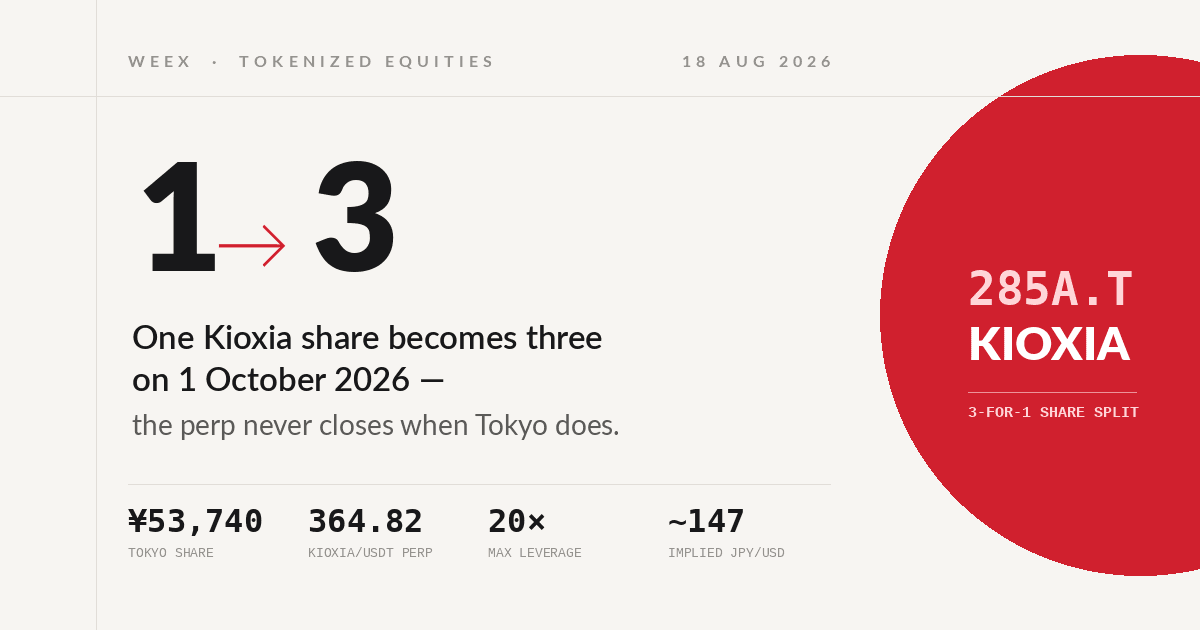
| Stock split | 3-for-1, record date 30 Sep, effective 1 Oct | announced 31 Jul 2026 |
| Bain Capital stake | Fully exited, ~¥2.5tn proceeds | Jul 2026 |
| WEEX perpetual | KIOXIA/USDT, last 364.82, up to 20x leverage | checked 18 Aug 2026 |
Sources: Investing.com, company disclosure of 31 July 2026, Nikkei/Bloomberg reporting on the Bain exit, and the live KIOXIA/USDT perpetual on WEEX.
The 52-week range is the number to sit with. A stock that travels from ¥2,280 to ¥112,700 and back to ¥53,740 inside a year is not being priced on discounted cash flows. It is being priced on the market's rolling guess about how long the NAND shortage lasts.
Why a record quarter still knocked Kioxia stock down
Kioxia reported the best quarter in its history on 31 July and the stock's medium-term trend broke anyway. Revenue of ¥1.767 trillion was up 415.5% year over year. Non-GAAP operating income of ¥1.326 trillion implied a 75% operating margin — a number that would be implausible in almost any other manufacturing business.
Both figures came in below Bloomberg consensus, which sat at ¥1.835 trillion and ¥1.370 trillion respectively.
That is the whole story of the drawdown in one line. When a stock has appreciated roughly twentyfold, the market is no longer paying for growth; it is paying for growth versus an expectation that has been marked up every quarter. A 415% revenue increase that misses by 4% is a downgrade. The company answered with capital returns — a ¥800 billion buyback covering up to 30 million shares (about 5.5% of the count), running 3 August to 30 October — which supports the float without changing the underlying question.
The demand side still looks intact. Data centre and enterprise SSDs now account for more than 60% of revenue, blended average selling prices are up roughly 70% year over year, and Kioxia's own guidance points to NAND market growth above a 20% CAGR through 2028 with supply staying tight into 2027. The risk is not that the cycle is over. The risk is that a 75% operating margin is, by definition, a shortage margin, and shortage margins invite capacity.
This is the same tension that has whipsawed the rest of the memory complex — SanDisk's 50% drawdown came off record numbers too, and SanDisk is Kioxia's joint-venture partner in the Yokkaichi and Kitakami fabs. When one of them signals capacity, both re-rate.
What the Oct 1 three-for-one split actually changes
Mechanically, almost nothing: record date 30 September 2026, effective 1 October, authorised shares rising from 2.07 billion to 6.21 billion. Every holder ends up with three shares priced at roughly a third. The stated purpose is to lower the investment unit and widen the retail base — at ¥53,740 a share, a standard 100-share Japanese lot costs over ¥5 million, which prices out most domestic retail.
Operationally, it matters more than usual for anyone holding synthetic exposure, because a split is a corporate action, and corporate actions are the one event class where a perpetual contract and the underlying share can legitimately behave differently.
WEEX's own listing terms are explicit about this: corporate actions such as dividends or stock splits may cause sharp price movements, and the exchange may take measures such as early settlement when required. Read that literally. "Early settlement" means a position you intended to hold through October can be closed at a price the venue determines, on a date you did not choose.
| Aspect | Holding the share (broker) | Holding the perp (24/7 venue) |
|---|---|---|
| Split handling | Automatic 1→3 adjustment by the registrar | Contract adjustment, or early settlement, per venue policy |
| Who decides | Exchange and registrar rules | The venue, announced case by case |
| Trading over 30 Sep – 1 Oct | Tokyo hours only | Continuous, including while Tokyo is closed |
| Worst realistic outcome | Cost basis restated | Position closed at a venue-set price before you act |
The practical instruction is unglamorous: before 30 September, read the specific contract notice for KIOXIA/USDT rather than assuming the split is handled the way your broker would handle it. Traders who lose money on splits almost never lose it on the split itself. They lose it on the leverage they were carrying when the adjustment landed.
-- Price
Trading Kioxia on WEEX: the perp is quoted in dollars
Here is a detail that is genuinely absent from the mainstream Kioxia coverage. The KIOXIA/USDT perpetual on WEEX was showing 364.82 when the pair page was checked on 18 August 2026, with leverage up to 20x. The underlying trades in yen at roughly ¥53,740.
Divide one into the other and the contract is carrying an implied cross rate near 147 JPY/USD.
That means a KIOXIA perp holder is running two positions, not one: a view on Japanese NAND economics, and an unhedged short-yen-against-dollar exposure layered on top. If Kioxia stock is flat in Tokyo and the yen strengthens 3%, the dollar-quoted contract falls anyway. Traders who came from crypto, where the quote currency and the asset's home currency are the same thing, routinely miss this.
The second structural gap is time. Tokyo is closed roughly 19 hours out of every 24, and all weekend. The perp is not. Over a Japanese public holiday the contract can drift for three days on thin, sentiment-driven flow with no cash market to anchor it, then re-converge violently at the Tokyo open. This is not theoretical — the same fracture between a home listing, its ADR and its tokenised versions is documented in detail for SK Hynix, where Seoul, Nasdaq and tokens disagreed during a sharp drawdown.
Then there is carry. Funding on stock perpetuals settles every eight hours. On a name with Kioxia's realised volatility, a directionally correct trade held for six weeks into the split can still finish flat after funding.
Nine leveraged ETFs are about to shape the intraday tape
At least nine leveraged ETFs referencing Kioxia — 2x long and 2x inverse products from issuers including Tuttle Capital, GraniteShares and Corgi Strategies — have been prepared for US listing, with the first expected as early as August 2026. If they list, Kioxia becomes the first Japanese company used as the underlying for single-stock leveraged ETFs.
The relevant mechanic is daily rebalancing. Leveraged ETFs must reset their exposure at the close to maintain the stated ratio, which means they buy into strength and sell into weakness, every day, mechanically. Concentrate enough assets in those products and you get a reflexive loop: a large Kioxia move forces a same-direction rebalance, which extends the move beyond what the news justified.
For a trader, the implication is narrow and useful. It does not change whether Kioxia stock is cheap. It changes the shape of the tape — expect fatter closing-hour moves, and treat late-session breakouts with more suspicion than you would on an unleveraged name. Stops placed just beyond the day's range are the ones that get taken.
Is Kioxia stock a buy here? What has to stay true
Analyst targets are not much help: the 12-month average sits near ¥111,431 with estimates spanning ¥40,000 to ¥200,000 (15 buys, 1 sell, as of August 2026). A five-fold spread between the high and low estimate is a polite way of saying nobody knows.
The more honest framing is conditional. Three things have to hold for the current price to look cheap in hindsight:
| What has to stay true | Why it matters | What would break it |
|---|---|---|
| NAND supply stays tight into 2027 | 75% operating margins are shortage margins | Aggressive capex announcements from Samsung, SK Hynix or Chinese suppliers |
| AI inference keeps pulling storage, not just DRAM | Data centre SSD is over 60% of revenue | Inference workloads shifting toward memory-light architectures |
| Post-Bain ownership settles cleanly | Bain's ~¥2.5tn exit removed the anchor holder | Persistent index and float-driven selling with no replacement base |
Notice what is not on that list: the split. A three-for-one split creates no value. It changes the denominator and the retail accessibility, and in a stock this volatile it mostly creates a date around which positioning clusters.
The better reading of Kioxia stock at ¥53,740 is that it is neither the twentyfold momentum trade of late 2025 nor a broken story. It is a high-margin cyclical, halfway down from an unsustainable peak, with a defined catalyst on 1 October and a genuinely tight supply picture behind it. That is a tradeable setup. It is not a buy-and-forget one.
Where traders actually lose money on this name
Practical, in rough order of how often it happens:
- Leverage into the split date. The single most avoidable loss. Reduce size before 30 September or accept that the venue may settle for you.
- Ignoring the currency leg. A dollar-quoted perp on a yen-denominated share is a two-factor bet. Size it as one.
- Holding perps through the Tokyo weekend gap. Three-day drifts on thin books re-converge fast at the open.
- Funding drag. Eight-hour funding on a high-vol name compounds quietly across a multi-week hold.
- Chasing the close. If the leveraged ETFs list, the last hour is partly mechanical flow, not information.
If you are trading Kioxia through a perpetual rather than owning the share, confirm the contract's split-handling notice, check the live funding rate, and size for a 30% adverse move — because the past twelve months delivered several.
FAQ
1. What is Kioxia's stock ticker?
Kioxia Holdings trades on the Tokyo Stock Exchange under 285A, not 6600 as older listings sometimes suggest. It also has an OTC line in the US (KXIAY) and a KIOXIA/USDT perpetual contract on WEEX.
2. Why has Kioxia stock fallen so much from its high?
The Q1 FY2026 results reported on 31 July 2026 were records in absolute terms — revenue ¥1.767tn, up 415.5% — but came in below Bloomberg consensus on both revenue and operating profit. After a roughly twentyfold run, a small miss against a repeatedly raised bar was enough to trigger a sustained de-rating.
3. When is the Kioxia stock split and what is the ratio?
Three-for-one, with a record date of 30 September 2026 and an effective date of 1 October 2026. Authorised shares rise from 2.07 billion to 6.21 billion. Shareholders receive three shares for each one held, at roughly a third of the price.
4. What happens to a Kioxia perpetual position through the split?
That depends on the venue's policy, not on the registrar. WEEX states that corporate actions including stock splits may cause sharp price movements and that it may take measures such as early settlement. Check the specific KIOXIA/USDT contract notice before the record date rather than assuming a broker-style automatic adjustment.
5. Does the WEEX KIOXIA perp give me real Kioxia shares?
No. A perpetual contract gives price exposure with leverage and funding costs. It carries no shareholding, no voting rights and no claim on the company — and because it is quoted in USDT against a yen-denominated share, it also carries currency exposure.
6. Is Kioxia stock a good investment after the drawdown?
That is a judgement, not a fact, and the analyst range says as much: a 12-month average target near ¥111,431 with estimates from ¥40,000 to ¥200,000 as of August 2026. The bull case needs NAND supply to stay tight into 2027 and AI storage demand to keep growing. The bear case is that a 75% operating margin invites competing capacity. Verify current prices before acting.
7. What are the Kioxia leveraged ETFs?
At least nine 2x long and 2x inverse single-stock ETFs referencing Kioxia have been prepared for US listing by issuers including Tuttle Capital, GraniteShares and Corgi Strategies, with the first expected from around August 2026. They would be the first single-stock leveraged ETFs built on a Japanese company. Their daily rebalancing tends to amplify closing-hour moves in the underlying.
Risk Warning
Kioxia is a high-volatility cyclical equity and any derivative referencing it can result in partial or total loss of capital. The shares have traded between ¥2,280 and ¥112,700 in the past twelve months and sit roughly 52% below their high as of 14 August 2026; a position sized for normal equity volatility is undersized for this name.
Specific risks to price in: corporate-action risk, because the 1 October three-for-one split may trigger contract adjustment or early settlement on synthetic products at a venue-determined price and date; leverage and funding risk, since stock perpetuals charge funding every eight hours and liquidate quickly at 20x; currency risk, because a USDT-quoted contract on a yen-denominated share exposes you to JPY/USD moves independent of the stock; liquidity and gap risk, as the perpetual trades 24/7 while the Tokyo Stock Exchange is closed roughly 19 hours a day and all weekend, allowing wide spreads and violent re-convergence at the open; counterparty risk, since a perpetual is a claim on the venue, not on Kioxia; cyclical risk, as today's margins depend on a NAND shortage that competing capacity can end; and regulatory risk, as availability of tokenised and synthetic equity products varies by jurisdiction and can change without notice.
Confirm the live contract specification, funding rate and split-handling notice before trading, and never commit funds you cannot afford to lose. This article is information, not investment advice.
This content is provided for general informational purposes only and doesn't constitute financial, investment, legal, or tax advice. Any events, rewards, online promotions, or related information mentioned herein should not be considered a recommendation, solicitation, or invitation to purchase, sell, trade, or otherwise deal in any crypto assets. Crypto assets are highly volatile and may result in loss. The availability of WEEX services, products, and related events may vary by region. You are responsible for ensuring that your participation is in accordance with applicable local laws and regulations.
You may also like

SNDK Stock Price Surges Past $1,700: What the Five-Day Winning Streak After Investor Day Actually Signals
OpenAI Stock Price: What Investors Who Want Exposure to ChatGPT Can Actually Buy Today

What Is OpenAI Stock? Why You Cannot Buy It Yet and What the IPO Timeline Actually Looks Like
XSolut, Stealth, or a Copycat? The XST Ticker Confusion Explained 2026

NVDA Stock Price Before August 26 Earnings: What Bank of America's $94-95 Billion Revenue Estimate Actually Requires
Nike Stock Price Prediction 2026-2027: Can NKE Recover After Hitting an 11 Year Low
How to Invest in XST Coin: What Due Diligence Actually Requires Before Buying XSolut

XST Coin on Coinbase: Why the Tokens You Find There Are Not the Real XSolut
XST Coin Has Fallen More Than 50% From Its All-Time High: What the Correction After the Peak Actually Means

MU Stock Is Down 24% While Micron's Profits Hit Records
MRVL Stock Before August 27: The Number That Decides the Print
Dow Jones Today: The 5.31% Yield Matters More Than the Dip
SNDK Stock: Inside the 56% Crash and 76% Rebound of 2026
Why Is ZEC Price Up Today? Zcash Jumps 5% as Trading Volume Surges
Pakistan Stock Market Gains 23% in One Year: What Is Driving the PSX Rally?

PSX Today: KSE-100 Closes Above 180,500 as Trading Activity Surges
ZKsync (ZK) Price Today: How the Latest ZKsync Token Unlock Could Affect Trading Liquidity
ZKsync (ZK) Token Release Explained: Circulating Supply, Unlock Schedule and Market Impact
What Is Driving MANTA/USDT Volatility? Manta Network Tokenomics and Market Catalysts
MANTA Price Today: What Traders Are Watching Around the Latest Token Release

Ether.fi (ETHFI) Token Unlock on August 18, 2026: Release Size, Schedule and Market Impact
Is MU Stock Cheap at 20x Earnings Despite 346% Revenue Growth? What the Valuation Gap Actually Means
SPYB Price Holds Near Record After US Retail Sales Miss
New Street Upgrades MU Stock to Buy: What Reaching Multi-Trillion Market Cap Requires
BlackBerry Stock Up 125%: Why BB and BBX Are Not the Same
Netflix Stock Is Down 38%: What the Tape Is Pricing
USDT to MYR: Why Every Converter Quotes a Different Rate
Nasdaq Futures vs Stocks: NQ at 30,141 and 3 Ways to Trade
XST Coin Has $12,000 of Real Depth Behind a $31 Million Price
XST Coin Buyer's Safety Guide: How to Verify the Real XSolut Token on Solana
SNDK Stock Price Surges Past $1,700: What the Five-Day Winning Streak After Investor Day Actually Signals
OpenAI Stock Price: What Investors Who Want Exposure to ChatGPT Can Actually Buy Today
What Is OpenAI Stock? Why You Cannot Buy It Yet and What the IPO Timeline Actually Looks Like
XSolut, Stealth, or a Copycat? The XST Ticker Confusion Explained 2026
NVDA Stock Price Before August 26 Earnings: What Bank of America's $94-95 Billion Revenue Estimate Actually Requires
Nike Stock Price Prediction 2026-2027: Can NKE Recover After Hitting an 11 Year Low
Contents
Popular coins
Latest articles


