
- Buy Crypto
- Markets
 Futures
- Spot
- Copy Trade
- Earn
- More
Why Does Oil Go Up When Bitcoin Goes Down?

The story of the Middle East has never belonged solely to the Middle East.
History has repeatedly shown that the financial world, while appearing complex on the surface, actually revolves around the most basic resources. Sometimes it's a trade route, sometimes it's a piece of land, and sometimes, it's oil.
Oil has always been a crucial asset influencing the global financial system's pricing. In 1973, Arab countries suddenly imposed an oil embargo on the West. Within a few months, oil prices quadrupled. The U.S. experienced skyrocketing inflation, and the stock market crashed.
Half a century later, this logic remains unchanged. However, this time, the asset that oil influences is not just the stock market but also the younger asset class of cryptocurrency.
2022 Russo-Ukrainian War, Oil, and Bitcoin
To understand the current situation, we must first go back to 2022.
When the Russo-Ukrainian War broke out, the world's primary concern was the disruption of Russian energy supply. That panic pushed Brent crude oil to $127 in just two weeks, with some grades even surpassing $130, reaching a ten-year high and increasing by thirty to forty percent.
But what about digital gold?
In the first few hours of Russia's military action, Bitcoin plummeted from $39,000 to around $34,300, a drop of over 12%. Although Bitcoin saw a brief rebound in early March, perhaps due to the "digital gold" narrative temporarily pushing it back to $44,000, it quickly faltered.
The soaring oil prices sparked inflation, which forced the Federal Reserve to embark on its most aggressive rate-hike cycle in decades, plunging Bitcoin into a long winter, dropping to below $20,000 by June 2022.
If we calculate from the peak in November 2021 to mid-2022, Bitcoin's price had fallen by over 60%; even just looking at the six months after the war broke out, its price had shrunk by over 50%.
Perhaps some began to realize back then that Bitcoin was not gold. Instead, it was more like Nasdaq's leverage: the higher the oil price, the higher the inflation, the more urgent the Fed, the more aggressive the rate hikes, the less money available to borrow, and the scarcer the people willing to bet on high-risk assets.
Bitcoin found itself at the top of the dumping list.
The key difference between today's situation and the 2022 Russian oil crisis lies in the nature of the disruption.
In fact, at that time, Russia's oil did not truly exit the global oil market. It was instead circumvented through Russia's "secret fleet." By using this clandestine fleet and taking alternative routes, Russia's oil bypassed sanctions and continued to be shipped.
What we are witnessing now, from the 3 million barrels per day shutdown of the Rumaila oil field in Iraq to the physical attack on the Tehran oil depot, indicates a severe infrastructure bottleneck. Related reading: "At Last, the Gulf Oil Crisis Has Arrived".
Over the weekend, the Middle East conflict continued to escalate. Both sides began targeting oil storage facilities and desalination plants. Iraq then confirmed the halt of 3 million barrels per day of oil production capacity. This number exceeds the feared Russian shortfall scale in 2022, a shortfall that as mentioned earlier never actually materialized.
If storage facilities are hit, they are hit. If pipelines are blown up, they are blown up. This is physical layer destruction, and no clandestine convoy can bypass a burning refinery. It is for this reason that Qatar warned that oil prices could rise to $150.
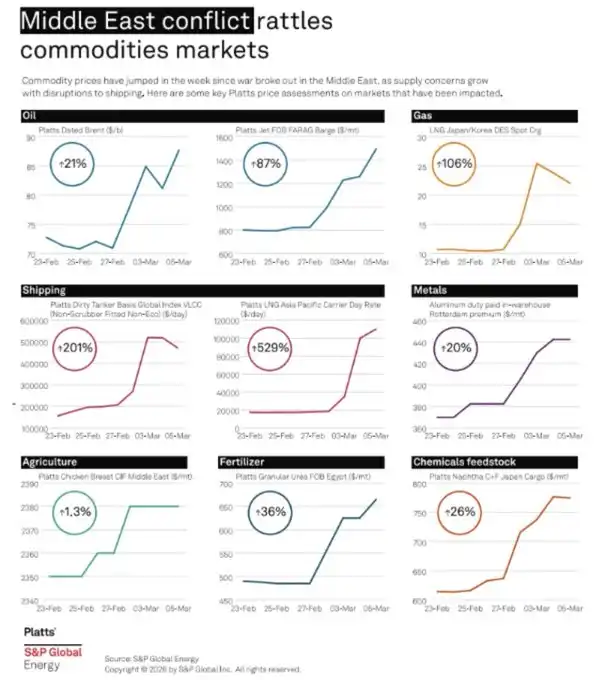
This morning, both US and Brent crude oil broke through $100 per barrel on Monday. Dow futures extended their initial losses to 2%, Nasdaq futures were down 1.65%, and S&P 500 futures fell 1.7%. Meanwhile, the price of Bitcoin fell below $66,000 this morning, erasing almost all of last week's rebound and returning to a downtrend.
When oil prices rise, Bitcoin tends to fall.
If you see this, most people should also understand the reason behind it. In simple terms: oil price moves, inflation moves; inflation moves, the Fed moves; the Fed moves, liquidity moves; when liquidity tightens, Bitcoin follows suit.
This week, as multiple macro data are released, each link in this chain will be sequentially scrutinized.
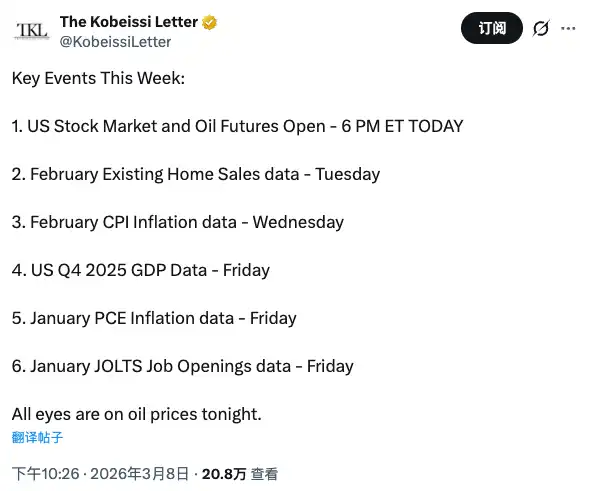
Several Key Events to Watch This Week
Most retail traders focus too much on CPI data release day and completely overlook the interrelated sequence of data.
First, the opening of US stocks and oil futures is the most critical data of the whole week. The news of the Iraq shutdown has fermented throughout an entire weekend, and the oil market's opening is the market's first true pricing of this event.
At the morning's opening, WTI crude oil futures surged by as much as 22%, surpassing the $110 mark; Brent crude oil futures also surged by 20% to $111.04 per barrel.
The sharp rise in oil prices means that the inflation tone for this week was basically set at this moment.
Next, we need to pay attention to Wednesday, when the February Consumer Price Index (CPI) data will be released. This data will also serve as validation or negation of the market direction following tonight's oil price opening.
On Friday, three data points will be released: GDP, PCE, and JOLTS. GDP will tell us if the economy is truly slowing down; PCE is the inflation indicator the Fed cares most about—if it continues to rise, the idea of a rate cut can basically be set aside for now; JOLTS will verify if there is any slack in the labor market. These three data points will further reveal whether the economy is indeed slowing down or if the Fed is maintaining a hawkish stance.
If all the data this week indicates "inflation is not receding, and the economy is still robust," it will be a tough week for Bitcoin.
Of course, not all voices are pessimistic. Real Vision co-founder and CEO Raoul Pal (@RaoulGMI) believes that the current oversold state of the crypto market is actually an opportunity to build a position. His core logic is based on global liquidity: "Since 2012, Bitcoin has been 90% correlated with an annualized growth rate of about 10% and is not slowing down."
He highlights several key supporting factors:
First, the liquidity environment remains accommodative: GMI's financial conditions lead global liquidity by 6 months and are currently indicating looseness; U.S. broad liquidity is accelerating from a low point, historically providing about a 3-month lead time effect on the crypto market.
Second, structural positives are accumulating: the Fed's rate-cutting cycle is not yet over, China is rapidly expanding its balance sheet, stablecoin issuance grew by 50% last year and is still accelerating, and the CLARITY Act is expected to remove legal barriers for banks and asset managers to enter the space.
Third, the technicals are nearing a bottom: both weekly and daily DeMark indicators are pointing to bottom confirmation within about two weeks; once these signals align, the potential for a trend reversal will be activated.
However, Raoul Pal himself also points out the biggest uncertainty: how long the high oil prices will persist.
The price of oil will be the focus of the next two weeks. And the price of oil will depend on how much longer this battle will last.
A Ceasefire Is Not That Simple
Currently, most military analysts believe that Iran's retaliatory power has been significantly weakened. Missile stockpiles have been depleted, launch vehicles have been continuously targeted, the navy has lost combat effectiveness, and drones are also in short supply. More importantly, the United States and Israel are not just targeting Iran's existing arsenal but its military industry itself, including factories, technological reserves, and related scientists.
According to Israel's estimates, in about two more weeks of strikes, Iran's ability to manufacture missiles and drones will be completely destroyed, turning it into a "toothless tiger."
This concern also directly affects the Strait of Hormuz. Many people are worried that this war will completely block this key global energy passage, but this concern is logically unfounded. Regardless of which regime is in power, Iran needs this strait to sell its own oil. Closing the strait would be akin to strangling its own source of foreign exchange. Temporary closure during wartime is possible, but portraying it as the "end of the era of cheap energy" is turning a temporary shock into a permanent structural change.
However, after resolving the military issues, the real challenges are just beginning.
Iran's two regimes, the Pahlavi dynasty and the Khomeini regime, may appear to be two diametrically opposed systems, but at a core level, they actually follow the same logic: both stopped halfway through modernization and then filled the remaining half with traditional authority. The Pahlavis pursued a modern economy but placed power above the separation of powers, ultimately dreaming of restoring the ancient Persian Empire's glory; Khomeini retained the facade of elections and a parliament but replaced the insides with religious rule. One used monarchy as packaging, the other used religion as packaging, but they walked the same path. This means that even if external forces topple the existing regime and send the Crown Prince Pahlavi back, history will not simply "rewind."
Therefore, a more realistic expectation for Iran's future may be a situation similar to Venezuela:
The regime does not completely collapse but continues to hemorrhage, military capabilities weaken, the economy becomes increasingly reliant on external sources, internal contradictions become increasingly difficult to reconcile, until one day a qualitative change occurs from within. The clerical class was never monolithic internally, and historical infighting has never truly ceased. When the Revolutionary Guard's power is sufficiently weakened, those "internal moderates" who have always existed but never dared to speak out may have the opportunity to emerge.
This process will be slow. It won't take weeks; it could take years.
So, what does this mean for oil prices, for Bitcoin?
We believe this means that while military action can have a conclusion, the uncertainty of Iran's political reconstruction will continue to disrupt the global energy market for a considerable amount of time. The volatility of oil prices may prove to be more enduring than most people expect. With each fluctuation in oil prices, the chain linking inflation to liquidity and then to Bitcoin will be tightened once again.
To think clearly about short-term trading, just watch the oil price opening tonight, Wednesday's CPI, and Friday's PCE data. If all these point to stubborn inflation and no hope of rate cuts, the script for 2022 will serve as a recent reference, with Bitcoin most likely coming under pressure.
If you extend your time frame slightly, another possibility also exists. If military action concludes within weeks, the market's pricing of "Iran risk" will readjust, and the geopolitical premium on oil prices will gradually diminish. At that point, the liquidity expansion logic described by Raoul Pal, along with the technical bottom signals, will provide a clearer basis for judgment.
As for a longer timeframe, that's left for the slow evolution of the Middle East's political landscape.
You may also like

Trading Never Sleeps: On-Chain, Crude Oil, and Leverage

On-chain Yield Panorama: The Evolution from Interest-bearing Stablecoins to Crypto Credit Products

RootData announced the integration with OpenClaw, and these gameplay features have gone viral

Key Market Intelligence on March 9th, how much did you miss out on?

a16z: After AI Superpowers, Where to Next for Humanity?

Decoding 112,000 Polymarket Addresses: The Top 1% Making Money Are Doing These Five Things

AAVE founder issues a warning: DeFi must never become the exit liquidity for Wall Street private credit

How To Create A Frequency So Strong It Makes Reality Obey You
The first-ever WEEX AI Hackathon has concluded, with 10 winners emerging from over 200 global teams. Beyond its $1.8 million prize pool, the event marked a milestone—proving that the future of AI trading belongs to accessible, AI-powered innovation.

The cryptocurrency industry has waited for five and a half years, and what they got is half a ticket

The trend of Ethena reveals what information about the cryptocurrency market

I've been in the crypto industry for five and a half years, and all I got was half a ticket.

Crude Oil Surges 25%, Hyperliquid Unfolds On-Chain Showdown

$20 Billion Valuation, Is Kalshi Engaging in an Arms Race with Polymarket?

Will Not Messing with OpenClaw Lead to Obsolescence in the AI Era? | Lobster Fuss Summit

Anticipating the Market's New Challenge to Political Elections

The Shadow Business Empire of Iran's New Supreme Leader: Oil, Real Estate, and Financial Intrigue

Next-Generation Software Built for Trillion-Agent Scale

Lessons From a Top 10 AI Trading Strategy in the WEEX AI Hackathon
A Top 10 finalist in the WEEX AI Hackathon shares how a market-neutral AI trading system competed against high-leverage strategies in live crypto markets.


 App
App