
USDC to USDT Swap Exploited with a $215k Loss, How Does MEV Attack Stablecoin Trades?




Original Article Title: Crypto trader gets sandwich attacked in stablecoin swap, loses $215K
Original Article Author: Brayden Lindrea, Cointelegraph Author
Original Article Translation: ChatGPT
Editor's Note: This article covers a sandwich attack incident that occurred in a cryptocurrency trade, where a trader lost over $215,000 during a stablecoin exchange. The article provides a detailed account of the attack, including how MEV bots profited through frontrunning and discusses potential money laundering activities. Additionally, it mentions the protective measures taken by the Uniswap platform to prevent such attacks and clarifies initial criticisms.
Below is the original content (slightly rephrased for better readability):
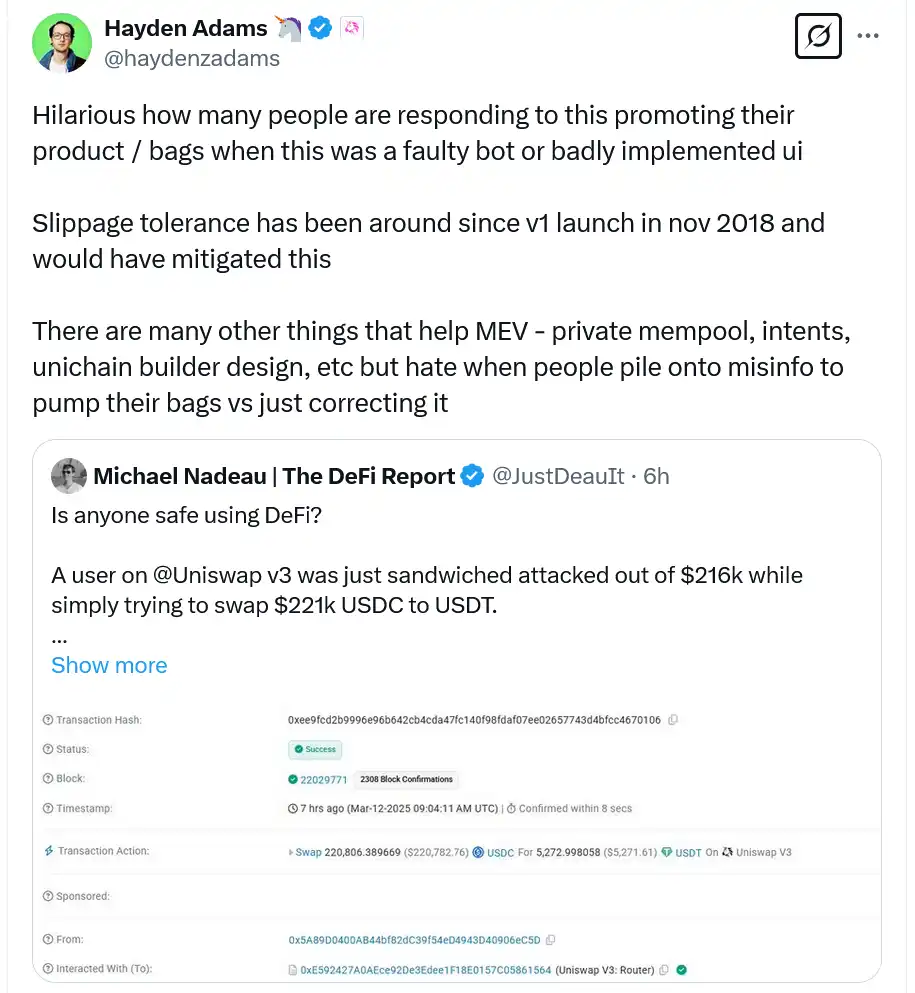
On March 12, a crypto trader fell victim to a sandwich attack while transferring $220,764 in stablecoins, losing nearly 98% of its value, amounting to $215,000, which was captured by a MEV bot.
A $220,764 USDC stablecoin value was swapped to $5,271 Tether USDT within 8 seconds, as the MEV bot successfully front-ran the transaction, profiting over $215,500 from it.
Data from the Ethereum block explorer shows that this MEV attack occurred in the USDC-USDT liquidity pool of the decentralized exchange Uniswap v3, with assets worth $19.8 million locked in the pool.
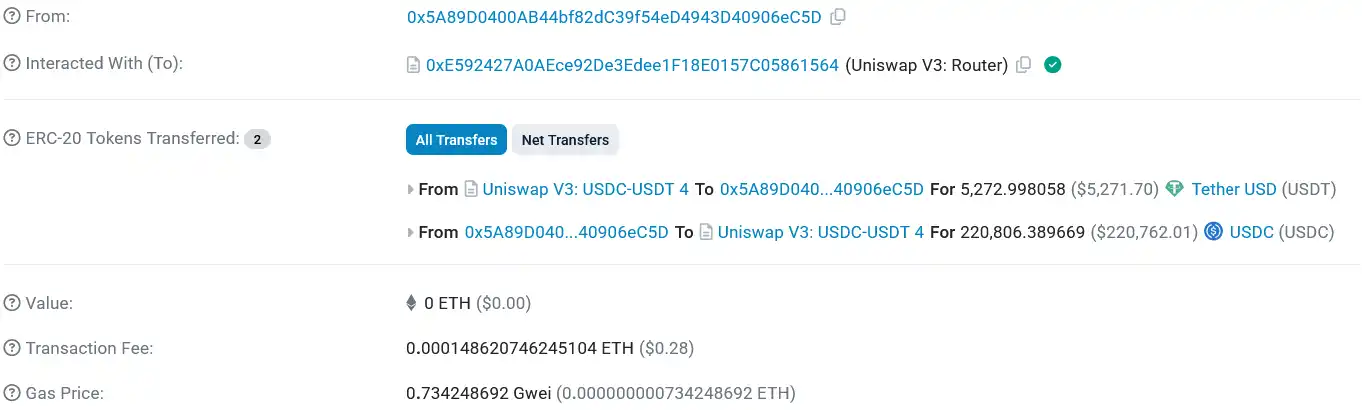
Details of the Sandwich Attack Transaction Source: Etherscan
According to Michael Nadeau, the founder of The DeFi Report, the MEV bot front-ran by swapping out all USDC liquidity from Uniswap v3's USDC-USDT pool and then putting it back after the transaction execution.
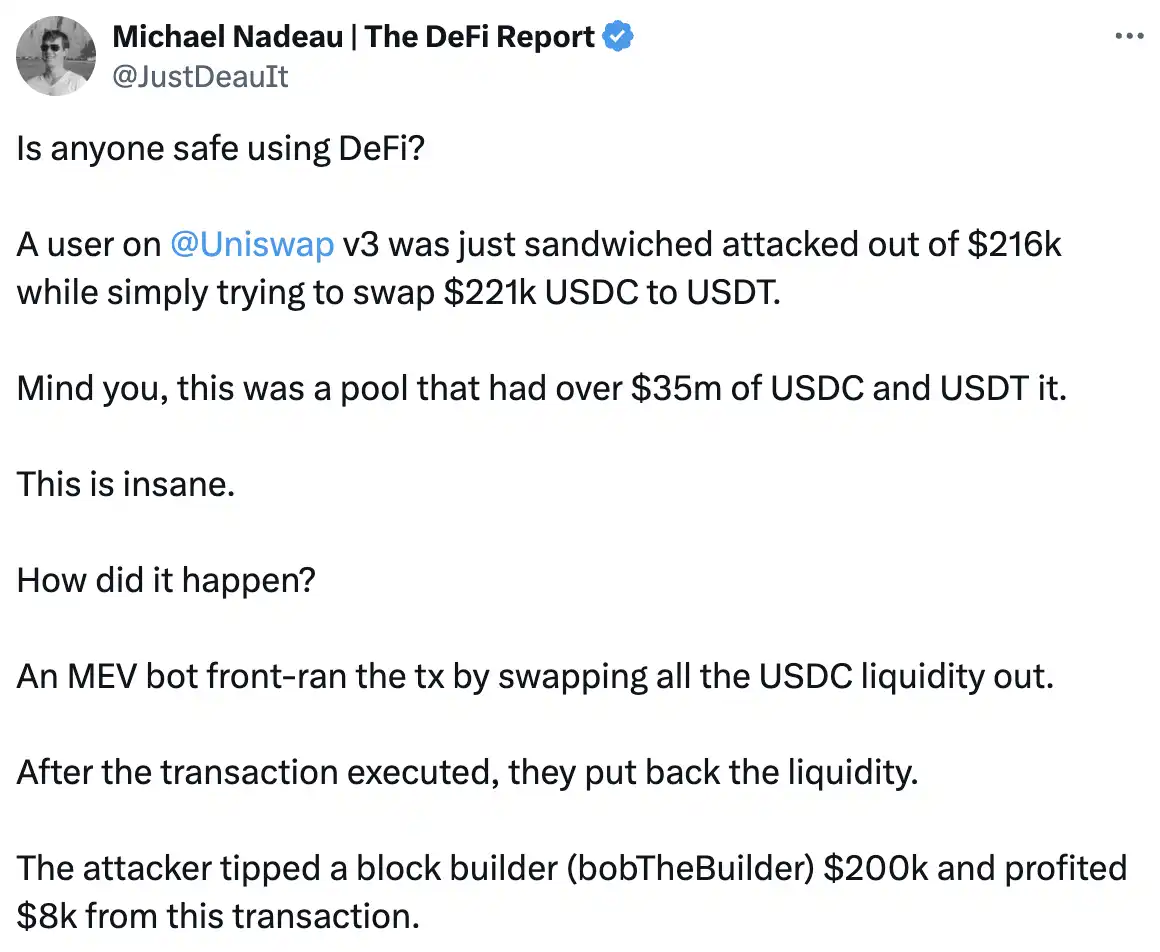
Nadeau stated that the attacker paid a $200,000 fee to the Ethereum block builder "bob-the-builder.eth" from the $220,764 transaction and pocketed $8,000 for themselves.
DeFi researcher "DeFiac" speculated that the same trader using different wallets may have experienced a total of six sandwich attacks, citing "internal tools" as evidence. They noted that all funds were sourced from the Aave lending protocol before being deposited into Uniswap.
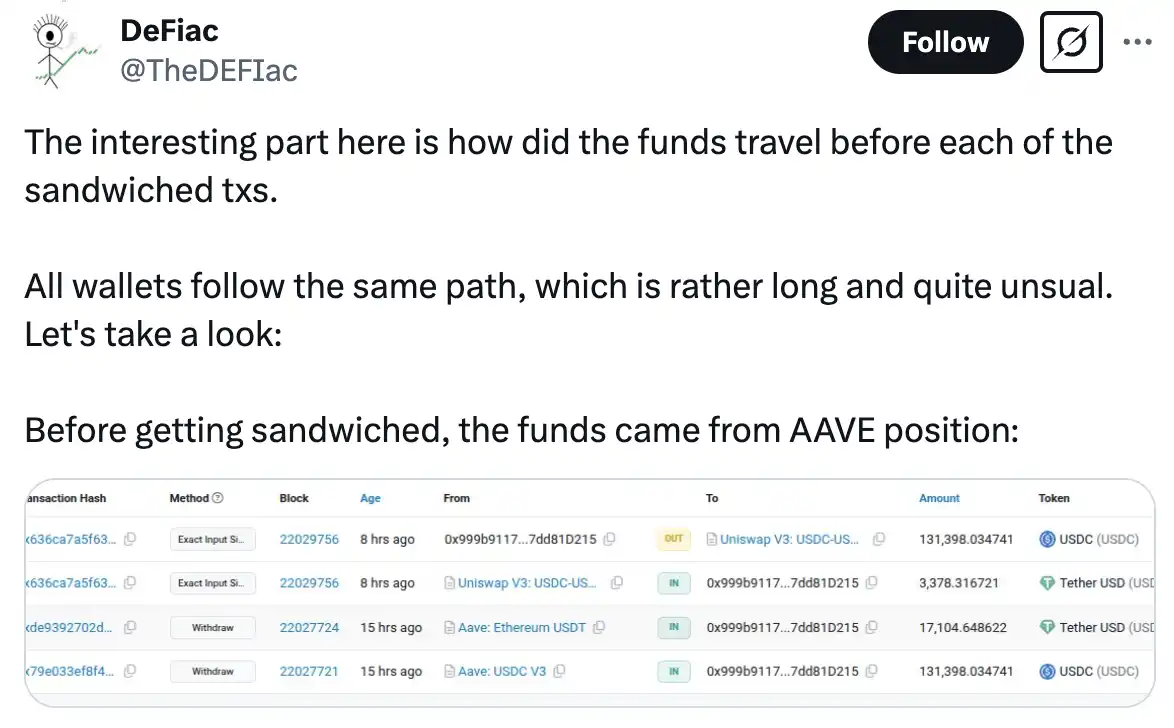
Two wallets fell victim to MEV sandwich attacks around 9 a.m. UTC on March 12th. Ethereum wallet addresses "0xDDe…42a6D" and "0x999…1D215" were sandwich attacked in transactions that occurred three to four minutes apart, resulting in losses of $138,838 and $128,003, respectively.
These two traders conducted trades in the Uniswap v3 liquidity pool similar to a trader exchanging $220,762.
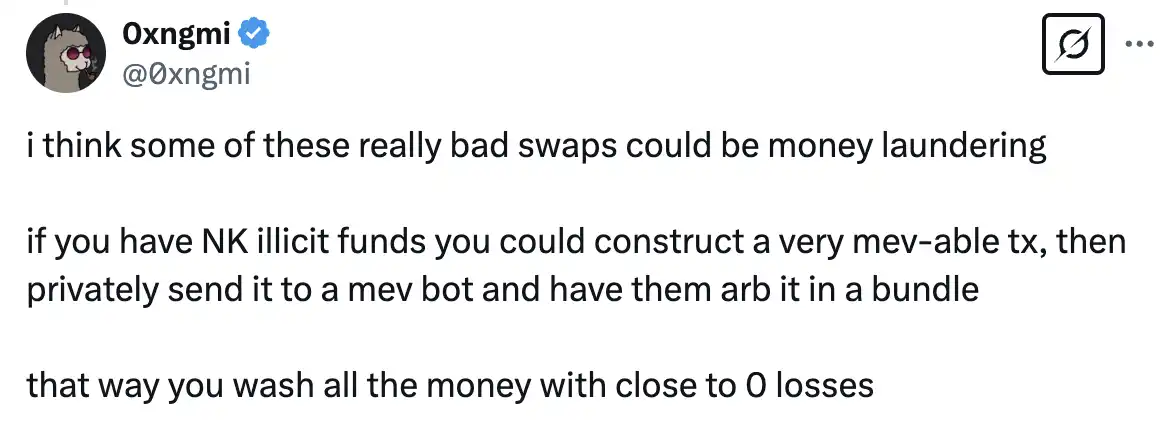
Speculation arose that these transactions might be related to money laundering.
0xngmi, the founder of the crypto data dashboard DefiLlama, stated, "If you have NK illicit funds, you can construct a transaction that is very easily exploited by MEV and privately send it to an MEV bot, allowing them to arbitrage in a bundle. This way, you can wash all the money with close to zero loss."
While Nadeau initially criticized Uniswap, he later acknowledged that these transactions did not originate from Uniswap's frontend, which has MEV protection and default slippage settings.
After Uniswap CEO Hayden Adams and others clarified the protective measures taken by Uniswap to prevent sandwich attacks, Nadeau retracted those criticisms.
You may also like

Morning News | CME Group launches Nasdaq Cryptocurrency Index futures; Asset management giant Janus Henderson strategically invests in Ethena

Bitcoin Layer 2 Network Botanix: Why Did We Choose to Dissolve?

Why did Oracle deliver the strongest financial report in history, yet its stock price fell?
When the P2P illicit funds from ten years ago turned into 60,000 bitcoins

Dialogue with OmenX Founder: Why does the prediction market need an evolution from "spot" to "derivatives"?
Galaxy in-depth report: Is Solana still worth paying attention to?

Young people in South Korea make a "final effort" in the epic bull market

The pricing controversy of Trade.xyz exposes the fatal weakness of Pre-IPO perpetual contracts

How much longer can Ethereum's last big buyer hold on?

World Cup 2026 Coming – WEEX Celebrates with $1M Prize Pool & Michael Owen Live

Morning Report | OpenAI has submitted an S-1 registration statement draft to the U.S. SEC; Morpho completes $175 million financing

Galaxy Deep Research Report: How Hyperliquid's HIP-4 Upgrade Changes the Landscape of Prediction Markets?

Latest research from 13 top universities including Cornell University: The current state, challenges, and misconceptions of the fusion of Crypto and AI

Deconstructing Anthropic: The Best AI Company, Possibly Also a Type of Organizational Invention

Every exchange is a "Universal Exchange."

The counterattack of traditional finance: Alliance chains are quietly reviving
Pantera Capital Partner: How Tokenization is Restructuring the Private Equity and Early Investment Ecosystem?

Mastercard Launches Agent Pay for AI, Plans to Record AI Agent Payment Authorizations on Polygon
Mastercard launched Agent Pay for AI, a new payment protocol designed to help AI agents make small payments such as pay-per-use access to data and APIs. The system plans to record human-granted AI agent permissions on Polygon, focusing on verifiable authorization, identity, and payment controls.
Morning News | CME Group launches Nasdaq Cryptocurrency Index futures; Asset management giant Janus Henderson strategically invests in Ethena
Bitcoin Layer 2 Network Botanix: Why Did We Choose to Dissolve?
Why did Oracle deliver the strongest financial report in history, yet its stock price fell?
When the P2P illicit funds from ten years ago turned into 60,000 bitcoins
Dialogue with OmenX Founder: Why does the prediction market need an evolution from "spot" to "derivatives"?
Galaxy in-depth report: Is Solana still worth paying attention to?


