
- Buy Crypto
- Markets
 Futures
- Spot
- Copy Trade
- Earn
- More
That person who cashed out at the NFT peak is now selling a new shovel in the OpenClaw craze

Original Title: "The Person Who Sold at the Peak of the NFT Craze Is Now the Most Secretive Winner Behind OpenClaw"
Original Author: David, Deep Tide TechFlow
OpenClaw is hot, but the company that quietly made money in this wave of craze is one you may not have heard of:
OpenRouter.
To use OpenClaw, you need to connect to various AI models to work. Each has its own fees and interfaces - Claude, GPT, DeepSeek. What OpenRouter does is package these models together so you can use them uniformly through it, and it earns the price difference.
The person behind this business is Alex Atallah. His company just received a $40 million investment led by a16z, now valued at $5 billion.
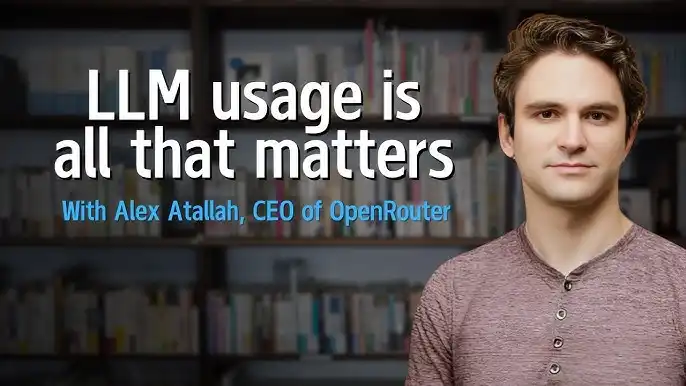
What you may be even less aware of is that his previous company was OpenSea, the world's largest NFT trading platform, which was once valued at over $13 billion at its peak.
However, he chose to exit during the hottest period of the NFT craze, and a few months later, the NFT market collapsed.
Now, he has made money again in this wave of AI craze.
From Liquidity Aggregation to Big Model Aggregation
Alex Atallah, a Stanford Computer Science graduate.
In 2018, he co-founded OpenSea with Devin Finzer. Their work was simple: while others minted NFTs, they provided a place for everyone to buy and sell, taking a 2.5% cut on each transaction.
OpenSea does not produce or hype NFTs; it only provides a platform, aggregating liquidity.
In 2021, during the NFT craze, popular NFTs like Bored Apes gradually became symbols of popularity. At that time, OpenSea's monthly trading volume reached over $5 billion, and Forbes estimated the net worth of Atallah and Finzer at a combined $22 billion.
In July 2022, he resigned as CTO, saying he wanted to do something new.
Everyone knows what happened next. The NFT market crashed, the overall market entered a deep freeze, and OpenSea's own business was a mess. However, someone always foots the bill for the feast, and Alex left before the music stopped.
In 2023, he started working on something called OpenRouter. In short:
A large-scale aggregation routing platform that puts hundreds of model APIs behind a single interface for developers to call, charging a 5% fee per invocation.
You might ask, why not just use OpenAI, Anthropic, Claude, or GPT for model inference?
Of course, you could.
But nowadays, no one is likely using just one model. They code with Claude, search with Gemini, delegate cost-saving tasks to DeepSeek, each requiring separate registration, separate top-up, and even different API formats...
Not to mention that many users want to use both Claude and GPT, with no direct API access from mainland China.
So, OpenRouter is the path of least resistance. One interface, 500+ models, unified format, auto-switching, all managed with a single key.
You may not have noticed when using OpenClaw, but the default provider in the configuration file used to be OpenRouter.
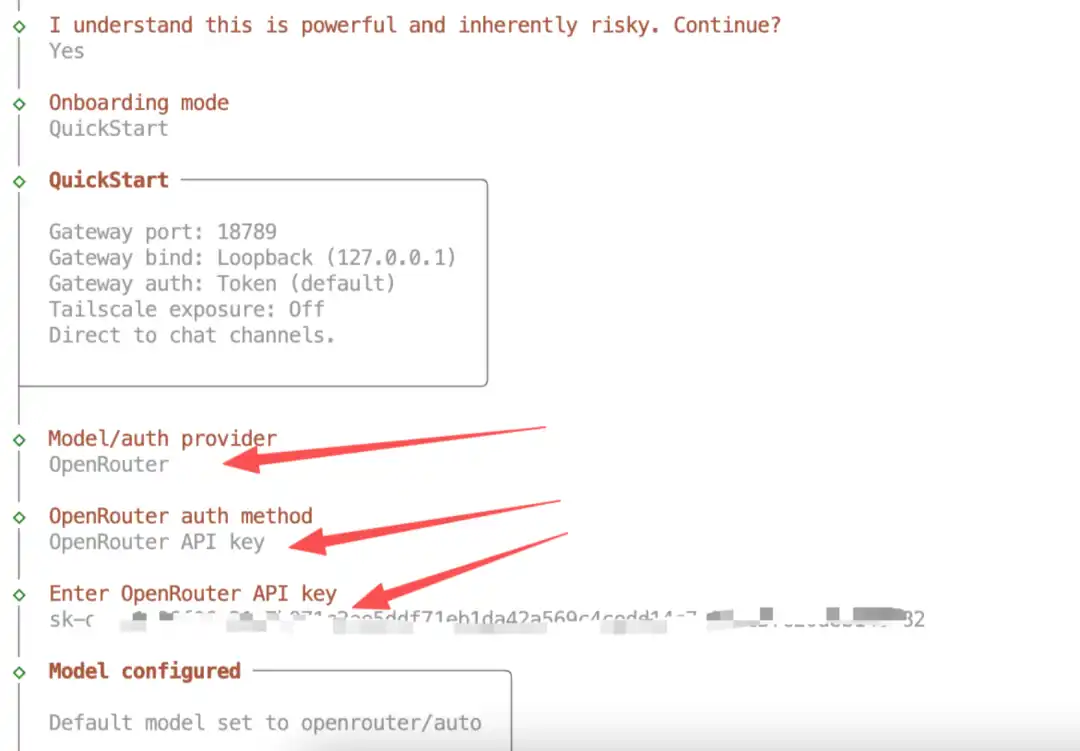
Image Source: Zhihu user Feng Alchemist
When you call Claude, invoke DeepSeek, your requests first come here before being routed to the model vendors. Even the OpenClaw documentation states:
If the system doesn't recognize your API key format, it defaults to OpenRouter.
How fast did this business grow?
In October 2024, the money flowing through OpenRouter each month was $800,000. By May 2025, this number had increased to $8 million.
Seven months, tenfold.
Over the course of a year, the money that passed through his hands exceeded 100 million U.S. dollars. He took a 5% cut, walking away with 5 million, and the team was fewer than ten people.
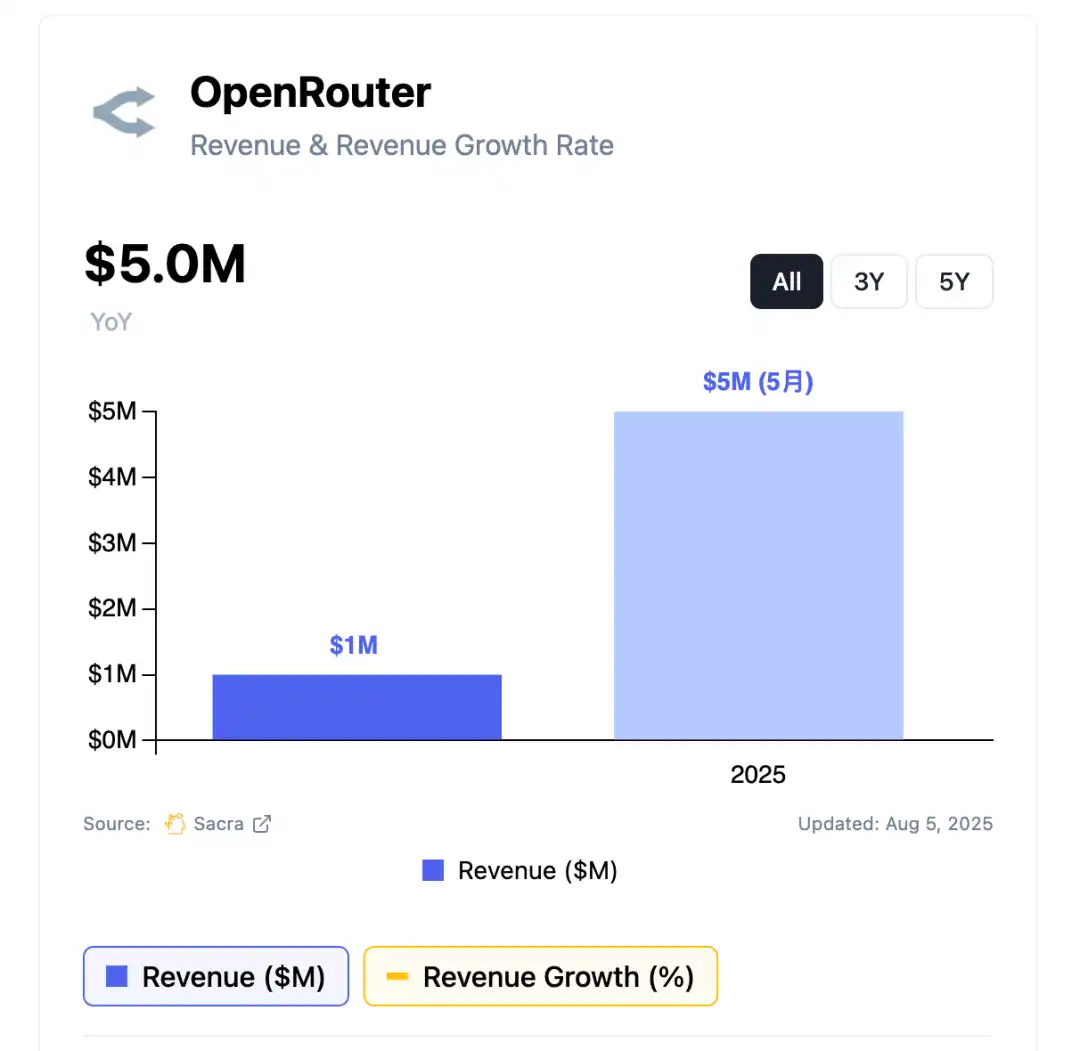
Image Source: sacra.com
a16z took his data and wrote an industry report called "The State of AI with 1 Trillion Tokens"; Stripe specially customized a billing system for him.
And with this year's explosion of OpenClaw, more developers and enthusiasts poured in, creatively burning tokens, inevitably needing to call various large models, which also completely lit up OpenRouter's business.
Furthermore, a16z led the investment in this company, giving it a valuation of 5 billion.
A person who sells shovels has once again become a person who sells shovels.
Different Hotspots, Same Pattern
If you look carefully at Alex's two businesses, the structure is actually the same.
OpenSea's business is not minting NFTs; it places NFTs minted by others in one place for buyers and sellers to trade, taking a 2.5% cut. OpenRouter's business is not training models; it puts models trained by others in one place for developers to call, taking a 5% cut.
This approach seems to have become his comfort zone, whether in NFTs or AI, the entire market structure is very similar:
The supply side is extremely decentralized, the demand side buyers don't know where to find supply, and he stands in the middle as a shelf.
How decentralized was NFT in 2021? Dozens of chains, hundreds of projects, tens of thousands of new collections every day. You want to buy a bored ape, it's impossible to visit each project's official website one by one. OpenSea brings them together for you to choose and buy, with the seller offering a price to you.
How decentralized will large models be in 2025? OpenAI, Anthropic, Google, Meta, DeepSeek, Mistral, Zero to One... Just mainstream, there are more than a dozen, plus hundreds in the open-source community.
Today you code best with Claude, tomorrow Gemini releases a new and more powerful search, and the day after tomorrow DeepSeek lowers its price by half. Each change requires modifying the interface.
Atallah once said a sentence, explaining this logic very clearly:
“OpenSea consolidates very fragmented inventory into one place, today’s AI looks very similar to that.”
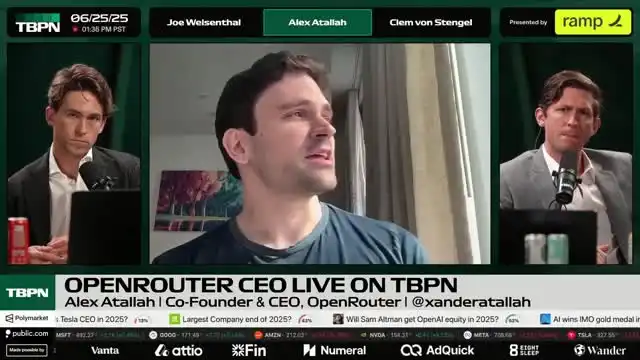
He doesn’t need to know which NFT will appreciate, nor does he need to know which model will win. All he needs to know is one thing: the more dispersed the supply, the more valuable the middleman.
Moreover, the interesting thing is the timing.
When he left in July 2022, OpenSea’s valuation was still high, although the monthly NFT transaction volume had fallen from its peak, no one felt it was going to collapse. He said he wanted to “create something new from zero,” and six months later, ChatGPT was released, marking the beginning of the era of large models.
Did he see something, or was he just lucky?
I don’t know. But one thing is certain:
When he registered OpenRouter at the beginning of 2023, there were almost no AI large model routing products on the market. By the time everyone realized the need for a unified interface, he was already there.
Previously, he did the same thing in the NFT field. When everyone crowded in, he was already the biggest platform.
Is AI the one that is on fire important?
In each wave of frenzy, the question most people ask is: What will be the next big thing?
In 2021, it was which NFT would appreciate; in 2024, it was which meme coin would skyrocket; in 2025, it was which AI application would emerge; in 2026, it was what lobsters could do.
Atallah's question may be different. I think his thought process should be, no matter what becomes popular, where will the money flow?
These two questions may seem similar, but they are actually entirely different bets.
Betting on “what will be the next big thing,” you have to guess right once. Bored Apes would surge, PEPE would increase a hundredfold, some AI product would be the next ChatGPT. Guess right and get rich, guess wrong and lose it all. Most people experience the latter.
Follow the Money, you don't need to guess either one. NFTs are up, trades are happening on OpenSea, he collects the fee. The fiercer the AI model war, the more developers need a unified interface to switch back and forth, the busier OpenRouter becomes.
Don't bet on who wins, bet that this battle will last a long time.
In hindsight, the biggest money makers in each cycle, regardless of the industry, are basically the platforms in this position.
Gold diggers come and go, but the water sellers have always been making money.
But I think just saying "water seller" or "shovel seller" is not enough. There are also a bunch of failed shovel sellers, Atallah did something more specific right: he always got stuck at the aggregation position.
It's not easy to collect tolls with just any tool. You have to be the one who brings together the dispersed supply. The more fragmented the supply, the higher the switching costs, and the aggregation layer in the middle has more pricing power.
This also explains why he entered the game early both times. Because aggregation business has one characteristic:
The first to arrive locks in the supply, making it hard for latecomers to catch up.
So, Atallah's remarkable point, I summarize in two sentences:
· First, don't bet on who wins, just find a junction that everyone has to pass through.
· Second, when others haven't realized the need for the junction yet, he has already built the road.
Great Minds Never Pick Tables
Now, I think there are two particularly loud voices around me.
One says the AI Agent is a toy, installing OpenClaw is only good for burning tokens; the other says this is another wave of AI hype, and no one will remember it in three months.
Maybe both of these views are correct.
But for people like Alex Atallah, it doesn't really matter.
Whether OpenClaw is useful or not, he is still making money. Whether you think lobsters are boring now and unload them, the tokens burned in the past two weeks have already passed through his hands.
Some people think NFTs are dirty, are Ponzi schemes, are scams. He built a company with a $13.3 billion valuation on it. Some people think AI Agents are a bubble, are hype, can't see the business model. He built a company with a $5 billion valuation on it...
Genius may truly not need us to admire the track they are on.
That NFT table, he made money. That AI table, he made money again. What will be placed on the next table, no one knows.
But I guess he will still be collecting tickets at the door when the time comes.
You may also like

Vitalik wrote a proposal teaching you how to secretly use AI large models

On the eve of the explosion of on-chain options

WEEX AI Hackathon: How Did This AI Trading Winner Succeed?
A self-taught AI trading enthusiast achieved top-10 results at the WEEX AI Hackathon. Learn about the mindset, AI tools, and lessons behind this impressive performance.

One Balance to Rule Them All: Gravitas' On-Chain Prime Broker Ambition

Inter-generational Prisoner's Dilemma Resolution: The Nomadic Capital and Bitcoin's Inevitable Path

Upstream and downstream are starting to fight, all for the sake of everyone being able to "Lobster"

Circle and Mastercard Announce Partnership, the Next Stage for the Crypto Industry Belongs to Payments

From 5 Mao per kWh of Chinese electricity to a $45 API export: Tokens are rewriting currency units

Why is OpenAI playing catch-up to Claude Code instead?

Vitalik wrote a proposal teaching you how to secretly use AI large models

The doubling of Circle's stock price and the paradigm shift of stablecoins

Key Market Information Discrepancy on March 13th - A Must-See! | Alpha Morning Report

On-Chain Options Explosion.ActionEvent

《Time》 Magazine Names Anthropic as the World's Most Disruptive Company
Predictions market gains mainstream traction in the US, Canada, Claude launches Chart Interaction feature, What's the English community talking about today?

500 Million Dollars, 12 Seconds to Zero: How an Aave Transaction Fed Ethereum's "Dark Forest" Food Chain

AI Agent needs Crypto, not Crypto needs AI
Stablecoins are breaking away from cryptocurrency, becoming the next generation of infrastructure for global payments
Vitalik wrote a proposal teaching you how to secretly use AI large models
On the eve of the explosion of on-chain options
WEEX AI Hackathon: How Did This AI Trading Winner Succeed?
A self-taught AI trading enthusiast achieved top-10 results at the WEEX AI Hackathon. Learn about the mindset, AI tools, and lessons behind this impressive performance.


 App
App