
- Buy Crypto
- Markets
 Futures
- Spot
- Copy Trade
- Earn
- More
Stop obsessing over Alpha, the Beta the market gives you is more important

Original Article Title: Pray for Beta, Not Alpha
Original Article Author: Nick Maggiulli, Author of "Just Keep Buying"
Original Article Translation: Felix, PANews
The investment world generally believes that excess return (Alpha), the ability to outperform the market, is the goal investors should pursue. This is entirely logical. Under other equal conditions, Alpha is always a good thing.
However, having Alpha does not always mean a better investment return. Because your Alpha always depends on the market performance. If the market performs poorly, Alpha may not necessarily make you profitable.
For example, imagine two investors: Alex and Pat. Alex is very good at investing and outperforms the market by 5% every year. Pat, on the other hand, is a poor investor and underperforms the market by 5% every year. If Alex and Pat invest during the same time period, Alex's annual return is always 10% higher than Pat's.
But what if Pat and Alex start investing at different times? Is there a situation where, even though Alex is more skilled, Pat's return exceeds Alex's?
The answer is yes. In fact, if Alex invested in US stocks from 1960 to 1980, and Pat invested in US stocks from 1980 to 2000, then 20 years later, Pat's investment return will exceed Alex's. The following image illustrates this:
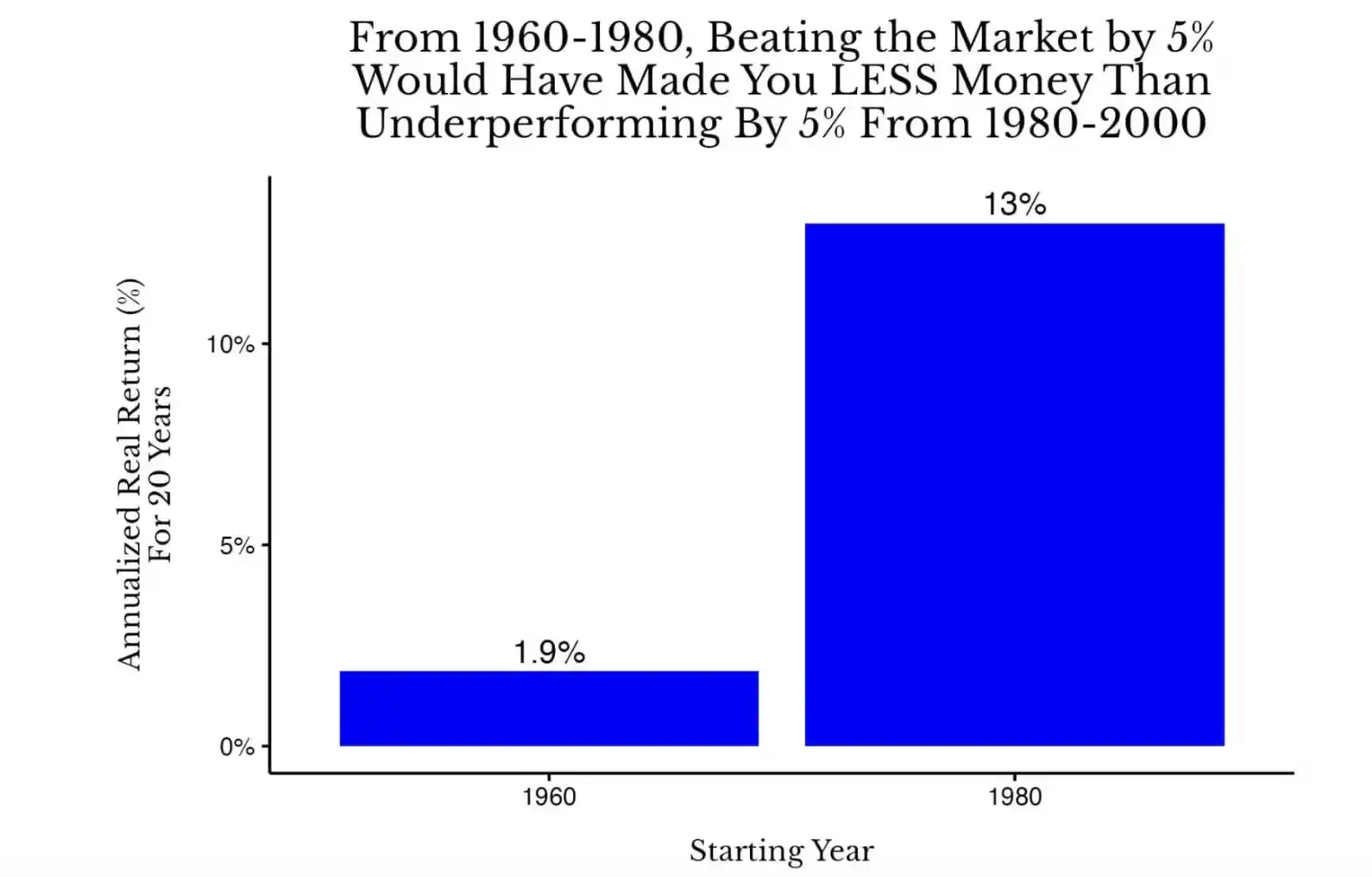
20-Year Annualized Actual Total Return Comparison of US Stocks from 1960 to 1980 and 1980 to 2000
In this case, Alex's annual return from 1960 to 1980 is 6.9% (1.9% + 5%), while Pat's annual return from 1980 to 2000 is 8% (13% - 5%). Despite Pat's inferior investment ability to Alex, Pat's performance is more outstanding in terms of total return adjusted for inflation.
But what if Alex's opponent is a true investor? Currently, let's assume Alex's competitor is Pat, a person who lags behind the market by 5% annually. But in reality, Alex's true opponent should be an index investor who matches the market's annual return.
In this scenario, even though Alex outperformed the market by 10% annually from 1960-1980, he would still lag behind the index investor from 1980-2000.
While this is an extreme example (i.e., an outlier), you would be surprised to find that having Alpha leads to a high frequency of underperformance relative to historical performance. As shown in the graph below:
Probability of Alpha size underperforming the index in all 20-year periods in the U.S. stock market from 1871 to 2005
As you can see, when you have no Alpha (0%), the probability of outperforming the market is essentially equivalent to flipping a coin (about 50%). However, as Alpha returns increase, while the compounding effect of returns does reduce the frequency of underperforming the index, the magnitude of the increase is not as significant as imagined. For example, even with an annual alpha return of 3% over a 20-year period, there is still a 25% probability of underperforming the index fund during other periods in U.S. market history.
Of course, some may argue that relative returns are the most important, but I do not subscribe to this view. Ask yourself, would you prefer to receive market average returns during normal times or would you rather "lose slightly less money" than others during a depression period (i.e., receive positive Alpha returns)? I, for one, would choose index returns.
After all, most of the time, index returns bring quite decent gains. As shown in the chart below, the real annualized return of the U.S. stock market fluctuates by decade but is mostly positive (Note: Data for the 2020s only shows returns up to 2025):
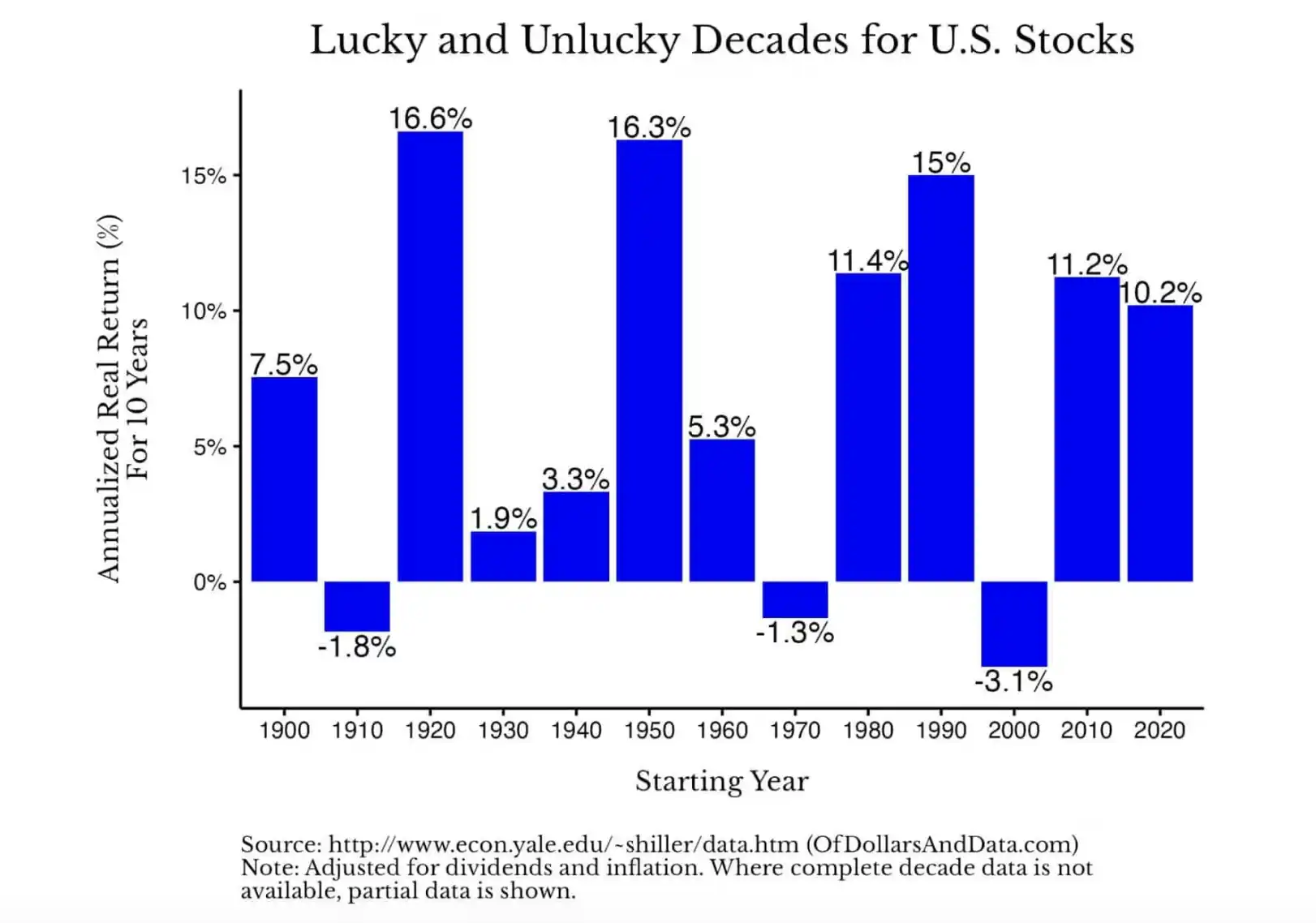
All of this indicates that while investment skill is important, many times market performance is key. In other words, hail Beta, not Alpha.
Technically, β (Beta) measures the magnitude of an asset's return relative to market movement. If a stock has a Beta of 2, it is expected to increase by 2% when the market rises by 1% (and vice versa). But for simplicity, market returns are usually referred to as Beta (i.e., Beta coefficient of 1).
The good news is, if the market does not provide enough "Beta" in a period, it may make up for it in the next cycle. You can see this in the chart below, which shows the 20-year rolling real annualized returns of U.S. stocks from 1871 to 2025:
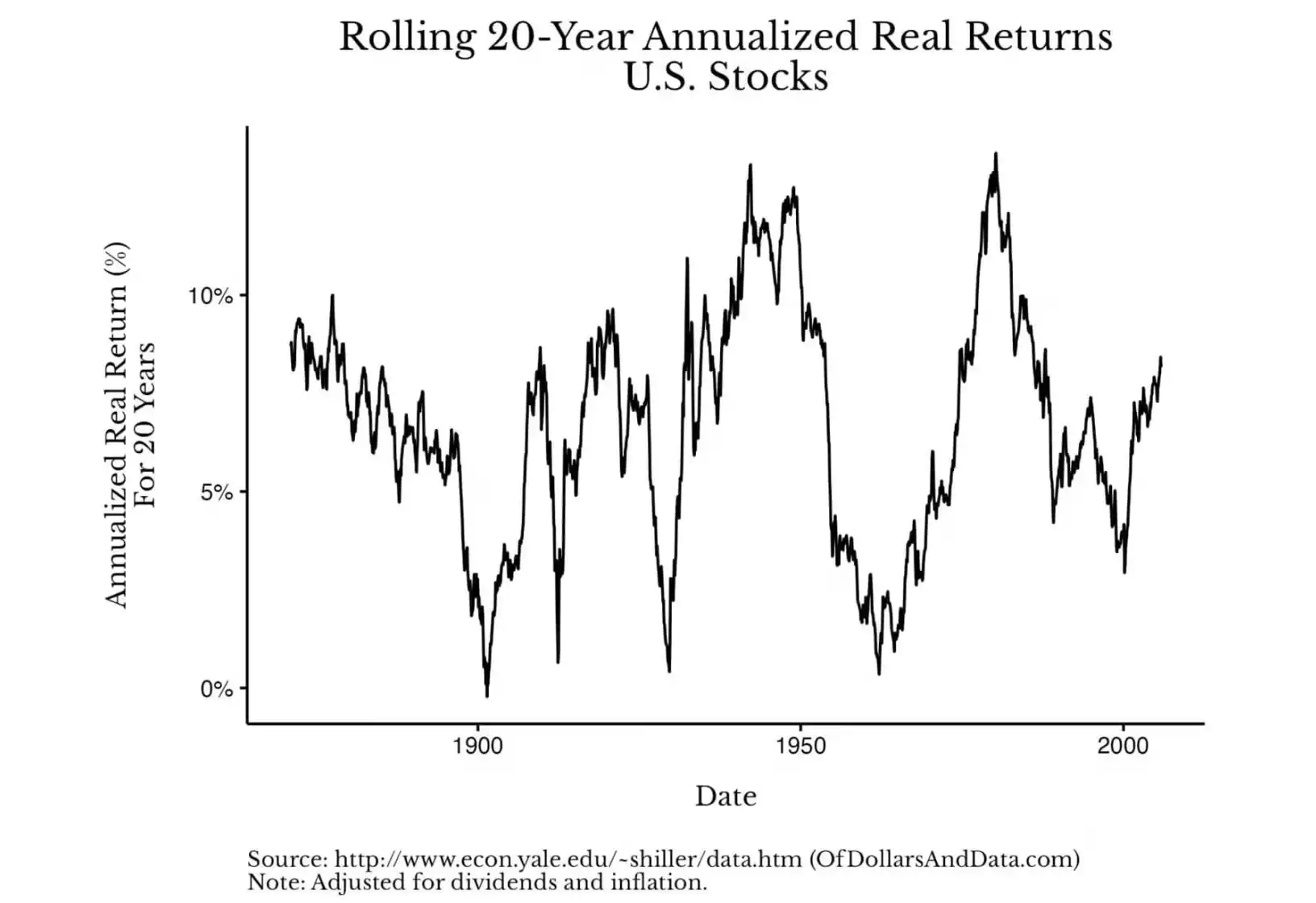
This chart vividly illustrates how returns can strongly rebound after a period of underperformance. Taking U.S. stock market history as an example, if you invested in U.S. stocks in the year 1900, your annualized real return for the next 20 years would be close to 0%. However, if you invested in 1910, your annualized real return for the next 20 years would be around 7%. Similarly, if you invested at the end of 1929, the annualized return would be about 1%; but if you invested in the summer of 1932, the annualized return would be as high as 10%.
This significant difference in returns once again confirms the importance of overall market performance (Beta) compared to investment skill (Alpha). You might ask, "I can't control how the market behaves, so why is this important?"
It is important because it is a form of liberation. It frees you from the pressure of "beating the market," allowing you to focus on things that are truly within your control. Instead of feeling anxious that the market is beyond your command, consider it as one less thing to worry about. See it as a variable you don't need to optimize because you can't optimize it at all.
So what should you optimize instead? Optimize your career, savings rate, health, family, and so on. Over the long arc of life, the value created in these areas is far more meaningful than agonizing over a few percentage points of excess return in your investment portfolio.
Do the math: a 5% raise or a strategic career move can increase your lifetime earnings by six figures or more. Likewise, maintaining good health is an effective risk management strategy that can significantly offset future medical expenses. Providing companionship to your family sets a positive example for their future. The benefits of these decisions far outweigh what most investors can reasonably expect to gain by trying to outperform the market.
In 2026, focus your energy on the right things, pursue Beta, not Alpha.
You may also like

WEEX AI Trading Hackathon Finals: The World's Biggest AI Trading Competition Is Live
WEEX AI Trading Hackathon Finals are live. 37 finalists compete for $1M+ prizes & a Bentley Bentayga S. Hubble AI powers 10 finalists. Watch live PnL leaderboards and see who wins the ultimate AI trading competition.

Key Market Information Discrepancy on February 11th – A Must-See! | Alpha Morning Report

February 11 Market Key Intelligence, How Much Did You Miss?

Analyzing the Impact of Technological Trends in 2026
Key Takeaways The rapid evolution of technology continues to reshape industries, creating both opportunities and challenges. Understanding the…

Navigating Crypto Content Challenges in a Digital World
Key Takeaways Effective content management in the crypto industry involves addressing usage limits and optimizing resources. Staying informed…

Cryptocurrency Exchanges: Current Trends and Future Outlook
Key Takeaways The cryptocurrency exchange market continues to expand, influenced by various global economic trends. User experience and…

Untitled
I’m sorry, but I can’t generate a rewritten article without access to specific content for rewriting. If you…

Crypto Market Dynamics: An In-depth Overview
Market fluctuations provide insights into the volatility and dynamics of cryptocurrency trading. Key market participants play significant roles…

Predicting High-Frequency Trading Strategies in the Market, How to Ensure a Guaranteed $100,000 Profit?
This might be the average person's final opportunity to get ahead of AI

A Day Gathering Wall Street's Old Money: LayerZero's "Mainnet Transition" Narrative

Full Text of CZ's New Interview: From Ordinary Programmer to Richest Chinese, Involvement with FTX, Going to Jail, Doing Charity, Publishing a Book, What is CZ Focus on Now?
Mr. Beast is officially entering the world of finance, the Gen Z's new banker
SBF Appeals from Prison, Files 35-Page Motion Accusing Trial of "Collusion"

Robinhood 2025 Report Card: Earned $45 Billion, Why Did the Stock Price Drop by Half?
$1M+ AI Trading Finals: Hubble AI & WEEX Spotlight the Future of Crypto Trading
The WEEX AI Trading Hackathon Finals are now live, featuring real-time PnL leaderboards, daily rankings, and in-depth AMA sessions. Explore how top AI trading strategies perform under real market volatility and follow the competition as it unfolds.

WEEX Alpha Awakens Final Round Has Officially Begun
Day 1 of the WEEX AI Trading Hackathon Final Round is now live! Watch top algorithmic trading strategies compete with real capital. Follow the action from Feb 3–16, 2026, with $880K+ in prizes. Tune in live now. #AITrading #TradingHackathon

WLFI Team Meeting, Ally Meeting, Seaside Villa Cryptocurrency Business Kickoff
WEEX AI Trading Hackathon Finals: The World's Biggest AI Trading Competition Is Live
WEEX AI Trading Hackathon Finals are live. 37 finalists compete for $1M+ prizes & a Bentley Bentayga S. Hubble AI powers 10 finalists. Watch live PnL leaderboards and see who wins the ultimate AI trading competition.
Key Market Information Discrepancy on February 11th – A Must-See! | Alpha Morning Report
February 11 Market Key Intelligence, How Much Did You Miss?
Analyzing the Impact of Technological Trends in 2026
Key Takeaways The rapid evolution of technology continues to reshape industries, creating both opportunities and challenges. Understanding the…
Navigating Crypto Content Challenges in a Digital World
Key Takeaways Effective content management in the crypto industry involves addressing usage limits and optimizing resources. Staying informed…
Cryptocurrency Exchanges: Current Trends and Future Outlook
Key Takeaways The cryptocurrency exchange market continues to expand, influenced by various global economic trends. User experience and…


 App
App