
Solana's Big 4 DEX Battle: Raydium, Jupiter, Orca, and Meteora - Who Will Come Out on Top?





Original Title: Introduction: Solana's Evolving DeFi Landscape
Original Author: vik0nchain, Researcher at Cyber Capital
Original Translation: Luffy, Foresight News
From the fourth quarter of 2024 to the beginning of 2025, Solana's DeFi ecosystem's competitive landscape has gradually emerged, mainly reflected in the rise of aggregators, user experience (UX) abstraction, major integrations, and evolving tokenomics standards. Although these changes were not initially apparent, recent data has clearly shown their impact, particularly in the redistribution of liquidity, fee generation, and shifts in market share.
This analysis delves into the liquidity positioning of Solana-based major decentralized exchanges (DEXes) — Raydium, Jupiter, Orca, and Meteora, focusing on discussing their advantages, disadvantages, and potential investment impacts compared to existing and emerging competitors.
Investment Analysis Framework
Raydium (RAY) Bullish Outlook: Deep Liquidity and Buyback Advantage
· Liquidity and Trading Volume Dominance: Raydium remains the most liquid and frequently used decentralized exchange in the Solana ecosystem. Over 55% of trades routed through Jupiter settle on Raydium. Additionally, Raydium holds a market-leading position in all decentralized exchanges across blockchains, sometimes even surpassing Uniswap, with its fully diluted valuation (FDV) and market cap being only about a third of Uniswap's.
· Raydium/Uniswap Fully Diluted Valuation Ratio: $28.72 billion / $91.02 billion = 31.5%
· Raydium/Uniswap Market Cap Ratio: $15.06 billion / $54.66 billion = 27.5%
· Pump.fun Integration: Key partnerships, including the integration with Pump.fun, have boosted trading volume and protocol stickiness due to all new Meme pools migrating to Raydium.
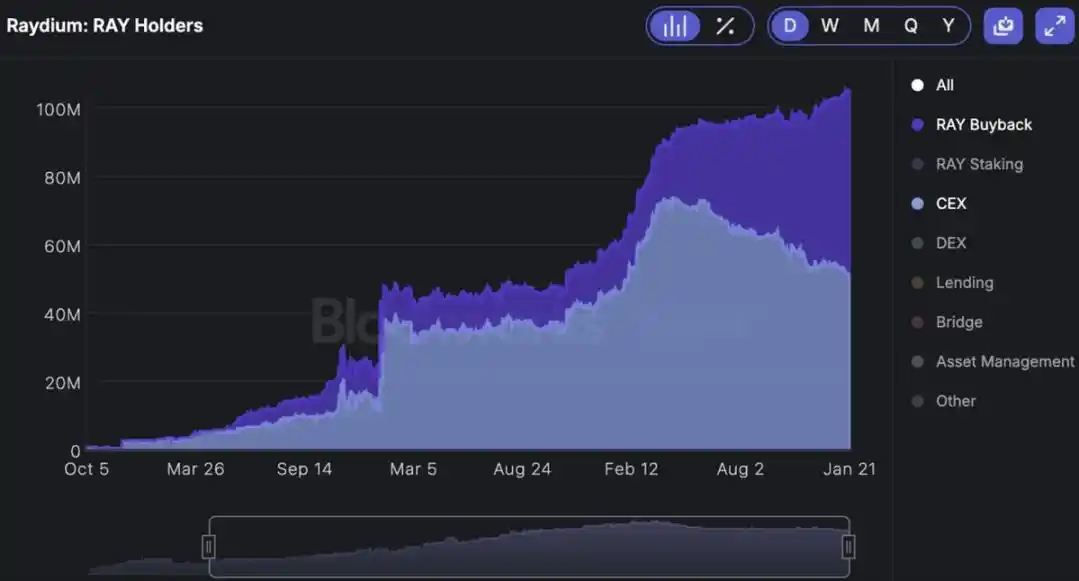
· Token Buyback: Raydium's 12% fee buyback plan has repurchased over 10% of the total token supply, significantly alleviating selling pressure. It is noteworthy that Raydium's buyback amount far exceeds that held by centralized exchanges.
Jupiter (JUP) Bullish Outlook: Market-Leading Aggregator
· Liquidity Aggregation Advantage: Jupiter, as a leading aggregator on Solana, plays a key role.
· Moonshot Acquisition: The acquisition of Moonshot enables Jupiter to integrate on/off-ramps within its decentralized exchange, enhancing competitiveness by simplifying the user experience.
· Unlocking Pressure: Due to token unlocking, Jupiter faces a 127% supply expansion, bringing mid-term inflation risk. Although a buyback mechanism has been recently announced, the internally estimated annual buyback rate is 2.4%, providing some support to the token economy but having limited impact in the competition with Raydium.
· Business Model: As aggregator fees are charged additionally on top of underlying protocol fees, in a low-fee environment, the aggregator model faces challenges.
· Lack of Competitors: Being the pioneering aggregator on Solana, Jupiter lacks strong competitors.
Meteora Bullish Outlook: Emerging Liquidity Aggregator
· Aggregated Liquidity Efficiency: Unlike standalone decentralized exchanges, liquidity aggregators like Meteora inherently have lower downside risk and more stable capital efficiency.
· Token Issuance Catalyst: A successful token launch for Meteora could shift liquidity preferences, providing long-term momentum for its market positioning. Unlike industry LP leader Kamino, MET points are not publicly displayed on the user interface. Furthermore, since the announcement of the MET points system over a year ago, there has been no official statement regarding airdrops. While liquidity providers can earn higher yields elsewhere in the ecosystem (such as lulo.fi), market positioning and airdrop expectations may be the primary drivers for liquidity providers.
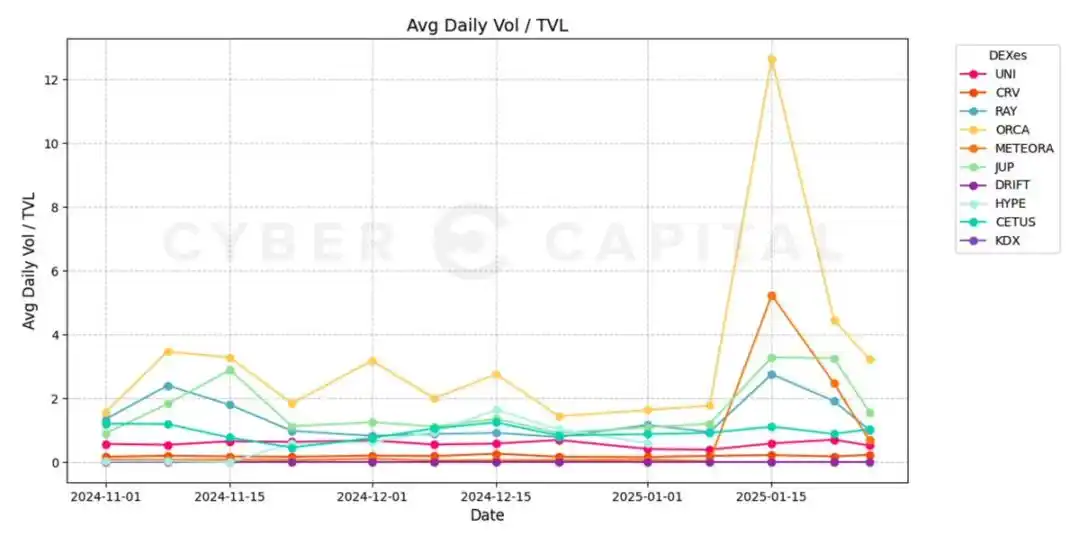
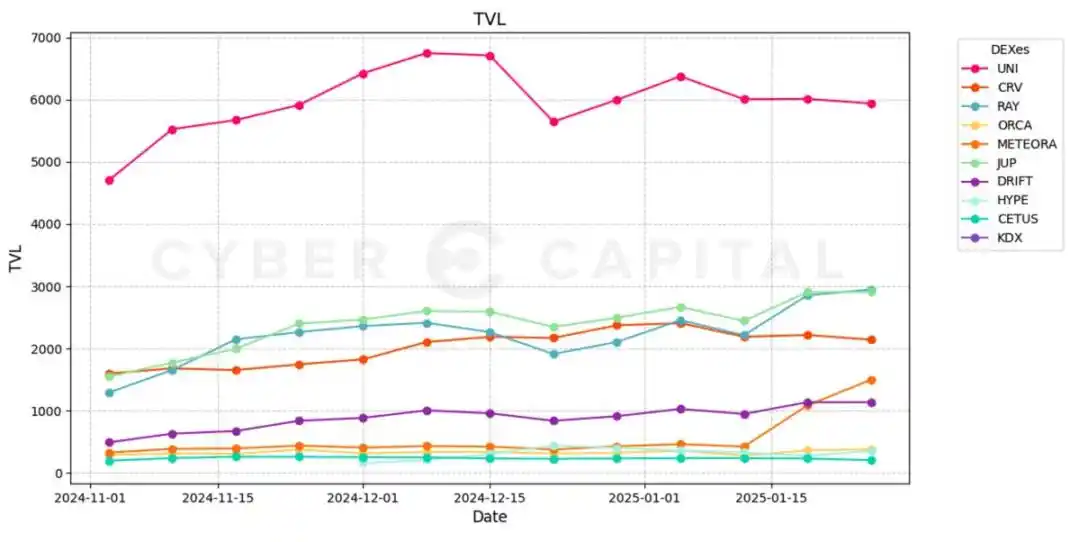
· Total Value Locked (TVL) Retention: With the Pengu airdrop and significant events like the Trump and Melania-related Memecoin launch, Meteora has made strides. Although during the Memecoin launch, the trading volume / Total Value Locked (Vol/TVL) ratio of many pairs rose due to temporary demand, Meteora's TVL continued to grow post-event, demonstrating good retention.
· Integration Development: Virtuals migrated to Solana in the first quarter of 2024 and announced integration with the Meteora liquidity pool.
Orca Bleak Outlook: Insufficient Liquidity Retention
· Insufficient Liquidity Depth: Despite high efficiency, Orca's pool size is significantly smaller than Raydium's, resulting in higher slippage for large trades.
· Market Positioning Issue: Jupiter's routing mechanism prioritizes exchanges with deeper liquidity, making emerging low-liquidity decentralized exchanges and liquidity pools unattractive. The emergence of Meteora as a liquidity aggregator further limits the competitive survival of non-leading decentralized exchanges in the routing framework, as routing only occurs when the slippage cost is lower than Meteora's fee premium, a situation that is very rare beyond the surge in market demand.
· Limited Liquidity Provider Incentives: Orca lacks a robust liquidity mining strategy, leading to a lower long-term liquidity provider retention rate.
· Inefficient Capital Allocation: Unlike Meteora, Orca has not yet implemented automated yield optimization, requiring manual LP management, resulting in a more cumbersome user experience.
· Unpromising Liquidity Trend: The upcoming Meteora token launch may divert liquidity providers completely from Orca, making its situation even more challenging.
· Insufficient Integration: Failure to reach a partnership with Pump.fun at the beginning of 2024 followed by a recent missed opportunity with Virtuals highlights its competitive disadvantage in acquiring orders from emerging retail-driven applications. Without upcoming catalysts to reverse this trend, the liquidity migration may continue. These factors have prevented Orca from retaining the additional user volume gained during network demand peaks.
Key Catalysts and Risks
Critical Catalysts to Watch
· RAY Buyback vs. Centralized Exchange Holdings Comparison: RAY's buyback rate now exceeds the total RAY held by centralized exchanges, reinforcing the token's scarcity.
· Total Locked Value Growth Trend: The continued dominance of Raydium, Jupiter, and Meteora indicates the sustainability of long-term liquidity. In high-pressure market conditions, the performance of emerging protocols deserves attention and should not be overlooked.
· Partnership Dynamics: Just as Pumpfun's integration brought significant liquidity to Raydium, Meteora's integration with Virtuals could have a similar effect. Given the impact of such partnerships on liquidity and total value locked, collaborations with lesser-known players are closely watched.
· Meteora's Token Issuance: This event could mark a turning point in the decentralized exchange liquidity distribution on Solana.
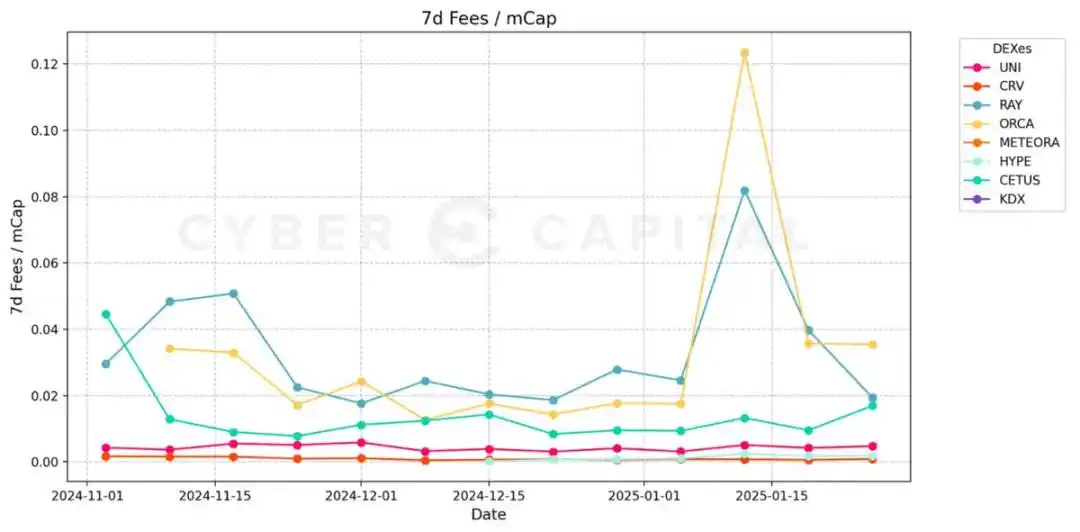
· Fee-to-Market Cap Ratio: Orca demonstrated high efficiency during a month of strong demand, but its retention of liquidity fell short, hindering long-term competitiveness. On the other hand, JUP faced the opposite situation due to constraints in its business model. Compared to the latest "hot project" Hyperliquid, Raydium generated ten times the fee with an eighth of the fully diluted valuation.
Risks
· JUP Inflationary Pressure: Despite Jupiter's aggregator position being solid, its large token supply could create short-term price pressure. Orca Market Share Erosion: If the trend of liquidity providers migrating continues, Orca may face ongoing liquidity drain. Meteora Airdrop and Tokenomics Implementation Risk: While early total value locked growth has been strong, its tokenomics and incentive structure remain untested.
Conclusion and Investment Outlook
Solana's decentralized exchange landscape is moving towards higher efficiency and deeper liquidity concentration. Raydium's outstanding liquidity positioning, active buyback mechanism, and market leadership make it a decentralized exchange with strong investment confidence. Jupiter's aggregator role remains critical and provides a competitive barrier, but token supply dilution poses a short-term challenge. Orca was once a competitive player, but faces serious challenges in liquidity retention and capital efficiency, becoming an increasingly fragile asset, indicating the dilemma of missing key integrations and struggling to compete head-on with established players. Meteora is poised to rise upon the successful launch of its upcoming token.
Based on our current theory, investment positions in decentralized exchanges should focus on the leading decentralized exchanges, decentralized exchange aggregators, and liquidity aggregators within a given ecosystem, while holding a small position in emerging participants that meet catalyst criteria.
You may also like

SpaceX vs Tesla vs xAI: Which Elon Musk Trade Has the Biggest Upside in 2026?

OpenAI Reveals It Has Confidentially Submitted an S-1 to the SEC, Keeping the Door Open for a Future IPO
On June 9, according to an OpenAI announcement, the company recently confidentially submitted a draft S-1 registration statement to the U.S. Securities and Exchange Commission (SEC), beginning the preliminary compliance process for a potential initial public offering. OpenAI said it chose to disclose this proactively because it expected the news might leak; however, the company has not yet set a specific listing timeline, and related arrangements may still take some time.

Latest research from 13 top universities including Cornell University: The current state, challenges, and misconceptions of the fusion of Crypto and AI
Deconstructing Anthropic: The Best AI Company, Possibly Also a Type of Organizational Invention
Apollo and Blackstone Reportedly Back $35 Billion Anthropic Chip Financing as Deal Details Remain Unclear
On June 9, according to currently available news alerts, Apollo and Blackstone Group participated in a $35 billion financing for an Anthropic “chip project.” Based on the original wording of the report, the funding has already been raised, but public information remains limited. The financing structure, use of proceeds, project entity, and whether Apollo and Blackstone participated through equity, debt, or project financing have not yet been disclosed.

Humanity Protocol Security Incident Escalates: More Than $31 Million Stolen From Related Addresses as Attacker Continues Selling H for ETH
On June 9, according to monitoring by Onchain Lens, more than $31 million has been stolen from addresses linked to Humanity Protocol, and the attack is still ongoing, with the hacker continuously swapping H tokens for ETH. Project founder Terence Kwok later confirmed the security incident on X, saying the issue involved a private key leak.

Bloomberg: As Bitcoin Weakens, Stablecoins and RWA Continue to Drive Expansion in Crypto Businesses
In June, Bloomberg reported that despite Bitcoin falling below $60,000 last week, wiping out about $235 billion in market value within seven days, and dropping close to 50% from last year’s peak, some core businesses in the crypto industry are still expanding, mainly in stablecoins, real-world asset tokenization (RWA), payments, and infrastructure. The report also noted that overall altcoin activity has contracted significantly: altcoin market capitalization has fallen from a peak of about $431 billion in November 2021 to around $170 billion, and among the tens of millions of tokens issued in recent years, fewer than 1,700 still maintain meaningful trading activity.

Galaxy Deep Research Report: How Hyperliquid's HIP-4 Upgrade Changes the Landscape of Prediction Markets?
Binance Research: RWA Market Expected to Expand Nearly 6x from Early 2025, with Public Equities and Onchain Payments Heating Up Together
In June, Binance Research said in its monthly market report that the real-world asset (RWA) market is expected to grow by about 589% from the beginning of 2025. Bond- and money market fund-related RWA expanded by about $6.5 billion, up 83% year over year, while publicly traded equity RWAs grew by about 422%. The report also noted that monthly crypto debit card transaction volume exceeded $747 million in May, up 48.6% year to date.

Japan to Assess a Framework for Yen Stablecoins and Crypto ETFs as Asia’s Compliant Payments Narrative Heats Up
Recently, according to the original report, Japan is considering the launch of yen stablecoins and cryptocurrency ETFs. Public information remains limited at this stage, and there is still no complete policy text, regulatory draft, or clear implementation timeline, so this is better characterized as a “policy discussion” rather than formal implementation. The original wording also noted that advancing stablecoin regulation in Asia is driving XRP usage and supporting growth in the XRPL ecosystem. However, based on currently available public information, there is not enough evidence to directly establish a clear causal relationship between this round of discussion in Japan and XRP or XRPL.

ZachXBT: Humanity private key leak and abnormal surge in H token should be viewed separately
On June 9, according to related disclosures, on-chain investigator ZachXBT posted an update on Humanity’s roughly $31 million security incident, saying that after further analyzing fund flows, he currently tends to believe the project team was not involved in an “inside job” or a self-staged attack. According to him, the official explanation about the private key leak was broadly accurate, but before the token unlock, the price of H had been artificially pushed higher, and the hacker later took advantage of that market environment; therefore, the private key leak and the earlier abnormal price pumping should be regarded as two separate and independent events. This reframing has shifted the market’s understanding of the nature of the incident. Earlier discussion around Humanity had focused on whether the team directly participated in the attack or used the security incident to cover up internal operations. ZachXBT’s latest remarks shift the focus from “whether it was self-theft” to “whether there were pre-unlock market structure issues.” He also questioned whether the team may have.

Morning Report | OpenAI has submitted an S-1 registration statement draft to the U.S. SEC; Morpho completes $175 million financing

Morning Report | BitMine increased its holdings by 126,971 ETH last week; trader Eugene announced his exit from the crypto market

Wang Chuan: How can one not feel anxious after the neighbor Old Wang made thirty times profit by investing in storage stocks? (Seven) - A quarter-century cycle
Cryptocurrency CEXs are flocking to sell US stocks, and traditional brokerages are facing an "uninvited guest."
$75 billion in foreign capital has fled, and South Korean retail investors have absorbed it all using leverage

Japan’s Three Megabanks Plan Joint Stablecoin Issuance in Fiscal 2026
MUFG, SMBC, and Mizuho reportedly plan to jointly issue fiat-pegged stablecoins in fiscal 2026, signaling Japan’s growing push into bank-led digital payment infrastructure.

Humanity Discloses H Token Dual-Chain Attack Details, With Losses on Ethereum and BSC Exceeding $36 Million
Humanity said the H token attack across Ethereum and BSC caused more than $36 million in losses after leaked ProxyAdmin keys enabled malicious contract upgrades and token minting.
SpaceX vs Tesla vs xAI: Which Elon Musk Trade Has the Biggest Upside in 2026?
OpenAI Reveals It Has Confidentially Submitted an S-1 to the SEC, Keeping the Door Open for a Future IPO
On June 9, according to an OpenAI announcement, the company recently confidentially submitted a draft S-1 registration statement to the U.S. Securities and Exchange Commission (SEC), beginning the preliminary compliance process for a potential initial public offering. OpenAI said it chose to disclose this proactively because it expected the news might leak; however, the company has not yet set a specific listing timeline, and related arrangements may still take some time.
Latest research from 13 top universities including Cornell University: The current state, challenges, and misconceptions of the fusion of Crypto and AI
Deconstructing Anthropic: The Best AI Company, Possibly Also a Type of Organizational Invention
Apollo and Blackstone Reportedly Back $35 Billion Anthropic Chip Financing as Deal Details Remain Unclear
On June 9, according to currently available news alerts, Apollo and Blackstone Group participated in a $35 billion financing for an Anthropic “chip project.” Based on the original wording of the report, the funding has already been raised, but public information remains limited. The financing structure, use of proceeds, project entity, and whether Apollo and Blackstone participated through equity, debt, or project financing have not yet been disclosed.
Humanity Protocol Security Incident Escalates: More Than $31 Million Stolen From Related Addresses as Attacker Continues Selling H for ETH
On June 9, according to monitoring by Onchain Lens, more than $31 million has been stolen from addresses linked to Humanity Protocol, and the attack is still ongoing, with the hacker continuously swapping H tokens for ETH. Project founder Terence Kwok later confirmed the security incident on X, saying the issue involved a private key leak.


