
Ray Dalio: If the United States loses Hormuz, it will lose more than just a war

 Prefer us on Google



Original Title: It All Comes Down to Who Controls the Straight of Hormuz: The "Final Battle"
Original Author: Ray Dalio
Original Translation: Peggy, BlockBeats
Editor's Note: In most wars, divergence and uncertainty are often the norm. However, in this conflict surrounding Iran, the criteria for victory and defeat are exceptionally clear: who controls the Strait of Hormuz.
This is not only a channel for energy transportation but also a "valve" for global capital flow and geopolitical power structures. Once the right of passage is weaponized, its impact will quickly spill over to oil prices, inflation, financial markets, and even the entire international order.
The author Ray Dalio presents a rather straightforward judgment in this article: if Iran retains control over Hormuz (even if only as a bargaining chip), this war will be viewed as a failure for the United States. The significance of this failure goes far beyond the gains and losses of a military operation.
Starting from historical comparisons, the author points out that similar nodes often correspond to turning points in power structures; based on this, he places this conflict within a larger "historical cycle," believing that the current situation in the Middle East is merely part of the evolution of debt, politics, and geopolitical patterns.
When the outcome of a war can be measured by whether a strait is open, its significance is no longer limited to the Middle East but points to the next phase of the entire world order.
The following is the original text:
Comparing what is happening now with similar historical situations, and calibrating my thoughts with the judgments of decision-makers and experts who have more information and mature judgments, has always helped me make better decisions.
I find that it often comes with significant divergence and surprises about future directions. However, regarding this conflict, there is one judgment that is almost undisputed: the key point is who controls the Strait of Hormuz.
The consensus I hear from government officials, geopolitical experts, and observers from different regions around the world is: if Iran still holds the control over the passage of the Strait of Hormuz, even if only retaining the ability to use it as a bargaining chip, then
The general view I hear from government officials, geopolitical experts, and people around the world is that if Iran continues to control the passage of the Strait of Hormuz, even if only retaining it as a bargaining chip for negotiation, then:
The U.S. Will Lose, Iran Will Win
The U.S. will be seen as having lost this war, while Iran will be viewed as the winner. The reason is simple. If Iran can use the Strait of Hormuz as a "weapon," it means the U.S. has no ability to resolve this issue.
This strait is one of the most critical energy channels in the world and should be protected at all costs. Because once it is blocked by Iran, the damage will not only affect the U.S. but also its Gulf allies, countries dependent on oil transportation, the global economy, and even the entire international order.
From the outcome perspective, the victory or defeat of this war can almost be measured by one indicator: whether the safety passage of Hormuz can be guaranteed. If Trump and the U.S. cannot "win" this war, they will not only be seen as losers but also be considered as having created an unresolvable situation.
As for why they cannot win, it is actually not important. Is it domestic anti-war sentiment affecting the midterm elections? Is American society unwilling to bear the costs of war? Is it insufficient military capability? Or is it the inability to rally allies to jointly maintain open shipping lanes?
These are all irrelevant. The result is only one: the U.S. lost.
Historically, the significance of such a failure could be very severe. Losing control of Hormuz for the U.S. could be akin to the 1956 Suez Canal Crisis for the UK (where the UK was forced to concede on the canal issue, leading to a shift in global power) or the 17th-century Spain (which lost its advantage due to financial overreach and weakened naval power) or the 18th-century Netherlands (which declined as its trade and financial center status was replaced by the UK), all are emblematic moments of imperial decline.
History often repeats similar scripts: a seemingly weaker country challenges the dominant power over a key trade route; the dominant power issues threats, and the whole world watches the outcome; then, based on victory or defeat, positions and capital are redistributed.
This "key battle" that determines victory or defeat often quickly reshapes history because people and money instinctively flow to the winner. This shift will directly reflect in the markets, affecting bonds, currencies, gold, and deeper geopolitical power structures.
Based on numerous historical cases, I have summarized a simple but important principle: when a dominant country with reserve currency status excessively expands financially while simultaneously showing fatigue militarily and financially, it should be wary that allies and creditors will begin to lose confidence, debts will be sold off, currencies will weaken, and even the status of the reserve currency will be shaken.
If the U.S. and Trump cannot control the shipping flow of Hormuz, this risk will significantly increase.
In the past, it was assumed that the U.S. could overwhelm its opponents militarily and financially. However, the cumulative effects of Vietnam, Afghanistan, Iraq, and possibly this conflict are eroding that belief and shaking the post-war international order led by the U.S.
Conversely, the situation is equally valid; when a dominant country demonstrates clear military and financial strength, confidence is reinforced. For example, Ronald Reagan quickly facilitated the release of hostages from Iran after taking office and provided escort for tankers during the Iran-Iraq War, which strengthened U.S. deterrence.
If Trump can fulfill his promises to ensure the safety of Hormuz and suppress the Iranian threat, it will significantly enhance external confidence in U.S. strength.
On the contrary, if the Strait of Hormuz falls into Iranian hands and is used as a tool of threat, the world will become its "hostage." This not only means that the global energy lifeline is "kidnapped," but also signifies that the U.S. "provoked a war but failed to win" in this conflict. Trump's credibility will be directly impacted, especially given his previous strong statements.
Many foreign policymakers privately express a straightforward view: "He talks a good game, but can he win when it matters?" Some observers even see this conflict as an "ultimate showdown," watching it like a gladiatorial contest or a championship final.
Trump is calling on other countries to join the escort operation, and whether he can truly organize allies is itself a test of capability. The reality is that relying solely on the U.S. and Israel, it is difficult to ensure the safety of shipping lanes without weakening Iran's control, which may likely require a real large-scale conflict.
Iran's attitude stands in stark contrast to that of the U.S. For them, this is a war about belief and survival. They are willing to bear greater costs, even sacrificing lives. Meanwhile, American society is more concerned about oil prices, and American politics is more focused on elections.
In war, who can "bear pain" often matters more than who can "inflict pain."
Iran's strategy is likely to be dragging the war out, prolonging the pain until the U.S. loses patience and withdraws. Once this happens, U.S. allies will quickly realize: the U.S. will not always stand behind them.
"Negotiated Resolution" is Just a Surface Option
Although there are discussions about ending the war through an agreement, everyone knows: agreements cannot truly resolve the problem. Almost everyone understands that such conflicts cannot be genuinely ended by agreements. What truly determines victory or defeat is the upcoming "key battle."
Whether the outcome is Iran continuing to control Hormuz or its control being taken away, the conflict will enter its most intense phase. This "final battle" that determines victory or defeat is likely to be very large in scale.
The Iranian military has stated: "Any regional energy facilities related to or cooperating with the U.S. will be destroyed." This is precisely the action they may take. If the Trump administration successfully unites other countries to send warships for escort, and the shipping lanes have not been mined, then this may be a path to resolution. But both sides know that the key battle that truly determines victory or defeat is still ahead. If the U.S. cannot reopen the strait, the consequences will be extremely severe; conversely, if Trump wins this battle and eliminates the Iranian threat, it will greatly enhance his prestige and demonstrate U.S. strength.
The "Decisive Battle" Will Affect the World
The direct and indirect impacts of this "decisive battle" will ripple across the globe. It will affect trade flows, capital flows, and the geopolitical landscape related to China, Russia, North Korea, Cuba, Ukraine, Europe, India, Japan, and more. More importantly, this conflict is not an isolated event but part of a larger "historical cycle." This cycle is driven by financial, political, and technological forces. The situation in the Middle East is just one facet of it.
For example, whether a country can win a war depends on the number and intensity of wars it faces, its domestic political situation, and its relationships with countries of similar interests (such as Iran, Russia, China, North Korea). No country has the capacity to simultaneously handle multiple wars, and in a highly interconnected world, wars can spread in unpredictable ways, much like a pandemic.
At the same time, domestically, especially in democratic countries where wealth and values are significantly divided, there will always be intense debates around "whether to go to war and who bears the costs (financial or lives)." These complex chain reactions, while difficult to predict, usually do not yield ideal outcomes.
Finally, I want to emphasize that I am not speaking from a political standpoint but as someone who must make judgments about the future. By studying the rise and fall of empires and the replacement of reserve currencies over the past 500 years, I have summarized five major forces that drive changes in the world order:
Long-term debt cycles
The rise and fall of political orders
The cycles of international geopolitical orders
Technological progress
Natural events
The current situation in the Middle East is just a fragment of this "great cycle." Although it is impossible to predict all the details accurately, the operational state of these forces can be observed and measured.
History does not necessarily repeat itself, but it often moves in similar rhythms. What is truly important is: you need to judge whether this "great cycle" is happening, which stage we are in, and how you should act in this context.
-- Price
This content is provided for general informational purposes only and doesn't constitute financial, investment, legal, or tax advice. Any events, rewards, online promotions, or related information mentioned herein should not be considered a recommendation, solicitation, or invitation to purchase, sell, trade, or otherwise deal in any crypto assets. Crypto assets are highly volatile and may result in loss. The availability of WEEX services, products, and related events may vary by region. You are responsible for ensuring that your participation is in accordance with applicable local laws and regulations.
You may also like

Bitcoin Bull Run: Arthur Hayes Sees Crypto Market Soaring Higher
Goldman Sachs Optimistic About Crypto Brokerage Trading Platforms: Can the Market Support a New Cycle?

Strive CEO: The Bitcoin Bull Market Has Just Begun, ASST Has Passed Its Bottom

Ravencoin (RVN) Price Forecast for 2026–2050

AI Agent's 'Coming of Age': What Step Is Missing from Simulation Training to Real Trading?
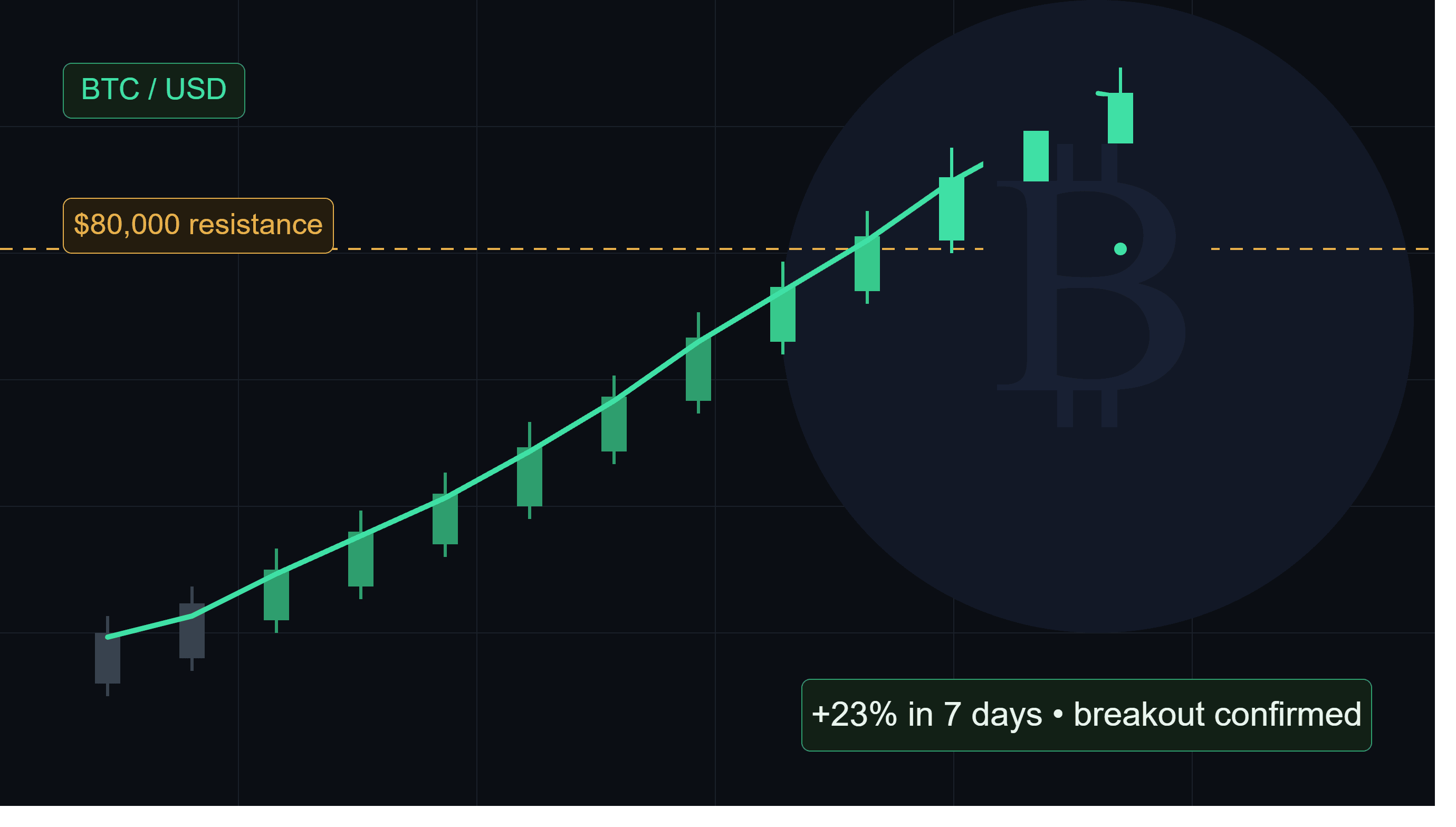
Bitcoin Just Hit $80,000: Last Week WEEX's Prediction Came True — What's Next?
Bitcoin hit $80,000 as WEEX predicted last week. See what drove the breakout, current key levels, and whether $90,000 is next.

Mining Artificial Intelligence: Why Bitcoin Miners Are Changing Their Business Model
CFTC Considers the Viability of Perpetual Futures in GPU Computing

Bitcoin is once again being 'buried' on social media: what this could mean for its price

They Thought They Were Talking to Apple: $195,000 in Cryptos Vanished in Singapore

Traffic Through the Strait of Hormuz Hits Lowest Level Since May
![[SCAN 2026 Final Interview] ⑬ BITSkrieg: Indian Engineering Students' Challenge for SCAN2026 Victory](/public-static/40_d9655504cd.png?format=avif)
[SCAN 2026 Final Interview] ⑬ BITSkrieg: Indian Engineering Students' Challenge for SCAN2026 Victory

New Project in the ZEC Space: Vitalik's Only Coin Purchase in Two Years

Reassessing $HTX Amidst the Bull Market: The Equity Token for Global Assets Entering the Crypto World
Cryptocurrency Trading at Bank Leumi: Israel's Largest Bank Partners with Galaxy

When Computing Power Becomes a Trading Asset - From Computing Power Futures to Computing Power Dollars
How Bitwise Funds Attracted $1.8 Billion in the First Half of the Year

Claims of 47% Rice Price Increase, Public Indicators Show 3.8%

General Intuition Negotiates New Round of Financing at $6 Billion Valuation

A Ring Sold for $16 Billion, Oura Prepares for IPO in the U.S.

Where is the Next Big Scene for AI Beyond Coding? Discussing Four Time Gaps in AI Development

U.S. Towns Resist Data Center Construction, Bitcoin Miners Become the Biggest Beneficiaries
Micron CEO Says Memory is the Strategic Infrastructure for AI

BMO Sets Target Price of $550 for AMD

Fear and Greed Index Records 74, Remains in Greed Zone

Financial Stability Standards to be Recalculated Considering Cryptocurrencies

Central Bank Strengthens Control: Cryptocurrency Sales to Be Monitored Due to Misleading Risks
U.S. Supreme Court Allows Trump’s Order on Mail-in Voting to Move Forward
NVIDIA Announces Expansion of CUDA-X Library

Amazon Reviews Plan for $530 Million Automated Delivery Stations
Bitcoin Bull Run: Arthur Hayes Sees Crypto Market Soaring Higher
Goldman Sachs Optimistic About Crypto Brokerage Trading Platforms: Can the Market Support a New Cycle?
Strive CEO: The Bitcoin Bull Market Has Just Begun, ASST Has Passed Its Bottom
Ravencoin (RVN) Price Forecast for 2026–2050
AI Agent's 'Coming of Age': What Step Is Missing from Simulation Training to Real Trading?
Bitcoin Just Hit $80,000: Last Week WEEX's Prediction Came True — What's Next?
Bitcoin hit $80,000 as WEEX predicted last week. See what drove the breakout, current key levels, and whether $90,000 is next.

Contents
Latest articles


Latest coin listings on WEEX


