
- Buy Crypto
- Markets
- Futures
- Spot
- Copy Trade
 Earn
Earn- More
Is the U.S. Stock Market Facing a Crash Risk Tonight as Well?

Following the plunge of gold and silver, US stocks are also under pressure. On February 2, Nasdaq index futures fell nearly 1% in pre-market trading, the S&P 500 index has retraced 0.43% from its peak, and the fear index VIX surged to 17.44, indicating a significant shift in market sentiment towards caution.
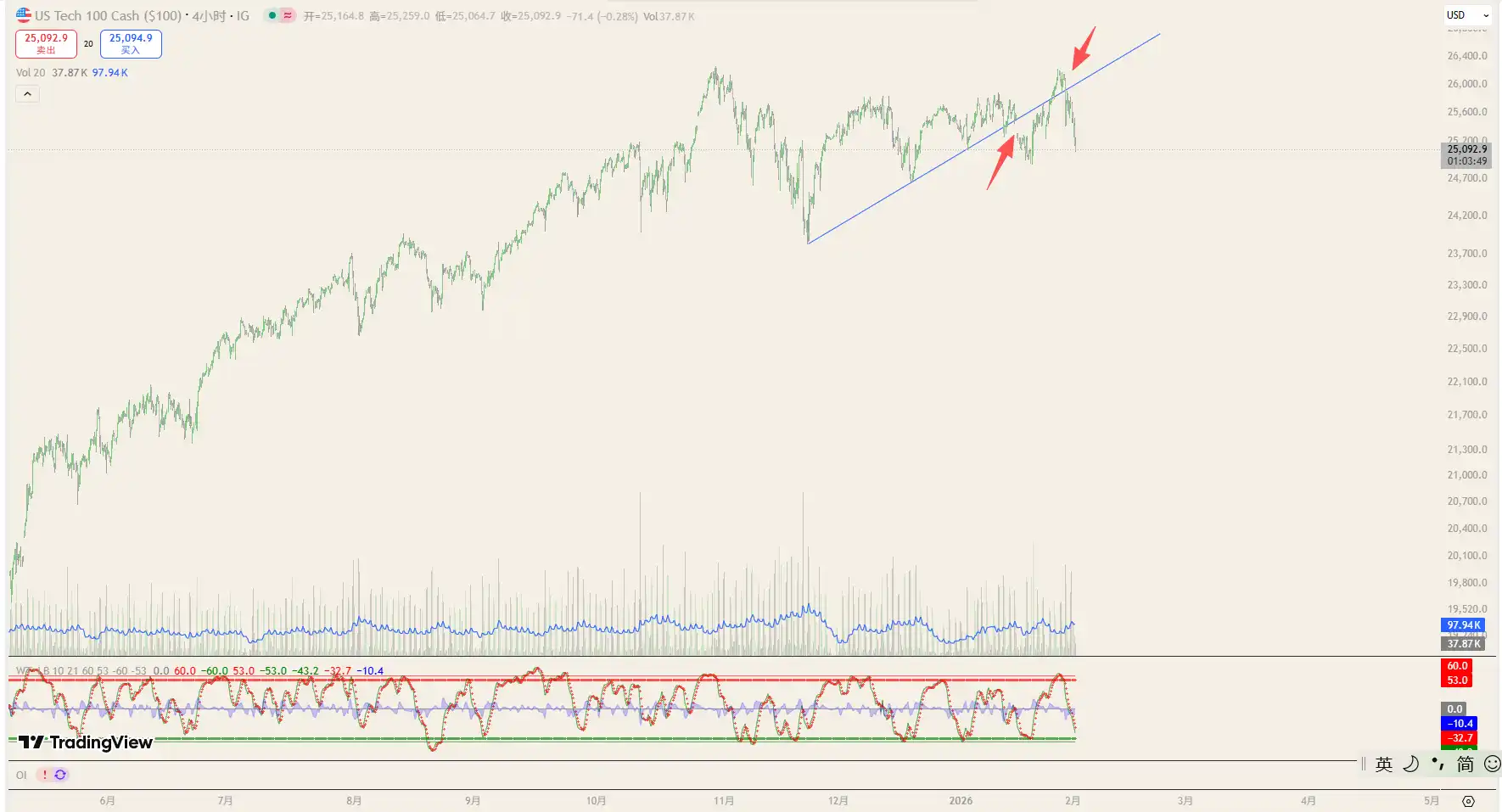
Technically, the Nasdaq index has been oscillating at high levels for three months, forming a rising wedge pattern. Now, this critical uptrend line has been breached for the second time, dealing a severe blow to market confidence.
If tonight's daily closing price is below the previous low, forming a "Lower Low," then a larger downtrend may unfold.
Adding to market unease is the continued fallout from last weekend's "Epstein Files." This batch of over 3 million pages of documents has implicated Kevin Warsh, the next Federal Reserve Chair nominee selected by the Trump administration.
His name appeared on the guest list for the 2010 "St. Barts Christmas Party" email. This has transformed distant political gossip into a tangible risk hanging over the market.
Escalation of Political Risk
Market panic primarily stems from a reassessment of policy uncertainty in the "Trump 2.0" era. Warsh is a staunch hawk, and his nomination almost signals the end of the low-interest-rate era.
Warsh has long been a vocal critic of the Federal Reserve, believing that a "regime change" is necessary. He has publicly rebuked the Fed for cutting rates by a full percentage point when inflation exceeded the target in 2024, only to backtrack afterwards, damaging its credibility.
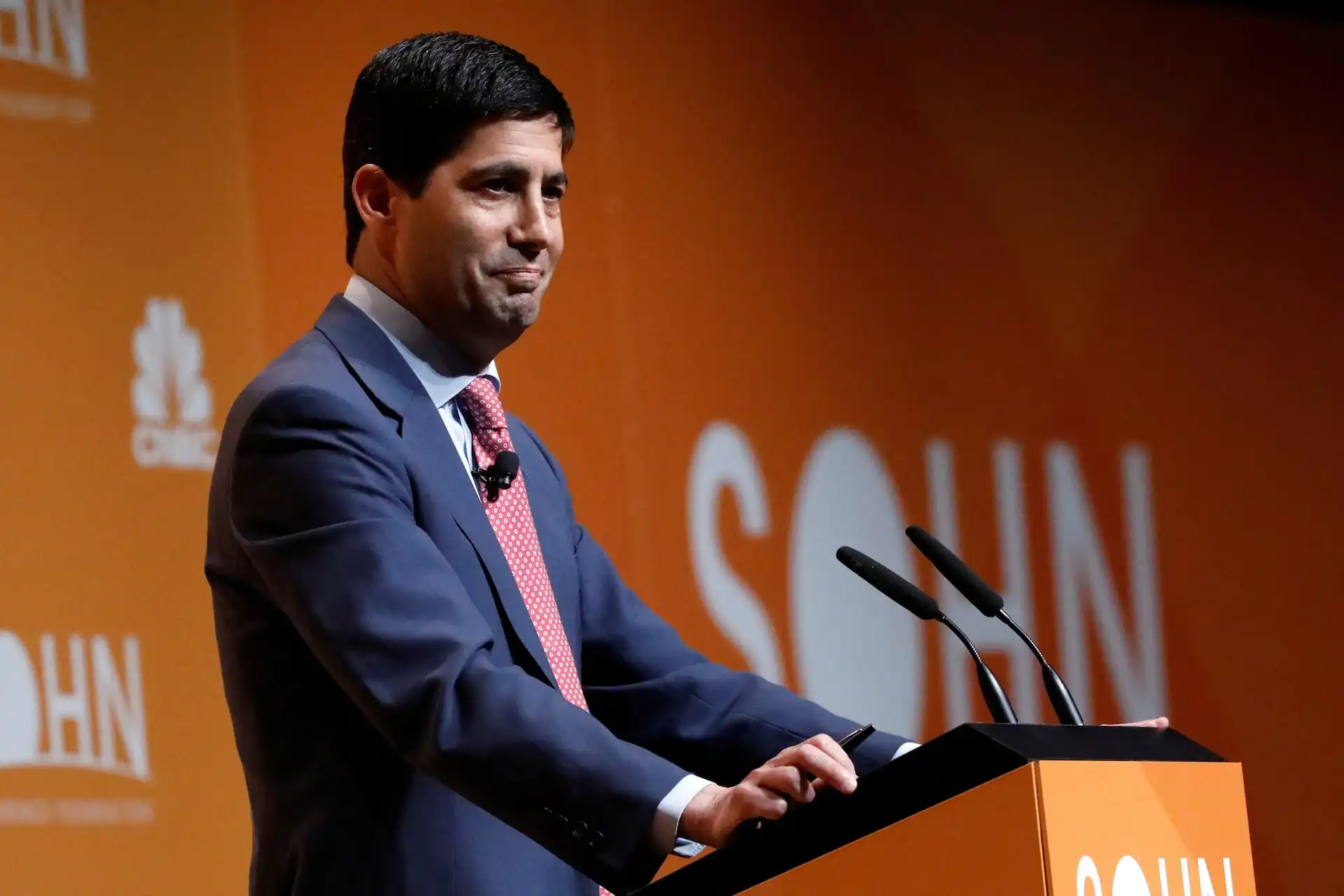
Kevin Warsh, the next Federal Reserve Chair nominee selected by the Trump administration
Warsh's core argument is that the Fed's bloated balance sheet distorts the healthy functioning of the economy and inflates asset bubbles. He advocates for balance sheet reduction, even if it means achieving it through tightening policies. This combination of "hawkish rate cuts" has raised concerns in the market about a sharp tightening of future monetary policy.
The release of the Epstein Files has exposed a significant, unpredictable political risk to the market. While there is currently no evidence of Warsh's involvement in illegal activities, his association with this century-defining scandal itself poses a major political liability, further complicating an already controversial nomination.
In addition, the Trump administration's iconic tariff policy has also caused market concerns due to its uncertainty. If a new round of tariffs expands in scope, it will not only impact consumer confidence and corporate profits but may also further swell the already huge fiscal deficit.
Forecasts indicate that in just the first three months of 2026, the U.S. fiscal deficit will reach $601 billion. This fiscal outlook, combined with the political trust crisis exposed by the Epstein files, collectively forms an extremely fragile market environment.
Global Markets and Commodity "Bloodbath"
The commodity market was the first to ignite the "long liquidation" stampede. Traditional safe-haven assets such as gold and silver experienced an epic collapse, with gold prices plummeting by 12% at one point, and silver flash-crashing by 36%, marking the largest single-day decline since 1980, with a trading volume of 30 billion under ETFs. High-leverage long positions were swiftly liquidated within a short period.
As prices fell, the Chicago Mercantile Exchange (CME) quickly raised margin requirements for gold and silver futures. For example, the margin ratio for non-high-risk accounts in silver futures was increased from 11% to 15%. This forced many underfunded long traders to be liquidated, triggering further sell-offs that crushed prices, creating a vicious cycle. According to statistics, the liquidation amount in tokenized futures alone reached as high as $140 million within 24 hours.
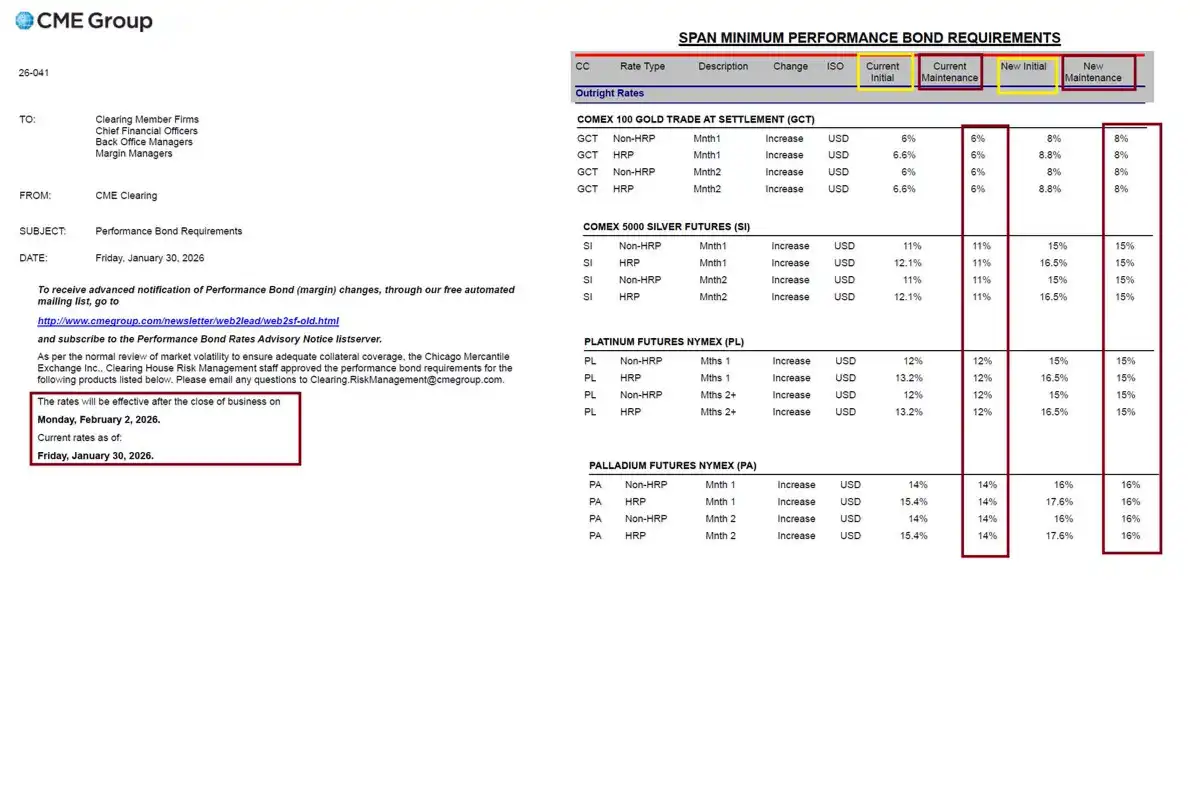
The Chicago Mercantile Exchange announced the margin ratio was increased from 11% to 15%
This storm also spread to the domestic market, with multiple gold shops in Shuibei, Shenzhen, experiencing a "bankruptcy" due to participating in unqualified gold futures gambling transactions, involving an amount of possibly hundreds of billions, affecting thousands of investors.
Crude oil prices were also not spared, falling by 5.51% to $61.62 per barrel. The softness in the Asian stock markets had already sounded the alarm, with the Nikkei index falling by 1.11% and the Hang Seng index plummeting by 3.15%. Bitcoin, as a risk asset indicator, also dropped below the psychological level of $75,000. Behind this series of chain reactions, a global deleveraging event may be unfolding.
When investors in one market (such as commodity futures) are forced to liquidate due to high leverage, they have to sell assets in other markets (such as Asian stocks, bitcoin) to raise margin, triggering cross-market risk contagion. If this liquidity drought continues, the next assets to be sold off could potentially be the overvalued U.S. stocks.
Economic Data and the AI Bubble
The cracks at the economic level are becoming increasingly clear. The upcoming job report has become the focus of the market's attention. Once the data shows an unexpected cooling in the labor market, concerns about an economic recession will quickly intensify. The Federal Reserve is currently maintaining interest rates, but faced with persistent inflation, its policy space is extremely limited. If inflation fails to recede as expected, future rate hikes will be inevitable.
The yield on the 10-year U.S. Treasury bond has risen to 4.218%, and the massive amount of interest the U.S. government needs to pay on its debt each year is further exacerbating its fiscal situation. Historically, an inverted yield curve has repeatedly been a reliable leading indicator of an economic recession, and the market is once again approaching this dangerous edge.
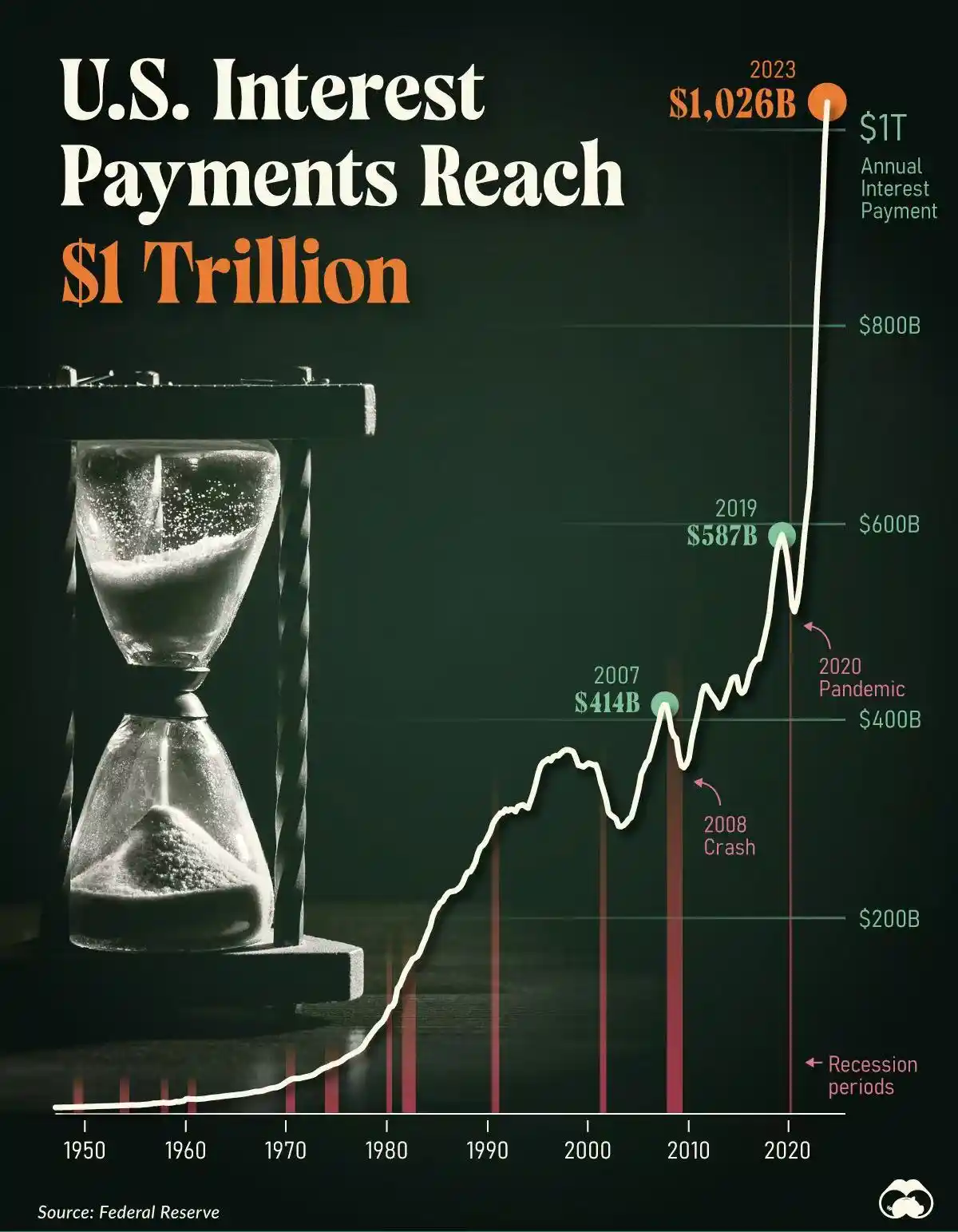
Historical trend of total U.S. government debt interest payments, which have now surpassed $1 trillion
Meanwhile, the AI narrative that underpinned the market prosperity of 2025 is also showing cracks. The recent weakness in the Nasdaq index, especially in software stocks becoming the most oversold sector in the S&P 500, indicates that the market's enthusiasm for AI is cooling off.
Investors are beginning to realize that the commercialization and profit realization of AI are much longer and more challenging than imagined.
The upcoming earnings season, especially the financial reports of tech giants like Amazon and Alphabet, will be a "litmus test" to evaluate the true capability of AI. If the reports fall short of expectations, a large-scale sell-off may be hard to avoid.
The Ghost of 1979
The current geopolitical and macroeconomic environment bears striking similarities to 1979, causing many seasoned investors to feel uneasy.
1979 marked the end of the era of detente in the Cold War. In December of that year, the Soviet Union invaded Afghanistan, leading to a sharp deterioration in U.S.-Soviet relations and a peak in global geopolitical tensions.
Almost simultaneously, the Iranian Revolution triggered the second oil crisis, causing oil prices to skyrocket and the global economy to fall into a state of "stagflation" (economic stagnation combined with high inflation). Back then, under political pressure, the Federal Reserve failed to take timely decisive action, resulting in uncontrolled inflation. It ultimately took the new chairman, Paul Volcker, implementing a sharp rate hike through "shock therapy" to contain it, but not without the cost of a deep economic recession.
Today, we are facing a similar situation once again: Middle East geopolitical tensions. According to prediction market Polymarket, as of February 2, the market believes there is a 31% probability of the United States striking Iran by the end of this month, with an insider whale betting big on regime change in Iran.
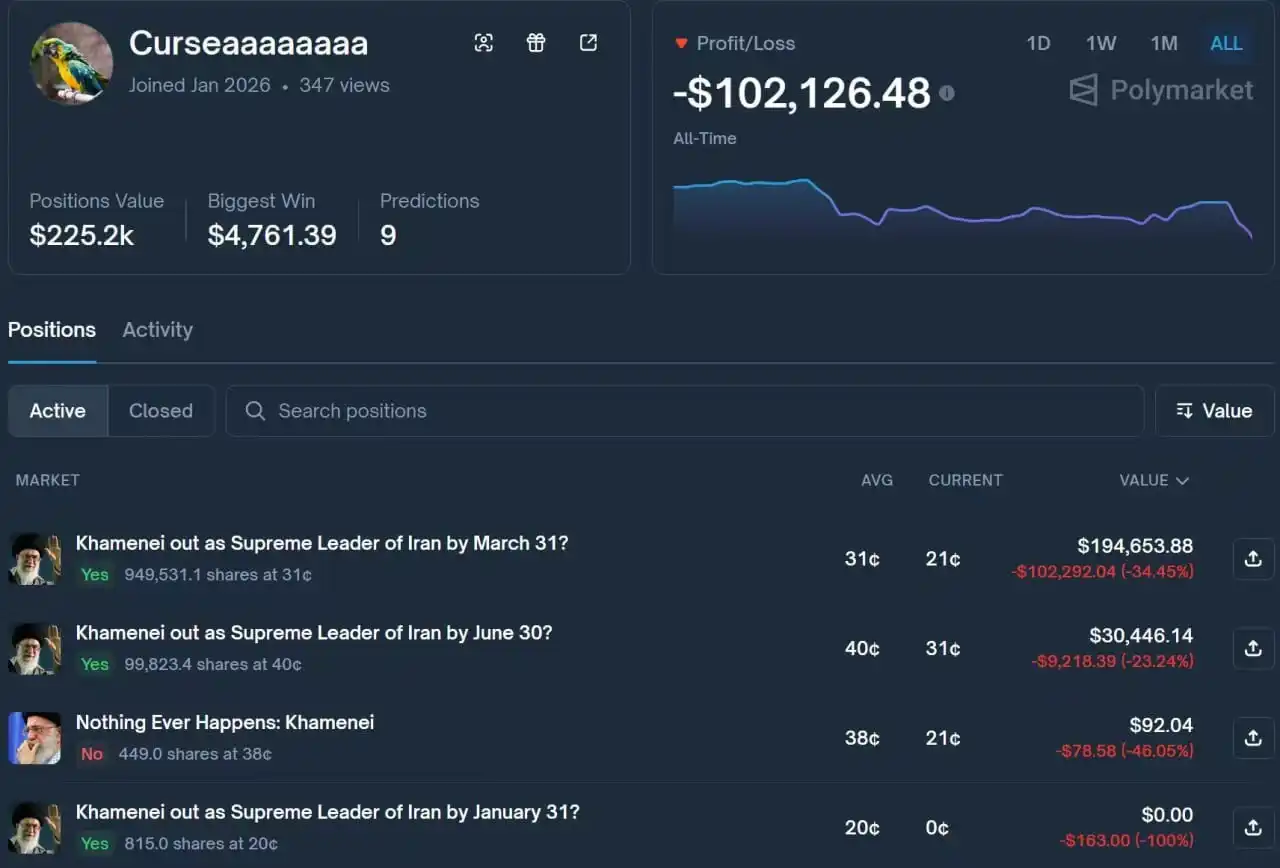
Polymarket insider whale heavily bets on regime change in Iran, total bet $336.7k | Source: Polybeats
Meanwhile, energy prices are experiencing significant volatility, and global inflation pressures remain high. Concerns about potential interference by the Trump administration in the Federal Reserve's independence, along with the nomination of hawkish figure Warsh, are reminiscent of past policy mistakes made under political pressure.
If history repeats itself, the aggressive tightening policies implemented to control inflation could bring an end to the current artificially prolonged bull market, leading to a crisis of confidence in the US dollar and a significant stock market correction similar to the late 1970s to early 1980s.
For investors who have been riding high in the euphoria of 2025, now may be the time to reassess risks and prepare for potential market turbulence ahead.
You may also like

Ripple Joins Elite Crypto and Banking Players at High-Stakes White House Summit
Key Takeaways Ripple secured a critical position at a White House summit focusing on stablecoin regulation. The meeting…

Crypto Apocalypse Coming: Renowned Expert Foresees Catastrophic End for Cryptocurrency
Key Takeaways Nouriel Roubini, known as “Dr. Doom,” anticipates a “catastrophic end” for the cryptocurrency sector. Even with…

Moonbirds NFTs Are Soaring Again: Unveiling the Recent Price Surge
Key Takeaways Moonbirds NFTs, once a joke in the NFT world, are making a staggering comeback thanks to…

Trump Says Crypto Reserve Will Include XRP, Solana, Cardano—And ‘Obviously’ Bitcoin and Ethereum
Key Takeaways President Trump announced a strategic U.S. crypto reserve to include digital assets such as XRP, Solana,…

‘Big Short’ Investor Burry: Bitcoin Has Not Succeeded as a Safe Haven
Key Takeaways Michael Burry warns that Bitcoin has not proven to be the secure asset many expected it…

SEC Chair Paul Atkins to Make History as First Sitting Chair to Speak at the Bitcoin Conference in Las Vegas
Key Takeaways Paul Atkins, SEC Chairman, is set to become the first sitting SEC Chair to speak at…

Vitalik’s Vision: Redefining Ethereum’s Layer 2 Landscape
Key Takeaways Ethereum creator Vitalik Buterin calls for a new role for Ethereum’s Layer 2 solutions (L2s) as…

Jeffrey Epstein’s Investment in Blockstream and the Unfolding Controversy
Key Takeaways Jeffrey Epstein was involved as an investor in the early seed round of the Bitcoin technology…

Cardano (ADA) Price Analysis for February 3: Can It Stabilize Above $0.30?
Key Takeaways: The current trading value of Cardano (ADA) is $0.2999, reflecting a 1% drop over the past…
SHIB Price Analysis for February 3: A Week to Watch for Shiba Inu Investors
Key Takeaways The SHIB price is currently rising after finding local support at $0.00000677. A potential upward move…

Crypto Market Review: Shiba Inu’s (SHIB) 1,000,000,000,000 Bull Market Trigger, Bitcoin (BTC) Crash Might Stop Here, Is Dogecoin (DOGE) in Mini-Bull Market?
Key Takeaways Shiba Inu (SHIB) shows signs of a potential recovery with a significant green candle, hinting at…
The Top Airdrop Opportunities of January 2026
Key Takeaways: Discover the top five airdrop opportunities available in January 2026, each representing promising tokenless protocols. Uniswap…
BitMine’s $6 Billion Ethereum Losses: Strategic Planning or Market Gaffe?
Key Takeaways BitMine Immersion Technologies, holding the largest Ethereum treasury, reports over $6 billion in unrealized losses. The…

Strategy Stock ($MSTR) Reaches 52-Week Low As Bitcoin Slips Below $84,000
Key Takeaways Strategy ($MSTR) shares hit a session low of $140.25, dropping significantly amid Bitcoin’s price decline. Bitcoin…

Jeffrey Epstein’s Unusual Bitcoin Connections
Key Takeaways: Jeffrey Epstein’s substantial involvement in the cryptocurrency industry, particularly Bitcoin, was revealed through document releases. Epstein…

Cardano Price Prediction as the Planned CME’s ADA Futures Launch Nears
Key Takeaways Cardano’s current price stability reflects structural balance in the market, maintaining a firm foothold below $0.30.…
Ondo Price Prediction Amid MetaMask’s Integration of Over 200 Tokenized U.S. Stocks
Key Takeaways Ondo (ONDO) token exhibits positive movement, rebounding from a bearish trend and maintaining levels above $0.27.…
Why Bitcoin’s Defense of $76,000 Matters for MicroStrategy’s Earnings Narrative
Key Takeaways MicroStrategy’s Q4 2025 earnings are heavily influenced by Bitcoin’s price performance, especially maintaining the $76,000 level.…
Ripple Joins Elite Crypto and Banking Players at High-Stakes White House Summit
Key Takeaways Ripple secured a critical position at a White House summit focusing on stablecoin regulation. The meeting…
Crypto Apocalypse Coming: Renowned Expert Foresees Catastrophic End for Cryptocurrency
Key Takeaways Nouriel Roubini, known as “Dr. Doom,” anticipates a “catastrophic end” for the cryptocurrency sector. Even with…
Moonbirds NFTs Are Soaring Again: Unveiling the Recent Price Surge
Key Takeaways Moonbirds NFTs, once a joke in the NFT world, are making a staggering comeback thanks to…
Trump Says Crypto Reserve Will Include XRP, Solana, Cardano—And ‘Obviously’ Bitcoin and Ethereum
Key Takeaways President Trump announced a strategic U.S. crypto reserve to include digital assets such as XRP, Solana,…
‘Big Short’ Investor Burry: Bitcoin Has Not Succeeded as a Safe Haven
Key Takeaways Michael Burry warns that Bitcoin has not proven to be the secure asset many expected it…
SEC Chair Paul Atkins to Make History as First Sitting Chair to Speak at the Bitcoin Conference in Las Vegas
Key Takeaways Paul Atkins, SEC Chairman, is set to become the first sitting SEC Chair to speak at…


 App
App