
Interview with Silentberry Founder: On-Chain Literature as a New Medium of Human Civilization, RGB++ Protocol Building a New Creator Economy Ecosystem


In early 2024, the emergence of the RGB++ protocol once again ignited the market's enthusiasm for the Bitcoin ecosystem. The scalability and security brought by isomorphic linking and on-chain validation have made numerous investors excited about the potential "on-chain liquidity infrastructure" explosion in the Bitcoin ecosystem. As books, carriers of knowledge and culture, preserve the historical memory of human civilization, they are not only an important force driving the continuity and development of civilization but also a new form of on-chain assets. SilentBerry is the magical chemical reaction that combines the two.
As the first decentralized publishing platform built on the RGB++ protocol, SilentBerry has pioneered a new way of publishing by permanently recording book content on the Bitcoin blockchain. Through smart contracts and a tiered NFT issuance model, SilentBerry divides book ownership and revenue rights into four forms: Goldberry, Silverberry, Copperberry, and Blueberry. Users can purchase these digital assets using BTC, ETH, and CKB to obtain printing rights, e-book versions, and ongoing royalty income from books. The emergence of SilentBerry is not only a significant step forward for decentralized publishing but also a small step towards driving mass adoption of crypto.
At the same time, the new book "Rescuing Democracy" by renowned historian and economist Professor Qin Hui was globally launched on the SilentBerry platform on January 3, 2025. This innovative move not only marks a technological breakthrough in the publishing industry but also signifies a profound transformation in the dissemination of ideas and culture.
It is worth noting that on December 10th, SilentBerry received a strategic investment from the CKB Eco Fund, indicating that decentralized publishing has attracted the attention and support of capital.
Today, BlockBeats and SilentBerry's founder Eero Dong had a chat about how SilentBerry will change the way human history is recorded and what new increments it will bring to the entire Bitcoin ecosystem?
Why Choose the Decentralized Publishing Track?
BlockBeats: You have been working in the traditional cultural content dissemination industry. What experiences and reasons prompted you to start a Web3 venture? What was the realistic demand behind the emergence of SilentBerry?
Eero Dong: I have always been working in the cultural content dissemination field. I made an early attempt to securitize music intellectual property, which also attracted the attention of many musicians. I have also been involved in the dissemination and promotion of poetry. For example, I have been the overall planner of the Beijing Poetry Festival and this year marks the tenth anniversary. In this process, I have accumulated a lot of resources from creators. Through communication with them, I learned about the practical needs of many creators, inspiring me to pursue a creator economy on the Web3 track.
Although the book market is not large, we still believe that the publishing industry has always been an important medium for the dissemination of ideas. Books will never disappear because they can impart precise concepts and systematic knowledge. Now, the traditional book publishing track is facing the impact of AI and decentralization, standing at a critical juncture of transformation.
In the traditional publishing model, authors often face some content review and market-oriented restrictions, making it difficult for niche writers' books to be published or to earn revenue.
Another more important aspect is that the existing revenue distribution mechanism is highly unfavorable to authors and is very opaque. For example, the specific print run of a book and the royalty income allocated to the author are not easily transparent to the author, giving rise to our pursuit of decentralized publishing to address this structural issue.
Book publishing should not only be about cultural dissemination and expression but should also make the communication bridge between authors and readers more transparent and efficient. In this context, Silentberry emerged.
BlockBeats: From a technical standpoint, why did you choose RGB++? Why not choose the more developer-populated Ethereum or the more cost-effective Solana ecosystem?
Eero Dong: We chose the RGB++ protocol primarily based on its scalability and security advantages. The RGB++ protocol can directly record book content on the Bitcoin blockchain, ensuring not only the immutability of the content but also enabling flexible distribution of ownership and benefits, which is the foundation of our core business model.
Compared to other blockchains like Ethereum or Solana, Bitcoin places more emphasis on the robustness of its infrastructure and trust value. As the pioneer of blockchain technology, Bitcoin is not only the most primitive blockchain but is also widely recognized as the most trustworthy chain. Building on this foundation to further expand its functionality and provide a solid and tamper-proof storage platform for human knowledge is one of the key reasons we chose the Bitcoin ecosystem. Through distributed ledger technology, information can receive long-term protection while ensuring its trustworthiness and immutability on a global scale.
The technical flexibility of the RGB++ protocol also provides us with significant optimization space. It has brought significant improvements in storage fees, convenience, and reductions in fees similar to gas costs. We have made some adjustments to the RGB++ protocol to better align it with the actual needs of book content publishing and storage.
In Silentberry's vision, every book should be a monument to culture. Through a decentralized structure, we have eliminated the exploitation in the middle links of the traditional publishing model, allowing copyright revenues to be directly distributed to authors and readers through smart contracts. This not only protects the author's labor but also significantly enhances the transparency and efficiency of the publishing process.
In addition, the content itself will be directly engraved on the Bitcoin blockchain. On January 3, 2009, the first Bitcoin block was born. Therefore, we have also chosen to permanently engrave Professor Qin Hui's new work, "Rescuing Democracy," original manuscript on the Bitcoin blockchain for the first time on January 3, 2025, symbolizing an immutable record of knowledge. This is not only a way to respect the author's intellectual property rights but also a unique way of feedback to the buyers. Buyers will be able to receive an NFT of the book, further enjoying the true value and potential returns of the work.
BlockBeats: We see that Silentberry has adopted an innovative TTNFT issuance model, and many people may not be very familiar with this four-tier NFT gameplay. What specific rights and values do the four tiers of NFT provide to creators, readers, and early investors?
Eero Dong: Many creators do not have a large number of fans or a broad readership; they may only have a few hundred or less than a thousand loyal users. In the traditional publishing industry, such a scale is often difficult to be seen as "having market value" and cannot form an effective commercial chain. In this situation, the high threshold of the traditional publishing model and reliance on sales volume make it difficult for these creators to effectively connect with their loyal readers.
The lack of this scale effect has led many creators, even with solid creative ability and content value, to face the dilemma of not being able to generate income after completing their work. This not only undermines the enthusiasm of creators but also hinders the generation and dissemination of more high-quality content.
Silentberry's decentralized publishing platform aims to break through this barrier. Through technological means and innovative models, we hope to establish a direct and efficient channel for these smaller but valuable creators to connect with their readers, allowing every valuable work to find its rightful audience.
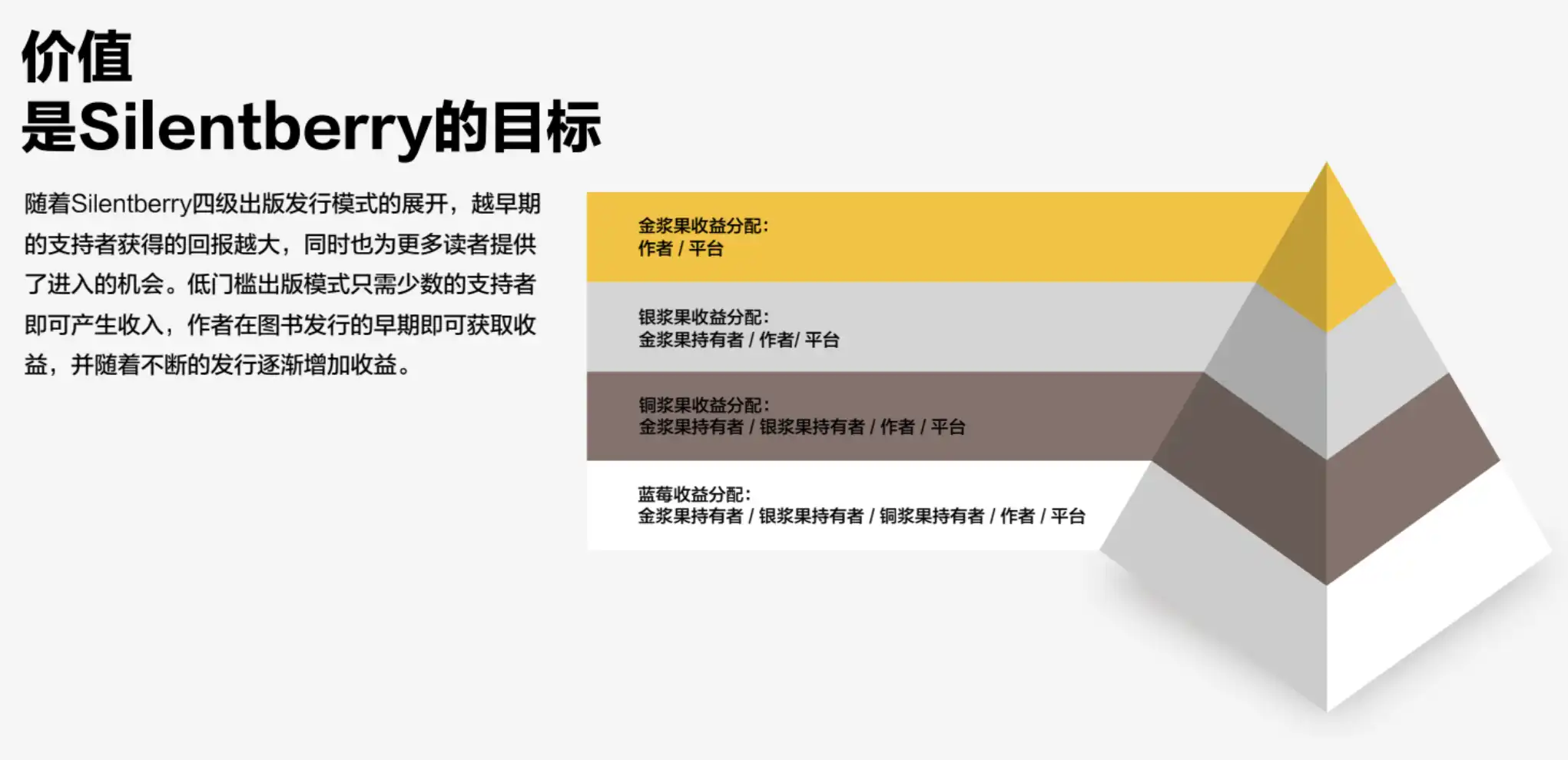
SilentBerry's Four-Tier NFT Issuance Model
Through the innovative four-tier issuance model, SilentBerry has established a more equitable revenue sharing system between supporters and creators, while reducing the publishing threshold and expanding reader participation opportunities. Authors can receive income at the early stage of book release, and as the release progresses, the earnings will continue to increase.
In the first stage (Goldenberry Stage), the revenue distribution for the book is 80% to the author and 20% to the platform. The pricing in this stage is self-set by the author based on their own reputation and the bestseller potential of the book, usually meeting the author's psychological expectations. Authors can earn income with only a small number of supporters, and once the Goldenberry Stage is sold out, it proceeds to the second stage.
The second stage (Silverberry Stage) is priced at 1/10 of the Goldberry Stage price, but the issuance quantity is 20 times that of the Goldberry quantity. After the Silverberry sells out, 60% of the proceeds will be distributed back to Goldberry holders to reward them for the high-risk support as early adopters. This model is similar to an IPO in the book industry: Goldberry holders are akin to early investors, receiving higher returns.
The issuance rules for the third stage (Copperberry Stage) and fourth stage (Blueberry Stage) follow suit. The Copperberry price is 1/10 of the Silverberry, with a quantity 20 times that of the Silverberry; the Blueberry, being the final tier, offers the book's NFT but does not include revenue-sharing rights. Blueberry holders can access the e-book download, physical book acquisition, and book club membership benefits, with all proceeds going to early supporters and the author.
It's worth noting that the author receives 80% of the proceeds in the first stage (Goldberry Stage), followed by a continuing 20% proceeds share in each subsequent stage, ensuring the long-term value of their creation. This tiered issuance model not only protects the author's rights but also, through fair revenue distribution, provides high returns to early supporters, attracts more readers, and builds a more decentralized book distribution ecosystem.
Professor Qin Hui's Web3 Debut, Silentberry's Startup Story
BlockBeats: Professor Qin Hui's role as the inaugural author for Silentberry may differ from public expectations. In Web3 startup projects, it's common to invite Crypto Native authors to release works. However, your collaboration with Professor Qin Hui seems particularly special; what's the story behind it?
Eero Dong: Professor Qin Hui's new book, "Saving Democracy," will officially launch on January 3, 2025. We chose this date to pay tribute to the birth of the first Bitcoin block on January 3, 2009. This is both a nod to Satoshi Nakamoto and because Bitcoin is not just a financial asset but also a content asset. It's crucial that Professor Qin Hui's first book is inscribed on the Bitcoin blockchain.
Readers familiar with Professor Qin Hui know he is a renowned historian who has long been in the academic spotlight. We selected Professor Qin Hui's work because his liberal ideas align closely with Bitcoin's decentralized nature, creating a profound resonance between philosophy and technology.
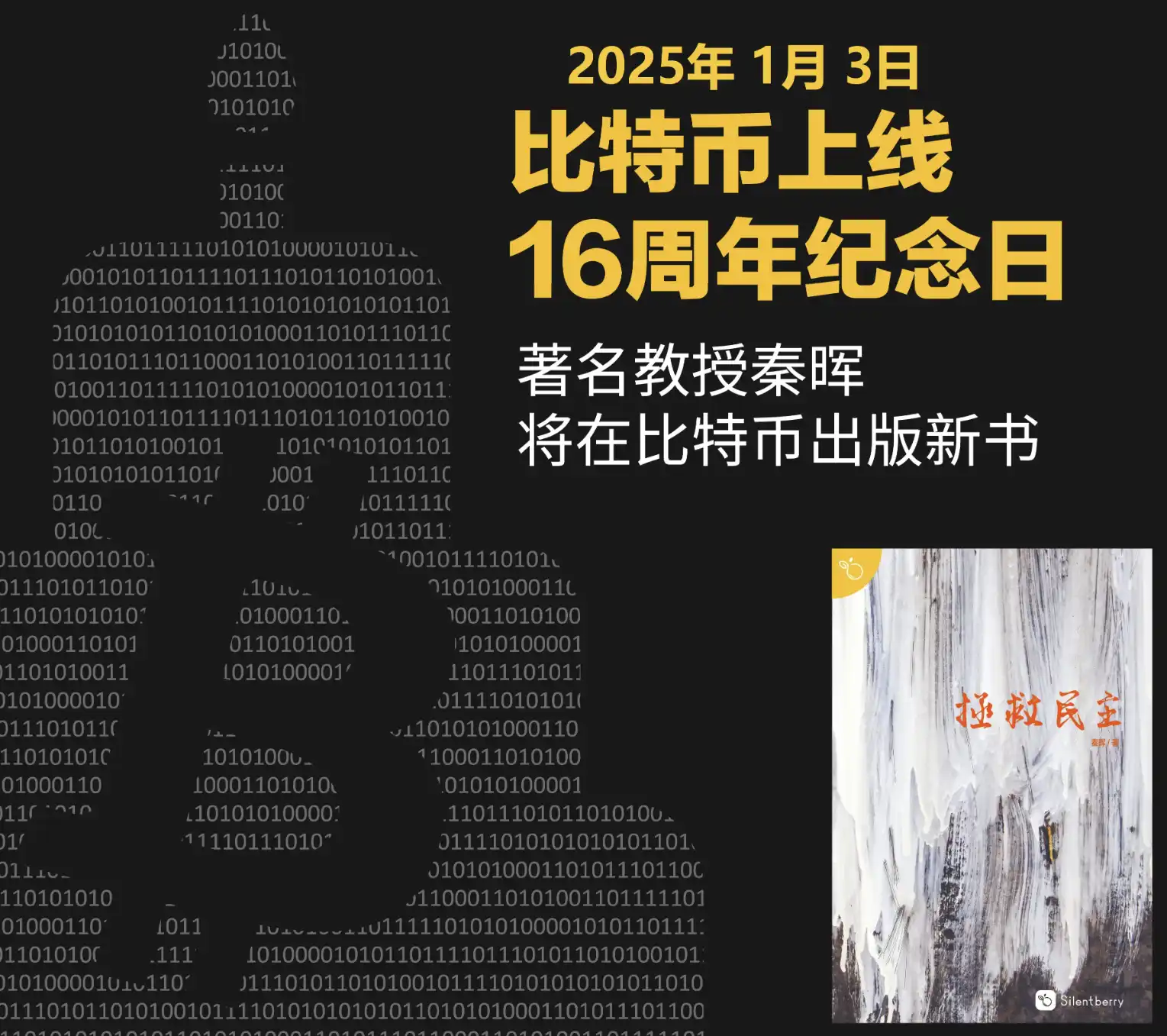
On January 3rd this year, Professor Qin Hui published a new work titled "Saving Democracy" on SilentBerry
In fact, before confirming the collaboration with Professor Qin Hui, we had many other well-known scholars and authors as alternative options. Initially, we had reservations when communicating with these scholars. However, after discussions, we realized that the Web3 space may have overlooked an important direction: the cultural and ideological potential embedded in decentralized publishing. While many had previously viewed Bitcoin solely as a financial asset, when we proposed that Bitcoin also has properties related to content dissemination and content assets, many scholars showed great interest and were willing to collaborate with us.
These scholars' core values align closely with SilentBerry's principles. They uphold the principles of publishing freedom and fair dissemination, which align with what SilentBerry aims to achieve through technology - a sense of freedom and fairness. Through this collaboration, we believe that decentralized publishing will open up a new path for the dissemination and innovation of ideas.
BlockBeats: The core of Web3 decentralization coincidentally aligns with the spirit of democracy. How do you view Professor Qin Hui's upcoming publication of "Saving Democracy" on SilentBerry? What significance does the publication of "Saving Democracy" have for SilentBerry?
Eero Dong: Professor Qin Hui has always been very attentive to the development of new technologies. However, as a large-scale, widely-adopted application in the Web3 space has yet to emerge, many people still have a vague understanding of Web3 and have missed further opportunities to engage. Therefore, when Professor Qin Hui learned that "Saving Democracy" could be published on the SilentBerry platform, he found that this model aligned well with his own beliefs.
The content of this book continues Professor Qin Hui's consistent style, fully reflecting his depth and breadth in analyzing issues from a global perspective, which I believe will be warmly welcomed by readers. In the book, Professor Qin Hui delves into various issues faced during the democratic development process and provides insightful perspectives.
The transparency and decentralization of the SilentBerry platform will bring innovative advantages to the publishing model, such as immutable content, transparent distribution mechanisms, and the widespread dissemination of books. This model not only emphasizes the archival value of knowledge but also continuously expands the reach of knowledge dissemination through a four-tier issuance model, allowing more people to access the book's content. This focus on knowledge dissemination is a common pursuit among many scholars.
In addition, a key feature of the Silentberry mode is fairness, where the author can directly see the revenue distribution, completely eliminating the complex intermediate steps in traditional publishing. This direct connection between creators and readers contrasts sharply with the traditional publishing model. In our view, many creators, including Professor Qin Hui, believe that this more transparent and efficient publishing form is likely to become the mainstream way of knowledge dissemination in the future.
BlockBeats: So apart from Professor Qin Hui, who we already know about, which other authors will be publishing works on Silentberry in the future? Will there be development of markets in different languages?
Eero Dong: In the foreseeable future, we plan to attract more authors to join the decentralized publishing ecosystem of Silentberry. Currently, we are in talks with several authors in Chinese, English, Japanese, Korean, and other languages, covering a diverse range of topics and perspectives. At the same time, our platform already has a significant backlog of manuscripts, and based on the experience and features of this initial launch, we will gradually introduce works by more outstanding authors.
At the current stage, the platform is still in its early operational phase, so we are using an invitation system to release works, focusing on curated content. However, as the platform stabilizes over time, we plan to open up work publishing permissions, fully realizing decentralization, allowing anyone to publish their works on the platform.
In the work publishing process, we provide a set of automated tools that will greatly facilitate authors' operations. The tools can automatically generate and design covers, upload content, and set printing and formatting. We offer over 1,000 printing formats to choose from, and have partnered with a global printing network to support on-demand printing, starting from a single copy and distributing globally. This efficient publishing model not only enhances the convenience of publishing but also further lowers barriers, providing more authors with opportunities for creation and dissemination.
In the future, our primary market focus will be on the European and American regions, especially in Europe. The linguistic and cultural diversity of Europe is one of our core concerns, as it aligns closely with the inclusivity of knowledge dissemination advocated by our platform. In this context, we plan to incorporate AI tools in the platform's second-phase product to better support multilingual publishing.
Through these AI tools, we hope to assist excellent authors who use less common languages in quickly translating their works into mainstream languages such as English, French, Spanish, etc., for broader dissemination of their ideas and content. This will not only enhance the international impact of outstanding works but also allow more readers to access unique perspectives from different cultural backgrounds.
Overall, our focus is more on building a globalized publishing market, leveraging technology to break down language and cultural barriers, and providing a more open and inclusive knowledge-sharing platform for global authors and readers.
Behind CKB Eco Investment, How Will Silentberry Plan for the Future?
BlockBeats: Recently, we saw Silentberry receive a strategic investment from the CKB Eco Fund. How will Silentberry plan to use this funding? What impact will this investment have on Silentberry's ecosystem development and technological improvement?
Eero Dong: First and foremost, we are very grateful for the investment from the CKB Eco Fund. This not only marks the first time that the decentralized publishing sector has received attention and recognition from capital, but also further demonstrates the potential and feasibility of the sector's future development.
Regarding the planning and use of this funding, we will mainly focus on the following three areas:
1. Optimize Technical Structure: Further enhance the platform's technical infrastructure to ensure system stability and scalability.
2. Improve User Experience: Continuously enhance user interaction and operation processes to provide authors and readers with a more convenient and user-friendly experience.
3. Expand Global Content Distribution Ecosystem: Promote the dissemination of content on a global scale, especially content value around the Bitcoin ecosystem, and explore more innovative application scenarios.
CKB Eco Fund Invests Strategically in SilentBerry
Our team has always paid close attention to the CKB project because their focus and solid performance in the Web3 field are impressive. Especially against the backdrop of the current hype in the Web3 community, CKB has always focused on infrastructure construction and steadily rolled out a series of excellent products and protocols, such as the RGB++ protocol, wallets, and Lightning Network-related applications, among others. Our development team also sees great potential for application explosion in the Bitcoin ecosystem, and CKB is undoubtedly in a leading position in this field.
This collaboration with CKB can be described as a perfect match. Our project focuses on driving content assetization, aligning highly with CKB's concept of the "Common Knowledge Base." As our strategic investor, CKB has not only provided us with financial support but has also greatly assisted us in various aspects such as technical guidance, incubation, marketing, and product positioning. This is particularly important for a startup team like ours.
We are very excited to work with CKB to further the development of decentralized publishing, injecting new vitality into the Bitcoin ecosystem and global knowledge dissemination.
BlockBeats: Besides Silentberry's own efforts in marketing, what are your future market expectations for the industry as a whole? Specifically, in the next few years, what scale or achievements do you think Silentberry should reach?
Eero Dong: I believe that in the next few years, Silentberry will gradually realize the diversified development of content assets. We will not only focus on book publishing but also plan to enter other fields such as music assets and gaming assets. Through our unique model, especially the four-level NFT approach, we will achieve direct connection and dissemination of these assets with users.
On a technological level, in the next one to two years, we will introduce a DAO mechanism to allow more people to directly participate in the content governance process, achieving a more open and decentralized content ecosystem. At the same time, we will also launch more AI-based innovative products. For example, in future iterations, we plan to introduce a feature for interacting with books. At that time, books will not only be static reading materials but will evolve into interactive, dynamic content forms, providing users with a completely new reading experience.
BlockBeats: For a decentralized platform, if there is no intervention in content publishing, there may be low-quality or even illegal content. What measures will Silentberry take to prevent the tragedy of the commons?
Eero Dong: In terms of content governance and compliance, we have always placed high emphasis on the protection of minors and compliance with the laws and regulations of the relevant countries and regions. To this end, we will introduce a DAO (Decentralized Autonomous Organization) mechanism to allow more users to participate in the platform's content governance, forming a more open, transparent, and efficient governance model.
BlockBeats: Apart from the publishing or content publishing sector, what impact do you think blockchain technology will have on the entire cultural industry or content publishing sector?
Eero Dong: I believe the impact of blockchain technology on the cultural industry and content publishing sector is undeniable. During our conversation, many companies may have already been developing new products or iterating on existing products, and the pace of this change may be faster than we expect.
Taking our Silentberry publishing track as an example, as early as mid-November last year, Microsoft established 8080 Publishing House, aiming to reshape traditional publishing using AI technology. They clearly could not tolerate the highly centralized and lengthy cycle issues in traditional publishing. Additionally, ChatGPT has deep cooperation with a German publishing giant, attempting to reshape the publishing industry's landscape through new technology.
At the core of blockchain technology lies its ability to decentralize, and smart contracts enable a more efficient profit-sharing mechanism. This technology will break through existing geographical and language barriers, especially with the combination of AI and Web3, greatly enhancing the efficiency of knowledge dissemination. My personal prediction is that in the first half of 2025, we may see a series of explosive growth in new tools and new models, bringing profound changes to the cultural and educational fields.
BlockBeats: Many thanks to Teacher Eero Dong for sharing insights on the decentralized publishing track.
You may also like
Cape Verde 2-3 Argentina: The Underdog Team That Stunned the World in Defeat
Cape Verde's run ended in a 3-2 defeat to Argentina, but their journey — three unbeaten draws, one heroic goalkeeper, and a fight that pushed the defending champions to the brink — is the kind of story markets recognize too: small caps can rattle blue chips long before anyone expects it.
A valuation of 8 billion dollars, doubling in 8 months! What makes the crypto-friendly bank Erebor Bank stand out?
340 billion valuation: Li Yanhong's largest IPO, a seat in Kunlunxin's shares is hard to come by
Stablecoins are the "royalists" of the crypto world: Open USD brings the old currency system into play
Semiconductor stocks plummet, yet Anthropic wants to create a 2nm chip
Where is Zhao Changpeng's billion-dollar investment going? YZi Labs' investment landscape fully revealed
Ethereum Foundation Report: A Basic Guide to Ethereum for Governments and Financial Institutions
A pre-announced harvesting case: After the cryptocurrency price dropped by 99%, the public chain Saga exited to transform into AI
When American giants collectively "defect" from Chinese AI models
BIS Report Compliance Observation: The Real Risks of Stablecoins, Not Just "Depegging"
Portugal 2-1 Croatia: Ronaldo's 20-Year Knockout-Stage Drought Ends With a Debt Finally Collected
Portugal beat Croatia 2-1 in the 2026 global football championship's knockout rounds as Ronaldo scored his first-ever knockout-stage goal, Gonçalo Ramos struck a stoppage-time winner, and VAR ruled out a late equalizer for offside.
Bitcoin Price Prediction July 2026: Will BTC Recover to $70K or Drop Below $55K?
A South Korean company that learned the strategy of hoarding coins, from a bull market to delisting?
WEEX API Broker Program: Turn Your Trading Platform Into a Revenue Engine
How to choose between buying discounted ETH, Bitmine, and SharpLink?
Wosh: Inflation has cooled in recent weeks, AI is reshaping the economy, and forward guidance has lost its necessity
From Pump.fun to Collector Crypt: Has Solana's income throne changed hands?
Dan Bin's latest speech: Don't miss out on a great era
Cape Verde 2-3 Argentina: The Underdog Team That Stunned the World in Defeat
Cape Verde's run ended in a 3-2 defeat to Argentina, but their journey — three unbeaten draws, one heroic goalkeeper, and a fight that pushed the defending champions to the brink — is the kind of story markets recognize too: small caps can rattle blue chips long before anyone expects it.
A valuation of 8 billion dollars, doubling in 8 months! What makes the crypto-friendly bank Erebor Bank stand out?
340 billion valuation: Li Yanhong's largest IPO, a seat in Kunlunxin's shares is hard to come by
Stablecoins are the "royalists" of the crypto world: Open USD brings the old currency system into play
Semiconductor stocks plummet, yet Anthropic wants to create a 2nm chip
Where is Zhao Changpeng's billion-dollar investment going? YZi Labs' investment landscape fully revealed