
Data Analysis How Much Does Raydium Really Rely on pump.fun?



Original Title: "Data Analysis: How Dependent Is Raydium on pump.fun?"
Original Author: Azuma, Odaily Planet Daily
The mainstream DEX protocol on Solana, Raydium (RAY), experienced a sharp decline today, directly triggered by pump.fun seemingly testing its own AMM liquidity pool. The market speculates that this move may lead to future pump.fun ecosystem tokens not being pooled on Raydium after breaking out of the "seed round," but instead being directly diverted to the pump.fun protocol, resulting in a reduction in Raydium's trading volume, corresponding revenue, and buyback amount.
Logic Behind RAY's Decline (Readers familiar with the relevant logic can skip this section)
Let's briefly outline the relationship between Raydium and pump.fun.
As the current leading meme token launchpad platform on Solana, the issuance of pump.fun's token goes through two stages: "seed round" and "public round." After the token is issued, it will first enter the "seed round" trading phase, which relies on pump.fun's protocol's own Bonding Curve for matching transactions. When the trading volume reaches $69,000, it will then enter the "public round" trading phase, at which point liquidity will migrate to Raydium, where a pool will be created and trading will continue.
Next, let's look at Raydium and RAY.
Currently, Raydium charges a 0.25% fee per transaction, with 0.22% allocated to Raydium's liquidity providers (LP) and 0.03% used for RAY buyback and ecosystem support. In summary, Raydium's trading volume will indirectly affect RAY's price through fee revenue.
So the current situation is that if pump.fun builds its own AMM, liquidity will no longer migrate to Raydium in the future, thereby reducing the latter's trading volume, fees, and consequently affecting RAY's value performance.
How Dependent Is Raydium on pump.fun?
Today, there has already been a lot of analysis in the market on the above points. However, it seems that no one has carefully examined how much Raydium relies on pump.fun in terms of trading volume. Therefore, we queried some data sources on Defillama and Dune, and the conclusion is shown in the following figure.
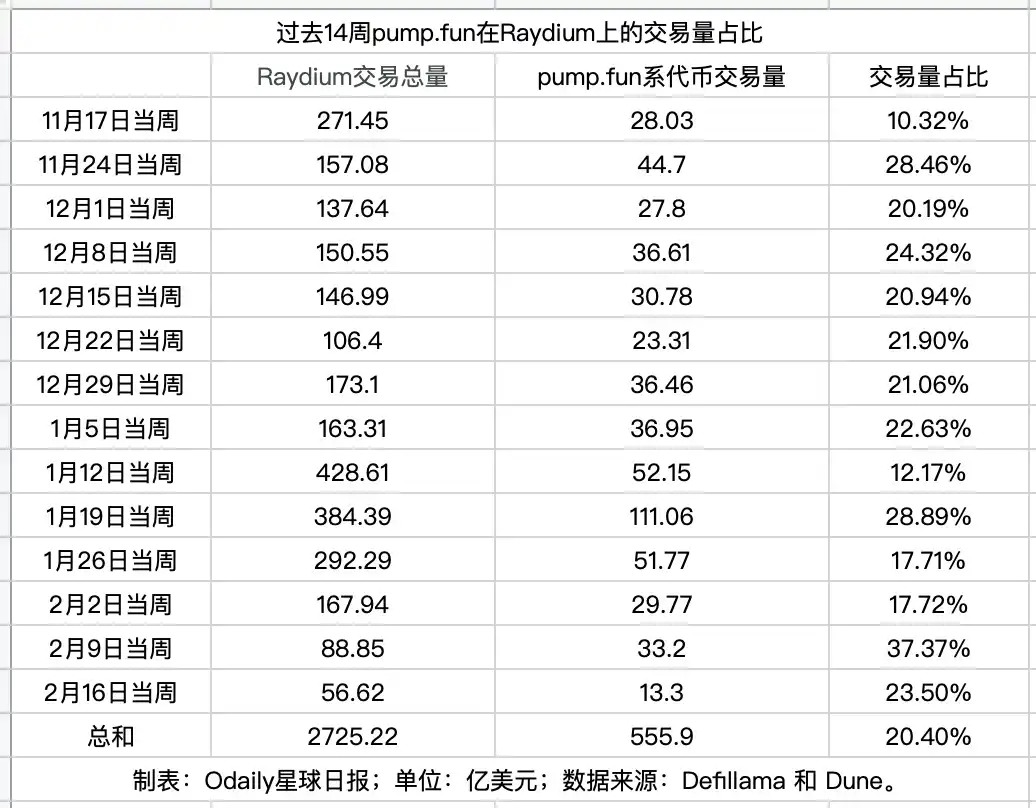
As can be seen from the above chart, in the past 14 weeks, the trading volume of the pump.fun token on Raydium has generally accounted for around 20%. This means that if pump.fun does indeed redirect trading volume from Raydium in the future through its own AMM (excluding autonomous liquidity migration activities due to uncertain platform fee rate differences), Raydium is expected to experience around a 20% reduction in trading volume.
Oversold?
Turning back to the market situation, OKX data shows that RAY dropped to a low of $2.82 today, corresponding to a decrease of over 30% (the data was delayed, but in hindsight, there was indeed some overselling at that time). The current price has gradually recovered to $3.15, representing a 25.43% decrease.
Considering that SOL also experienced a 5.8% decrease, RAY's current decline is basically within a reasonable range, meaning that the market has preemptively priced in pump.fun's frontrunning behavior.
Let's end with a quote from Fluid COO DMH:
“RAY's plummet once again proves to us that ‘distribution >>> tech.’ Both the traditional world (Microsoft) and the crypto space (Metamask) have countless examples showing that if you have a large enough user base, your product isn't that important.”
You may also like

Pantera Capital Partner: How Tokenization is Restructuring the Private Equity and Early Investment Ecosystem?

New York Proposes Stricter Stablecoin Issuer Rules Aligned With Federal GENIUS Act
NYDFS proposed stricter stablecoin issuer rules aligned with the GENIUS Act, covering reserves, custody, redemption timelines, audits, and capital buffers.
Every exchange is a "Universal Exchange."

The counterattack of traditional finance: Alliance chains are quietly reviving

CryptoQuant Says Bitcoin Profitable Supply Is Near 45% Pressure Zone as On-Chain Data Points to Market Repricing
CryptoQuant said Bitcoin’s profitable supply is nearing the 45% pressure zone, signaling rising market stress, unrealized losses, and a possible on-chain repricing phase.

Bitcoin Falls Below 200-Week Moving Average as On-Chain Data Shows Over Half of Supply in Loss
Bitcoin dropped below its 200-week moving average as on-chain data showed over 50% of circulating supply is now in loss, signaling rising market stress.

CFTC Reportedly Plans New Prediction Market Rules Focused on Manipulation Risk and Public Interest Review
The CFTC is reportedly preparing new prediction market rules focused on manipulation risk, public interest review, and retail trader protections.

Meet the new WEEX trial fund—your gateway to greater profits

WEEX Labs Lands at Dutch Blockchain Week: A Disruptive Crypto × AI Conversation Sets Sail in Amsterdam

SK Hynix Reportedly Plans U.S. ADR Listing as Early as August, With SEC Approval Possible in Late June
SK Hynix may pursue a U.S. ADR listing as early as August, with SEC approval reportedly possible in late June amid strong AI chip supply chain demand.

SpaceX vs Tesla vs xAI: Which Elon Musk Trade Has the Biggest Upside in 2026?
OpenAI Reveals It Has Confidentially Submitted an S-1 to the SEC, Keeping the Door Open for a Future IPO
On June 9, according to an OpenAI announcement, the company recently confidentially submitted a draft S-1 registration statement to the U.S. Securities and Exchange Commission (SEC), beginning the preliminary compliance process for a potential initial public offering. OpenAI said it chose to disclose this proactively because it expected the news might leak; however, the company has not yet set a specific listing timeline, and related arrangements may still take some time.

Latest research from 13 top universities including Cornell University: The current state, challenges, and misconceptions of the fusion of Crypto and AI
Deconstructing Anthropic: The Best AI Company, Possibly Also a Type of Organizational Invention
Apollo and Blackstone Reportedly Back $35 Billion Anthropic Chip Financing as Deal Details Remain Unclear
On June 9, according to currently available news alerts, Apollo and Blackstone Group participated in a $35 billion financing for an Anthropic “chip project.” Based on the original wording of the report, the funding has already been raised, but public information remains limited. The financing structure, use of proceeds, project entity, and whether Apollo and Blackstone participated through equity, debt, or project financing have not yet been disclosed.

Humanity Protocol Security Incident Escalates: More Than $31 Million Stolen From Related Addresses as Attacker Continues Selling H for ETH
On June 9, according to monitoring by Onchain Lens, more than $31 million has been stolen from addresses linked to Humanity Protocol, and the attack is still ongoing, with the hacker continuously swapping H tokens for ETH. Project founder Terence Kwok later confirmed the security incident on X, saying the issue involved a private key leak.

Bloomberg: As Bitcoin Weakens, Stablecoins and RWA Continue to Drive Expansion in Crypto Businesses
In June, Bloomberg reported that despite Bitcoin falling below $60,000 last week, wiping out about $235 billion in market value within seven days, and dropping close to 50% from last year’s peak, some core businesses in the crypto industry are still expanding, mainly in stablecoins, real-world asset tokenization (RWA), payments, and infrastructure. The report also noted that overall altcoin activity has contracted significantly: altcoin market capitalization has fallen from a peak of about $431 billion in November 2021 to around $170 billion, and among the tens of millions of tokens issued in recent years, fewer than 1,700 still maintain meaningful trading activity.

Galaxy Deep Research Report: How Hyperliquid's HIP-4 Upgrade Changes the Landscape of Prediction Markets?
Pantera Capital Partner: How Tokenization is Restructuring the Private Equity and Early Investment Ecosystem?
New York Proposes Stricter Stablecoin Issuer Rules Aligned With Federal GENIUS Act
NYDFS proposed stricter stablecoin issuer rules aligned with the GENIUS Act, covering reserves, custody, redemption timelines, audits, and capital buffers.
Every exchange is a "Universal Exchange."
The counterattack of traditional finance: Alliance chains are quietly reviving
CryptoQuant Says Bitcoin Profitable Supply Is Near 45% Pressure Zone as On-Chain Data Points to Market Repricing
CryptoQuant said Bitcoin’s profitable supply is nearing the 45% pressure zone, signaling rising market stress, unrealized losses, and a possible on-chain repricing phase.
Bitcoin Falls Below 200-Week Moving Average as On-Chain Data Shows Over Half of Supply in Loss
Bitcoin dropped below its 200-week moving average as on-chain data showed over 50% of circulating supply is now in loss, signaling rising market stress.


