
BTC Price Flash Crash: Are Long-Term Holders Selling the Dip to Fuel the Bull Market?


Original Title: "BTC Flash Crash Needle Insertion, LTH Profit Taking a Bull Market 'Standard'?"
Original Source: BitpushNews
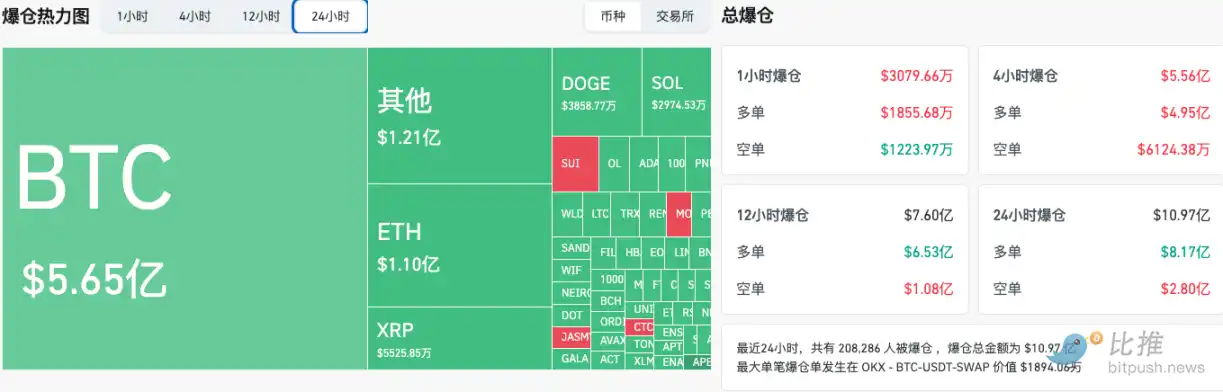
Bitpush data shows that after hitting a historical high of nearly $104,000 yesterday, Bitcoin experienced a sudden and sharp plunge around 6:30 AM Beijing time on December 6, plummeting to around $91,000 in a few minutes, leading to a widespread market liquidation. Data shows that in the past 24 hours, nearly 210,000 investors were liquidated, totaling over $1 billion, with long positions predominating. At the time of writing, the BTC price has rebounded to above $97,000. This needle insertion did not affect other altcoins.
Analyst: LTH Profit Taking Not Yet at Extreme Levels
CryptoQuant's data shows that after breaking the $100,000 mark, long-term holders (LTH) began to take profits. The Long-Term Holder Spent Output Profit Ratio (LTH-SOPR) indicator shows that the Bitcoin sold by long-term holders has realized four times the profit from their original purchase price. Julio Moreno, CryptoQuant's research director, pointed out: "After Bitcoin broke the $100,000 mark, long-term Bitcoin holders (LTH) started to take profits, which is a normal phenomenon during a Bitcoin bull market, and profit-taking has not yet reached extreme levels."
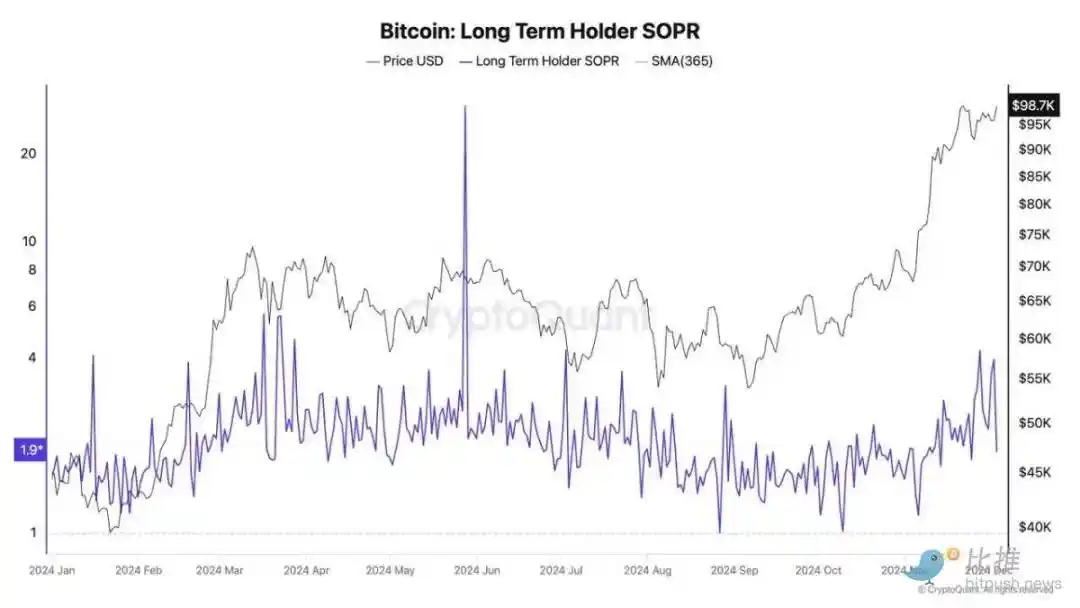
However, analysts believe that profit-taking is just one factor leading to Bitcoin's fall. Owen Lau, Executive Director and Senior Analyst at Oberheim, had previously warned investors to be cautious when Bitcoin reached $100,000, as profit-taking scenarios might arise. In addition, market concerns about macroeconomic conditions, regulatory policies, and other factors could also exacerbate market volatility.
Focus on Non-Farm Payrolls Data
Investors are currently focusing on the upcoming release of US non-farm payroll data on December 6 in Eastern Time, as this data could have a significant impact on the Fed's monetary policy, which may in turn affect the Bitcoin market.
Jag Kooner, Derivatives Director at Bitfinex, stated that the market is generally expecting positive trends in November's non-farm payroll data. If the data shows strength, the Fed may slow down its rate cut pace, or even delay rate cuts. This would lead to a stronger US dollar, exerting a certain dampening effect on risk assets, including Bitcoin.
However, the current market still leans towards a rate cut expectation for the Federal Reserve's December meeting. Data from the Chicago Mercantile Exchange shows that the market widely believes the Fed will cut interest rates by 25 basis points in December with a probability of over 70%. Lower rates typically stimulate market liquidity and provide support for risk assets, thus having a positive impact on Bitcoin prices.
In addition to monetary policy factors, institutional investor interest and political sentiment continue to support Bitcoin's rise. WeFi Co-Founder Maksym Sakharov emphasized that institutional investors have been steadily accumulating Bitcoin, with many believing that as global trade prepares for the impact of Donald Trump's proposed tariffs, Bitcoin can serve as a hedge against inflation and economic uncertainty.
Sakharov stated, "Institutional accumulation remains a key driving factor for Bitcoin price momentum. Additionally, the optimistic sentiment surrounding the Trump administration's support for cryptocurrency policies has boosted market confidence, and the combination of institutional purchases and favorable political sentiment has lifted the price of the coin."
21Shares' Cryptocurrency Research Strategist Matt Mena believes that the next key target for BTC is $110,000, as Deribit data shows that most of the call option contract volume on January 31, 2025, is concentrated at that price level.
You may also like

Do you want to buy CRCL?
Wosh: Inflation has cooled in recent weeks, AI is reshaping the economy, and forward guidance has lost its necessity
The most secretive AI winner
Looking at Stripe's ambitions and the future of stablecoins from OUSD
From Pump.fun to Collector Crypt: Has Solana's income throne changed hands?
Dan Bin's latest speech: Don't miss out on a great era
Robinhood launches its own blockchain, no longer wanting to be a tenant on others' chains
Why Tokenized Stocks Are Booming in 2026 While Crypto Is Still Struggling
Former ByteDance employee's account: How I started with two Pinduoduo hard drives and made six times the profit with Seagate to achieve financial freedom?
MiCA reshuffle begins, Binance temporarily bids farewell to the EU
How does Gate redo "buying and selling stocks" from the cryptocurrency world to the stock market?
Visa and Mastercard join 140 giants to launch a new stablecoin, but the impact on the market landscape may still be limited
Circle CEO responds to OUSD's challenge: Stablecoins are a winner-takes-all business, and we will not slow down
Argentina vs Cape Verde: When a Record-Breaking Legend Meets an Unbreakable Underdog
WEEX exclusive pre-match analysis of Argentina vs Cape Verde, exploring Messi-led Argentina’s dominance and Cape Verde’s historic defensive breakout, with a breakdown of volatility, structure, and match dynamics.
WEEX Launches Depth Chart for Spot Trading
Raising interest rates to protect STRC and selling coins to maintain credit, this time the strategy has chosen the two most expensive paths
Morning Report | Samsung announces a 265.5 trillion won investment plan, focusing on semiconductor and AI computing power data centers; Vitalik publishes an article detailing the entire technology tree behind the confusion protocol (iO) mainline
In the era of AI, what is left of Bitcoin?
Do you want to buy CRCL?
Wosh: Inflation has cooled in recent weeks, AI is reshaping the economy, and forward guidance has lost its necessity
The most secretive AI winner
Looking at Stripe's ambitions and the future of stablecoins from OUSD
From Pump.fun to Collector Crypt: Has Solana's income throne changed hands?
Dan Bin's latest speech: Don't miss out on a great era