BitGo adds 4 quantum controls for Bitcoin wallets

 Prefer us on Google


BitGo detailed four quantum-risk management controls for institutional Bitcoin wallets in a July 22 product announcement, aiming to measure and reduce public-key exposure before quantum attacks become practical.
Summary
- Four new BitGo controls score exposure, consolidate UTXOs, remediate addresses, and adjust wallet defaults automatically.
- Bitcoin public keys become visible after spending, while Taproot outputs expose keys from their creation.
- No practical quantum attack can break Bitcoin today, leaving BitGo's tools focused on operational preparation.
The tools apply to supported Bitcoin multi-signature wallets. They include a Quantum Risk Score, a guided address-remediation workflow, a new UTXO selection method and updated default address controls. BitGo said the release supports operational preparation and does not replace any future Bitcoin protocol upgrade.
BitGo turns public-key exposure into a wallet metric
For common hashed-key Bitcoin outputs, spending reveals the public key needed to verify the transaction. If coins remain tied to that key through address reuse or a partial spend, they could become targets if a cryptographically relevant quantum computer eventually derives private keys from public keys.
Taproot requires a separate distinction. Its output key is visible when the output is created, rather than only after a later spend. The draft BIP 360 proposal also identifies Pay-to-Public-Key outputs, reused outputs and Taproot outputs as exposed to long-duration attacks under a future quantum scenario.
BitGo's Quantum Risk Score gives clients an in-platform measure of exposure across supported wallets. However, the company has not published the score's formula, weighting system or thresholds. It is therefore a company risk-management measure, not an independent Bitcoin security standard.
Four controls change how institutions handle UTXOs
The new UTXO selection method groups coins by address. When a wallet selects one UTXO from an address, it attempts to include every other UTXO associated with that address. The approach is intended to avoid leaving funds behind after a spend exposes the relevant public key.
The Fix Exposed Addresses workflow moves affected funds into newly generated addresses whose public keys have not appeared onchain. Updated defaults are also intended to reduce reliance on address types and transaction patterns that create earlier exposure.
BitGo said Taproot and Pay-to-Public-Key funds require separate remediation because those formats expose public-key information from creation. The company did not identify support for those remediation paths in the current product release.
BitGo quoted Blockstream co-founder Adam Back as saying "nobody has a quantum computer that can touch Bitcoin today." That assessment means the product addresses a future risk rather than an active method of stealing Bitcoin. It also does not change Bitcoin's signature system or protect the network by itself.
Bitcoin developers are separately discussing BIP 360, a draft soft-fork proposal for Pay-to-Merkle-Root outputs. The design removes Taproot's key-path spend and aims to reduce long-exposure attacks. However, its authors say faster attacks against keys revealed while transactions await confirmation may require post-quantum signatures.
BIP 360 remains a draft and has not been activated on Bitcoin. Any network-wide change would still need technical review, implementation, testing and broad adoption across wallets, nodes and other infrastructure.
Onchain data explains the institutional focus
Glassnode estimated in May that 6.04 million BTC, or 30.2% of issued supply, had public-key exposure at rest. It classified 1.92 million BTC as structurally exposed through output design and 4.12 million BTC as operationally exposed through address reuse, partial spending or custody practices.
The research did not claim those coins can be stolen today. Instead, it measured where public keys are already visible and where better wallet management may reduce exposure. Exchange-related balances represented 1.63 million BTC within Glassnode's operational category.
However, BitGo and Silence Laboratories tested post-quantum signing inside an institutional custody workflow in May. In related coverage, nine companies pledged $15 million over three years to a Bitcoin security consortium that named post-quantum research as its first focus.
BitGo has not disclosed how many clients can access the controls, whether they carry separate fees or when support may expand. Institutions can use the tools to review and move exposed balances, while wider protection will depend on future Bitcoin proposals and adoption.
-- Price
This content is provided for general informational purposes only and doesn't constitute financial, investment, legal, or tax advice. Any events, rewards, online promotions, or related information mentioned herein should not be considered a recommendation, solicitation, or invitation to purchase, sell, trade, or otherwise deal in any crypto assets. Crypto assets are highly volatile and may result in loss. The availability of WEEX services, products, and related events may vary by region. You are responsible for ensuring that your participation is in accordance with applicable local laws and regulations.
You may also like

Billions Flow into Crypto ETFs, Trader Loses Again
Grayscale Launches Zcash ETF Following Critical Privacy Flaw That Rocked the Cryptocurrency

Whales Confirm Trend Reversal, Bitcoin Expected to Reach $100,000

Some Bitcoin holders tax bill is now set when they leave the country instead of when they sell
Bitcoin Surges to 80000, Needs to Exceed 81087 to Confirm End of Bear Market
Bitcoin Weekly RSI Shows Bullish Divergence, Analysts Assess Bear Market Trend

Michael Saylor Targets Bitcoin Orthodoxy: 'Satoshi Is Not a Prophet'

Strive by Vivek Ramaswamy Becomes the 7th Largest Public Holder of Bitcoin
Thailand advances spot Bitcoin and Ether ETF rules with 80% exposure floor

Bitcoin ETF Funds Attract $2.26 Billion in Six Days

Coldcard hackers leave 87% of stolen Bitcoin unmoved after $114M theft

DeFi Vaults Concentrate 69% of Funds in Top 5 Operators

Bitcoin Transfer by Metaplanet: Sale or Just Custody on Coinbase?

Coinbase Premium Turns Positive Amid Concerns Over Domestic Market Slowdown

Cardano-based Bitcoin DeFi project secures 500 million in commitments

The Smarter Web Bitcoin Strategy Head to Retire in September
Analysis of Right-Side Trading Strategies After Bitcoin Surpasses $80,000

Strive CEO: The Bitcoin Bull Market Has Just Begun, ASST Has Passed Its Bottom

X Trade Buttons to Launch Soon, Bier Denies Crypto Shadowban

Bitgo CEO Emphasizes the Need for Regulation in the Cryptocurrency Industry

Ravencoin (RVN) Price Forecast for 2026–2050
Michael Saylor Compares Bitcoin and Gold, Explains Where Bitcoin Can Replace the Metal

The Development of AI Boosts Bitcoin Growth, the Next Cycle Will Be the Most Powerful

Tether Shuts Down Bitcoin Mining Project in Uruguay with an Investment of $120 Million

Trial for Assaulting the Mother of a Crypto Entrepreneur in Yvelines
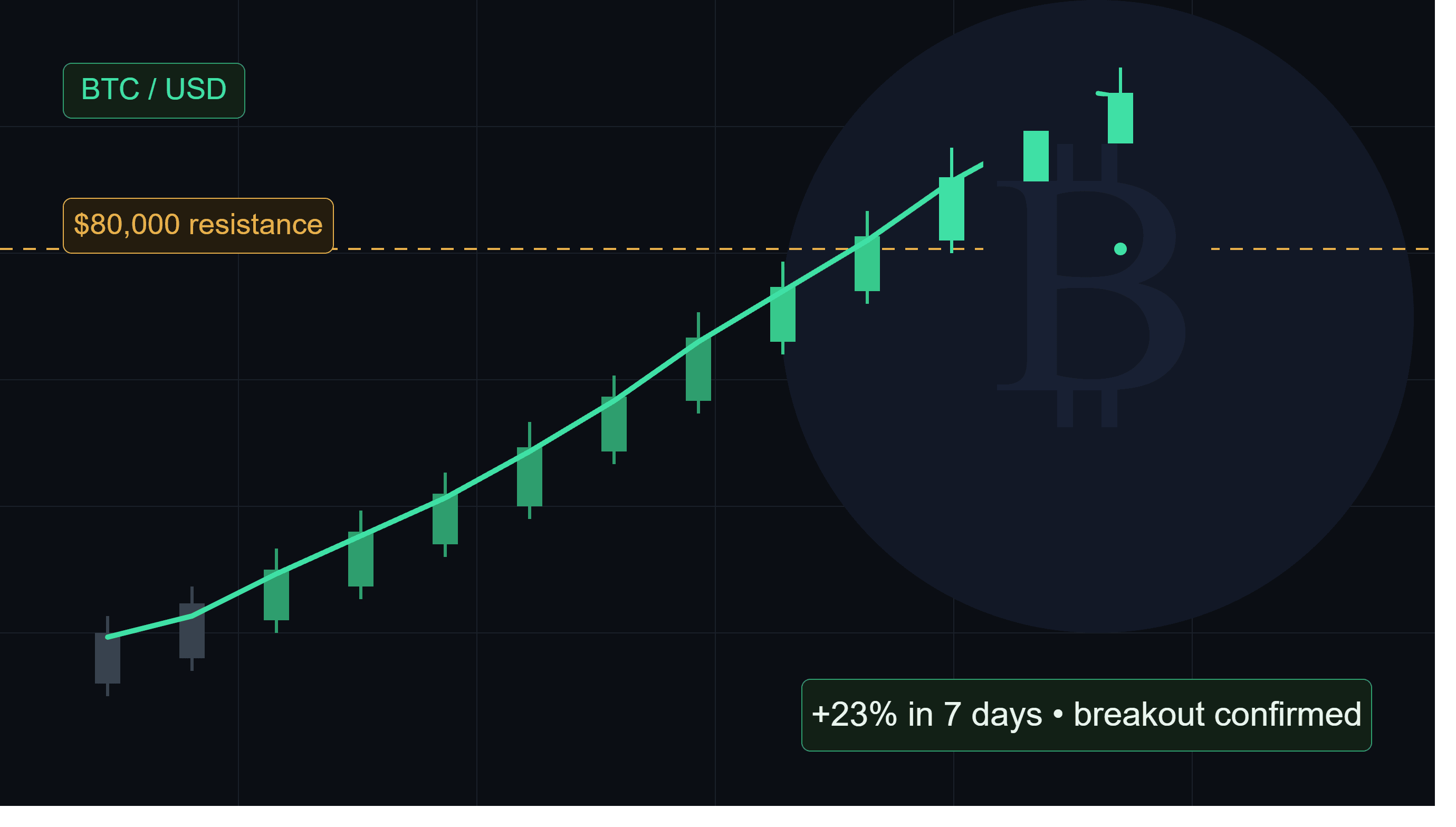
Bitcoin Just Hit $80,000: Last Week WEEX's Prediction Came True — What's Next?
Bitcoin hit $80,000 as WEEX predicted last week. See what drove the breakout, current key levels, and whether $90,000 is next.
WEEX Exclusive:Bitcoin break $80K!NVIDIA Extends Declines | WEEX TradFi Daily (Aug. 25, 2026)

Bitcoin break $80K!NVIDIA Extends Declines | WEEX TradFi Daily (Aug. 25, 2026)
Global markets delivered mixed signals. Bitcoin and Ethereum strengthened as institutional flows into spot ETFs supported a recovery in crypto risk appetite, while the Robinhood ecosystem and NFT sector also remained active. In technology, NVIDIA continued to weaken ahead of its earnings release, with investors focused on AI returns, customer capital expenditure, and order execution. PDD Holdings saw significant volatility after reporting results, while Applied Optoelectronics came under pressure following its large equity financing announcement. Investors are also awaiting new rate-path signals from the Jackson Hole Economic Symposium.
Bitcoin Sees Increased Interest from Long-term Investors

US Treasury May Tap $950 Billion Reserve to Calm Markets
Billions Flow into Crypto ETFs, Trader Loses Again
Grayscale Launches Zcash ETF Following Critical Privacy Flaw That Rocked the Cryptocurrency
Whales Confirm Trend Reversal, Bitcoin Expected to Reach $100,000
Some Bitcoin holders tax bill is now set when they leave the country instead of when they sell
Bitcoin Surges to 80000, Needs to Exceed 81087 to Confirm End of Bear Market
Bitcoin Weekly RSI Shows Bullish Divergence, Analysts Assess Bear Market Trend