
XRP News: Which August 2026 Headlines Actually Move Price

 Prefer us on Google


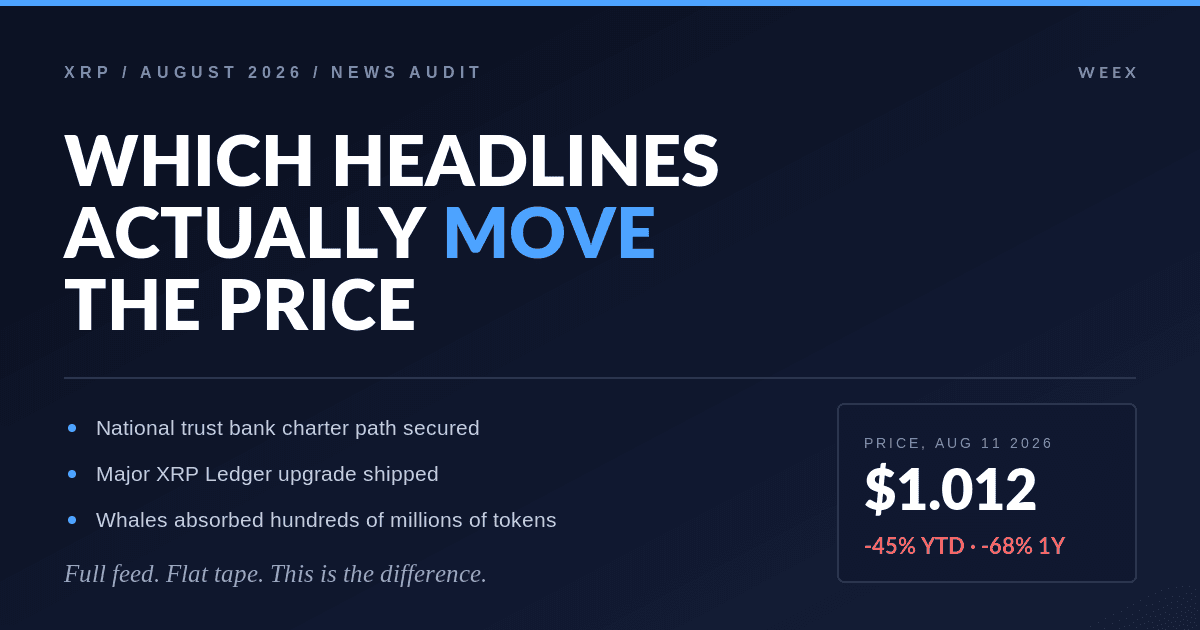
XRP news feeds are full this month, and the price has barely moved. XRP traded at $1.012 on August 11, 2026, inside a 24-hour range of $1.008 to $1.039 — down roughly 45% year-to-date and more than 68% below where it stood a year ago. In the same window, Ripple secured a national trust bank charter path, shipped a major ledger upgrade, and watched whales absorb hundreds of millions of tokens.
That gap between headline volume and price action is the story. Most XRP news pages hand you thirty items and let you sort them yourself. This one ranks them by whether they can actually reprice the token, and tells you which dates to put in the calendar.
Why XRP is stuck near $1 while the headlines look constructive
The simplest explanation is that XRP's 2026 price is driven by two variables — US regulatory status and net fund flow — and both stalled in the same fortnight.
Ripple's product news is real but slow-acting. A ledger amendment or a stablecoin partnership changes XRP's terminal value over years. A Senate vote or an ETF flow reversal changes it in an afternoon. When traders say "the news is good but XRP won't move," what they usually mean is that the good news is all in the slow bucket while the fast bucket has gone quiet.
The $1 handle matters for a mechanical reason too. It is the round number where retail stop clusters and options strikes concentrate, and it sits close to the 18-month support shelf that technicians have been defending since spring. Below roughly $0.99–$1.00, the next visible demand zone is $0.94, then a wider $0.86–$0.94 band. That is a long way down for a token whose narrative catalyst is now a month out.
XRP news ranked by what actually moves the price
Not every headline is tradeable. Here is how August's XRP news stack ranks on price impact, and why.
| Story (as of Aug 12, 2026) | Direction | Price impact | Why |
|---|---|---|---|
| CLARITY Act vote pushed to Sept 15 | Bearish near-term | High | Removes the only binary US catalyst before autumn |
| XRP ETF weekly inflows fall 93% to $1.01M | Bearish | High | Marginal buyer stepped away; net assets slipped to $964M |
| Whales absorb 380M+ XRP at the $1 test | Bullish | Medium | Real absorption, but slow and invisible to momentum traders |
| August escrow release: 1B out, 700M relocked | Neutral | Low | Net new supply is 300M, routine and pre-announced |
| xrpld 3.3.0 ships five institutional amendments | Bullish | Low near-term | Multi-year adoption story, not a repricing event |
| XRPL stablecoin supply approaching $900M | Bullish | Low | Signals rail usage; does not create XRP demand directly |
The takeaway: three of the six stories that dominated XRP news this month are structurally incapable of moving price in August. The two that could — legislation and fund flows — both went the wrong way.
The CLARITY Act delay is the biggest XRP catalyst left this year
The Digital Assets Market Clarity Act would draw formal jurisdictional lines between the SEC and CFTC, placing most crypto activity under the commodities regulator. For XRP specifically, a commodity classification would close the last chapter of a legal fight that has shaped the token's valuation since 2020.
The Senate missed its window to vote before the August recess. Leadership opened the first procedural votes on August 8 to keep the bill alive, and senators return to Washington on September 14 with a floor vote scheduled for September 15. The sticking point is not crypto policy itself but the rules of debate: Democrats want ethics, conflict-of-interest, and illicit-finance provisions attached; Republicans want a clean bipartisan framework.
The honest read is that a September vote is a coin flip, and the market is pricing it that way. What traders often get wrong is assuming a delay is neutral. It is not — it strips the calendar of its only scheduled repricing event and leaves XRP to trade on macro and flow for four weeks. That is exactly the drift you have seen.
ETF inflows collapsed 93% while whales bought the dip
Spot XRP ETFs took in $1.01 million for the week ending August 8, down from $14.86 million the prior week. Combined net assets fell to $964 million from $988 million. Daily flow told the same story: a $3.58 million outflow on August 5, a $3.45 million inflow on August 6, and exactly zero on August 7 — the second flat day of the month. Cumulative net inflow since launch stands near $950 million as of August 11.
On-chain behaviour diverged sharply. Wallets holding between 10 million and 100 million XRP added roughly 1.23 billion tokens year-to-date through early August, lifting the cohort from about 10.97 billion to 12.2 billion. Whales absorbed more than 380 million XRP during the August 11 test of $1.
Two readings are available and both are defensible. The bullish one: patient capital is accumulating at what it considers a floor while the marginal ETF buyer is absent. The bearish one: whale accumulation has been running since Q1 and has not stopped the slide, so absorption without a catalyst simply delays the decline. The more useful point is that whale flow is a poor timing signal — it tells you where a floor might form, not when.
August's escrow unlock: the net number is 300 million, not 1 billion
Ripple released 1 billion XRP from escrow on August 1, worth roughly $1.08 billion at the time, split across three transactions of 500 million, 300 million and 200 million tokens. Headlines stopped there. The detail that matters is that Ripple re-escrowed 700 million XRP before the release, cutting net new circulating supply to 300 million.
That is a routine month. The escrow mechanism has run on the first of every month since December 2017, and Ripple has relocked roughly 700 million per month through 2026. At $1.01, 300 million tokens is around $303 million of potential supply — meaningful, but small against a token that turns over $1.5 billion or more in a normal day.
If you see an XRP news headline built around "1 billion unlocked," check whether it mentions the re-escrow. Most do not, and that omission is the single most common way retail traders misprice the monthly event.
XRPL 3.3.0 and RLUSD: the slow build price is ignoring
RippleX shipped xrpld 3.3.0 in early August, bundling five amendments aimed squarely at institutional users: Confidential MPT, Batch, Permission Delegation, Sponsored Fees and Reserves, and Dynamic MPT. In plain terms, that adds transaction privacy, atomic multi-step settlement, delegated account permissions, and fee structures a business can sponsor on a user's behalf.
Alongside it, XRPL stablecoin supply is approaching $900 million, and USDV's arrival gives the ledger a second dollar token beside Ripple's own RLUSD. That second issuer is the more interesting signal — it tests whether XRPL can function as a neutral multi-issuer settlement rail rather than a Ripple-only venue.
On the corporate side, Ripple holds conditional OCC approval for Ripple National Trust Bank, granted in December 2025, and the OCC's final rule on national trust bank activities took effect in April 2026. Ripple has also applied for a Federal Reserve master account, which would grant direct Fedwire access. As of late May 2026 the Fed had set no public timeline.
None of this is priced, and reasonably so. XRP the token does not automatically capture value from RLUSD volume or institutional XRPL usage; the link runs through liquidity demand for the bridge asset, which is indirect and slow. Treat these as reasons the floor might be higher in 2028, not reasons to buy this week.
XRP market snapshot and what to watch next
Current supply and network facts, drawn from the XRP/USDT spot market on WEEX as of August 12, 2026:
| Metric | Value |
|---|---|
| Market cap | $75.675B |
| Circulating supply | 62.054B XRP (62.05% of max) |
| Total supply | 99.986B XRP |
| Maximum supply | 100B XRP |
| XRPL settlement time | 3–5 seconds |
| XRPL transaction cost | ~$0.0002 |
| XRPL throughput | ~1,500 transactions per second |
And the dates that carry actual repricing risk:
| Date | Event | Why it matters |
|---|---|---|
| Sept 1, 2026 | Monthly escrow release | Watch the re-escrow ratio, not the headline number |
| Sept 14, 2026 | Senate returns from recess | Procedural signalling on CLARITY resumes |
| Sept 15, 2026 | CLARITY Act floor vote | The only scheduled binary event for XRP this quarter |
| September FOMC | Fed rate decision | Sets risk appetite across the whole altcoin complex |
| Weekly | ETF flow prints | A sustained return above $15M/week would mark a real shift |
For traders positioning around these dates, the XRPUSDT perpetual futures market on WEEX supports leverage up to 500×, which is exactly the instrument that punishes event-driven trading hardest. A legislative vote can gap price in either direction on a headline that arrives between blocks of liquidity; leverage that survives a 5% move will not survive a 15% one. If you are new to the asset, start with the spot walkthrough in how to buy XRP before touching a perpetual, and compare your own assumptions against the scenario ranges in the XRP price prediction tool.
What matters most
Strip the XRP news cycle down and one thing is doing the work: whether the United States gives XRP a settled statutory category, and whether that brings the ETF bid back. Everything else — escrow mechanics, ledger amendments, stablecoin supply — is either noise or a story for a later year.
Between now and September 15, the base case is range-bound trade with $1.00 as the line that decides whether the range holds or breaks. Whale accumulation argues the floor is being built. Absent ETF demand argues it will be tested first. Both can be true.
FAQ
1. Why is XRP down when the news looks positive?
Because the positive news is structural rather than immediate. Ledger upgrades and banking-charter progress affect XRP's value over years, while the two fast-acting drivers — US legislation and ETF inflows — both stalled in early August 2026.
2. What is the next major XRP catalyst?
The CLARITY Act floor vote scheduled for September 15, 2026. It is the only binary, calendared event that could reclassify XRP as a commodity in the US and reopen institutional allocation.
3. Does the monthly escrow unlock crash the XRP price?
Historically no. Ripple typically re-escrows around 700 million of the 1 billion released, leaving roughly 300 million in net new supply — small relative to daily turnover and fully telegraphed in advance.
4. Are XRP ETFs still seeing inflows?
Yes, but at a sharply reduced rate. Weekly inflows fell to $1.01 million for the week ending August 8, 2026, down 93% from the prior week, with cumulative net inflows near $950 million.
5. What price levels should XRP traders watch?
The $0.99–$1.00 support shelf is the immediate line, with $0.94 and then $0.86–$0.94 below it. On the upside, $1.036 is the first reclaim level, with $1.07–$1.09 and $1.18 as subsequent resistance.
Risk Warning
Crypto assets are highly volatile and may result in partial or total loss of capital. XRP carries specific risks that this month's news flow illustrates directly: unresolved US legislative status means a single Senate outcome can reprice the token sharply in either direction; concentrated fund flows mean liquidity can thin quickly when ETF demand stops; and Ripple's scheduled escrow releases add predictable but recurring supply. Leveraged XRP futures amplify all of the above — a 500× position can be liquidated by a move far smaller than a normal daily range, and event-driven gaps can skip past stop orders entirely. Price data, flow figures and regulatory timelines cited here are current as of August 12, 2026 and change frequently. Nothing here is investment advice; assess your own risk tolerance and local regulatory requirements before trading.
This content is provided for general informational purposes only and doesn't constitute financial, investment, legal, or tax advice. Any events, rewards, online promotions, or related information mentioned herein should not be considered a recommendation, solicitation, or invitation to purchase, sell, trade, or otherwise deal in any crypto assets. Crypto assets are highly volatile and may result in loss. The availability of WEEX services, products, and related events may vary by region. You are responsible for ensuring that your participation is in accordance with applicable local laws and regulations.
You may also like

Kioxia Stock and SK Hynix: What Rivals Sharing the Same Shareholder Actually Means

Is HIMS Stock a Buy After the Earnings Selloff? What the Full-Year Guidance Raise Actually Implies

ASTS Stock Falls After Missing Q2 Estimates: What the Revenue Miss and Japan Launch Actually Mean

Intel Stock Is Up Over 170% in 2026: What the AI Foundry Turnaround Actually Required

Intel Stock Sale Draws Over $100 Billion in Demand: What the 5x Oversubscription Actually Signals

RKLB Stock Price Targets Range From $64 to $150: What the Analyst Disagreement Actually Reveals
RKLB Stock Has Fallen Sharply Since SpaceX's IPO: What History Says Happens to Number Two Players

SPCX Stock Price Target Raised to $450 by Arete Research: What the Upgrade After the Cursor Deal Actually Means
SPCX Stock Closes Above Its $135 IPO Price for the First Time in Weeks: What the Recovery Actually Signals
XST Coin: Which Token Is It, and How Thin Is the Market?

HOOD Stock at $94: Record Revenue, Crypto Slump, 24/7 Access

CRWV Stock After Q2: Demand Is Fine, the Interest Bill Isn't
PROM on 12 August 2026: What Upbit Added and What the Price Did
What Is Prom (PROM)? The Polygon CDK Chain, the Token and Where It Trades
Best Crypto Trading Bot Strategies for Beginners
How High Can XST Reach? Buy, Hold, or Wait?
How to Backtest a Crypto Trading Strategy? A Beginner’s Guide
How to Build a Crypto Trading Bot With an Exchange API: A Beginner’s Guide
Crypto Trading Bot vs Manual Trading: Which Is Better?
Is Cronos (CRO) Still Worth Buying in 2026? Ecosystem Growth, Staking Yields and Risk Factors
Google Stock and the $200 Billion Anthropic Financing Program: What the Largest AI Deal in History Means for GOOG

Why Is Cronos (CRO) Gaining Trader Attention? Key Drivers Behind the Recent Volume Surge
Is Bitcoin Preparing for a Bullish Breakout? Key Technical Indicators and On-Chain Data
How to Avoid Liquidation During Market Crashes? Futures Risk Management Strategies
Which AI Crypto Tokens Are Surging Today? Top Decentralized AI Projects to Watch
Is Cronos (CRO) Preparing for a Major Rally? Catalysts, Risks and the 2026 Outlook
Which Major Tokens Face Massive Unlocks Tomorrow? Market Impact and Price Predictions
HIMS Stock Falls After Raising Guidance: What the GLP-1 Regulatory Uncertainty Actually Changes
What Are the New Crypto Regulation Laws? Essential Compliance Guide for Traders
ASTS Stock Price Prediction 2026-2027: Can AST SpaceMobile Recover After the Launch Bottleneck
Kioxia Stock and SK Hynix: What Rivals Sharing the Same Shareholder Actually Means
Is HIMS Stock a Buy After the Earnings Selloff? What the Full-Year Guidance Raise Actually Implies
ASTS Stock Falls After Missing Q2 Estimates: What the Revenue Miss and Japan Launch Actually Mean
Intel Stock Is Up Over 170% in 2026: What the AI Foundry Turnaround Actually Required
Intel Stock Sale Draws Over $100 Billion in Demand: What the 5x Oversubscription Actually Signals
RKLB Stock Price Targets Range From $64 to $150: What the Analyst Disagreement Actually Reveals






