
What Is Interlink (ITLG) and How Does It Work?

 Prefer us on Google


As Web3 transitions from speculation to utility, verifying real human identity has become crucial. Rampant bot activity and Sybil attacks undermine governance and airdrops, hindering mainstream adoption.
Interlink (ITLG) addresses this through Proof of Personhood - a protocol placing verified human identity at Web3's core. By replacing bots with authenticated users, it creates secure foundations for dApps, DAOs, and community participation.
This human-centric approach enables trustless verification while maintaining privacy. For developers building dApps or communities seeking authentic engagement, Interlink establishes the critical identity layer missing from current blockchain infrastructure.
What Is Interlink (ITLG)?
Interlink represents a paradigm shift in blockchain architecture by placing verified human identity at the center of its ecosystem. The protocol functions as a Web3 infrastructure layer that exclusively authenticates and serves real human participants, effectively eliminating bots, artificial intelligence agents, and fraudulent accounts from its network. Moving beyond traditional consensus mechanisms like Proof of Work or Proof of Stake, Interlink introduces Proof of Personhood - a revolutionary approach where network validation and participation rights derive from verified human identity rather than computational power or financial stake.
The system employs advanced biometric verification including facial recognition and liveness detection to establish unique human identities, which are then cryptographically secured as encrypted hashes on-chain. This ensures the fundamental principle of one verified person equaling one network node, substantially reducing vulnerabilities to Sybil attacks and identity exploitation. The Interlink Genesis Token (ITLG) serves as the economic engine within this identity-centric ecosystem, functioning as both utility and governance instrument for verified participants. Beyond technical infrastructure, Interlink envisions creating a global digital citizenship framework where smartphone access enables secure, equitable Web3 participation without financial barriers.
How Interlink (ITLG) Works?
Interlink's operational framework builds upon a foundational premise: every digital identity should correspond to a verified human entity. The protocol achieves this through a sophisticated biometric verification process that replaces traditional mining equipment and staking requirements. Users initiate participation by downloading the Interlink application and completing a streamlined verification procedure incorporating facial recognition and liveness assessment. Successful verification generates an encrypted identity hash stored on-chain, representing a confirmed human participant without duplications or artificial entities.
These verified users, designated as "Human Nodes," gain full network participation rights without demanding substantial hardware investments or capital commitments. The implementation unfolds through several key mechanisms:
- Unique human validation: Each participant undergoes biometric verification ensuring singular, authentic human representation
- Automated system resistance: Exclusive verification requirements prevent bot infiltration in block production, transaction validation, and governance processes
- Privacy preservation: Zero-knowledge proof technology enables identity confirmation without exposing sensitive biometric information
- Cross-platform compatibility: Verified Interlink identities facilitate access across multiple blockchain networks including Ethereum, BNB Chain, and Solana
- Practical utility integration: Authenticated users can earn ITLG tokens, utilize them within decentralized applications, engage in governance, and access ecosystem tools
Interlink (ITLG) Tokenomics
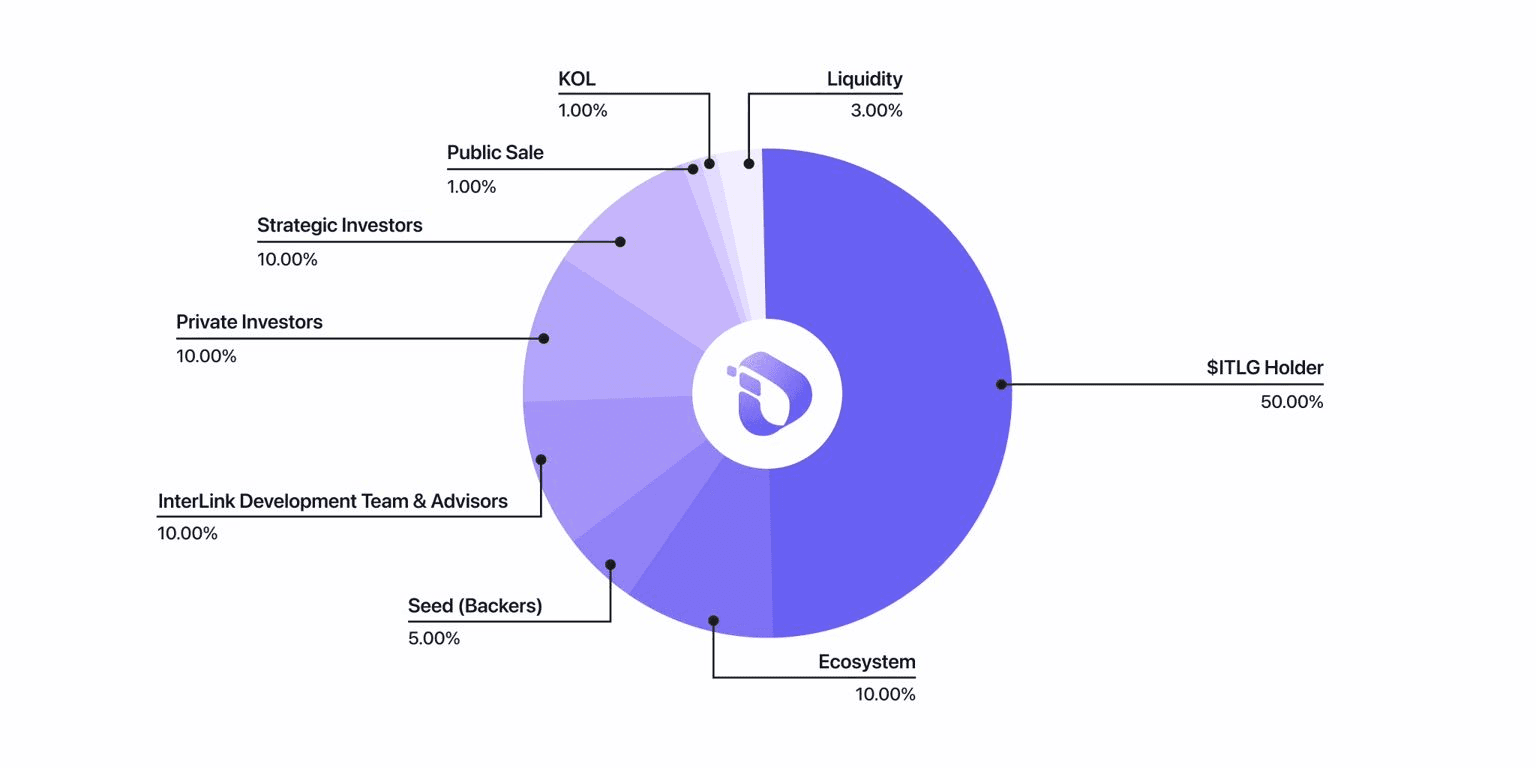
Interlink employs a sophisticated dual-token economic model that strategically separates internal ecosystem functions from external market dynamics. The primary token, ITLG (Interlink Genesis Token), distributes exclusively to verified users as reward for identity validation, network referrals, and active participation. This token serves dual purposes as both utility instrument within the ecosystem and governance mechanism for protocol decisions.
Complementing ITLG, the secondary ITL token facilitates external transactions, institutional engagement, and exchange liquidity. This structural separation enables Interlink to maintain focus on human verification incentives while ensuring seamless interoperability with broader cryptocurrency markets. The token distribution model emphasizes sustainable growth through carefully calibrated allocation mechanisms that prioritize network participation over speculative accumulation.
-- Price
Key Features of Interlink ($ITLG)
The defining characteristics of Interlink ($ITLG) encompass:
- Biometric Verification Mining
Participants generate tokens through periodic identity confirmation, replacing computational mining equipment with accessible human verification processes.
- Dual-Currency Architecture
$$ITLG operates as the primary utility token while$$ITL functions as the institutional-grade asset for accessing verified human network layers.
- Multi-Level Referral Framework
Structured referral mechanism enhances network integrity through tiered compensation, rewarding both direct and secondary network expansion contributions.
- Identity-Based Governance
Verified token holders exercise voting authority over protocol evolution, resource distribution, and strategic direction through authenticated participation.
- Integrated Application Ecosystem
$ITLG facilitates transactions across gaming platforms, revenue-generating applications, commercial services, and decentralized finance tools within the InterLink environment.
- Multi-Protocol Interoperability
Native compatibility with major blockchain networks including Ethereum, Solana, BNB Chain, Polygon, and Tron through unified wallet infrastructure.
Interlink (ITLG) Price Prediction 2025–2030
Interlink has scheduled its token listing for late 2025 or early 2026, with final determination subject to decentralized governance procedures through the InterLink DAO. The Token Generation Event will implement linear vesting schedules correlated with token ownership, featuring extended lock-up periods designed to minimize market volatility and encourage long-term stakeholder alignment. This structural approach, combined with the protocol's inherent resistance to automated manipulation, aims to cultivate genuine value appreciation rather than transient speculative interest.
The protocol incorporates deflationary measures including multiple halving events and token burning mechanisms triggered by on-chain activity. While specific pricing parameters remain undetermined, token valuation will directly correlate with verified user adoption metrics at launch - creating intrinsic alignment between network growth and economic value. The dual-token architecture maintains clear separation between community governance functions (ITLG) and institutional utility applications (ITL), enabling scalable expansion across both individual and enterprise use cases without compromising economic integrity.
Conclusion
Interlink represents a fundamental advancement in blockchain architecture by addressing the critical challenge of authentic human verification in digital environments. The protocol's identity-centric approach provides comprehensive solutions to persistent issues including Sybil attacks, governance manipulation, and reward distribution inefficiencies. Through its innovative Proof of Personhood consensus, privacy-preserving verification methods, and economically sustainable token model, Interlink establishes a robust foundation for trustworthy digital interactions.
The protocol's future trajectory will depend on execution capability, adoption rates, and scalability across diverse user segments. However, with its governance framework, deflationary economic model, and strategically segmented token system, Interlink positions itself as essential infrastructure for the next evolution of Web3 - where human identity becomes the cornerstone of decentralized ecosystems.
Further Reading
Disclaimer: The opinions expressed in this article are for informational purposes only. This article does not constitute an endorsement of any of the products and services discussed or investment, financial, or trading advice. Qualified professionals should be consulted prior to making financial decisions.
This content is provided for general informational purposes only and doesn't constitute financial, investment, legal, or tax advice. Any events, rewards, online promotions, or related information mentioned herein should not be considered a recommendation, solicitation, or invitation to purchase, sell, trade, or otherwise deal in any crypto assets. Crypto assets are highly volatile and may result in loss. The availability of WEEX services, products, and related events may vary by region. You are responsible for ensuring that your participation is in accordance with applicable local laws and regulations.
You may also like

What is BNB Upside Down (PUP) Coin?

What is BINANCELIFE (BINANCELIFE) Coin?
What is BNB SZN (SZNBSC) Coin?
What is BNB SZN (SZN) Coin?

With OpenClaw taking the world by storm, what can the Agentic economy bring to Web3?
What Is Audiera (BEAT)? Audiera (BEAT) Price Prediction 2025–2030

What is OASIS Coin? OASIS Price Analysis

What is AgentLISA (LISA) and How Does It Work?

What Is Lucidum (LUCIC)?

What is 黄果之年 (YEAROFYELLOWFRUIT)? The New Trending Chinese Meme Coin
ASTER Airdrop on WEEX Exchange: Claim Your Share of 50,000 USDT in the New User Welcome Reward

What Is APRO (AT) and How Does It Work?
What Is Lorenzo Protocol (BANK) and How Does It Work?
What Is Maxi Doge (MAXI)? A Complete Guide to $MAXI Token
What is Hajimi (哈基米)?
Phoenix (PHB) Price prediction 2025-2035

What Is DOGEX(DOGEX)?
What Is Piggycell (PIGGY)? Exploring the DePIN Powerhouse Linking South Korea's Charging Empire to Blockchain

4 Meme Coin Analysis: Why is 4 Meme Coin Trending?
Memecoin Season 2025 is Coming?
What is 索拉拉 (Solala) and Can Solala Make You Rich?
BNB Price Analysis: Why BNB Price Is Surging in October 2025?
Top 5 Four.meme Coins in the BNB Ecosystem
What is Labubu (LABUBU) and How Does It Work?
What is Hajimi (HAJIMI) and How Does It Work?
BNB Meme Coins Tank 90%: Will the Hype Continue or Has It Already Faded?
What is Binance Super Cycle (BSC) Coin: A Comprehensive Guide
What is BNB SZN (SZNBSC) Coin?
What is BINANCELIFE (BINANCELIFE) Coin?
What Is BIANRENSHENG (BIANRENSHENG) and How Does It Work?
Contents
Popular coins
Latest articles



