
What Is Futures Quantitative Trading? Strategies and Risks

 Prefer us on Google

Futures quantitative trading uses computer programs to analyze market data and trade futures or perpetual contracts according to predefined rules. The system may open long or short positions, manage leverage, place take-profit and stop-loss orders, and monitor account risk.
Its main advantage is disciplined execution. A program can monitor the market continuously and act without fear or hesitation. However, automation does not remove risk. Leverage can magnify losses, while fees, funding rates, slippage, and software errors may reduce performance.
The key point is simple: futures quantitative trading can improve execution, but it cannot turn a weak strategy into a profitable one.
What Is Futures Quantitative Trading?
In futures quantitative trading, a trader converts an idea into rules that a computer can understand.
For example, a BTCUSDT strategy may open a long position when a short-term moving average crosses above a long-term moving average. It may close the position or open a short position when the signal reverses.
A complete system normally includes:
- Real-time market data
- Entry and exit rules
- Position and leverage limits
- Take-profit and stop-loss settings
- Exchange API execution
- Order and account monitoring
Futures quantitative trading differs from spot quantitative trading in several important ways.
| Feature | Spot Quantitative Trading | Futures Quantitative Trading |
|---|---|---|
| Trading direction | Mainly buy, hold, and sell | Can open long and short positions |
| Leverage | Usually none or limited | Often available |
| Main costs | Trading fees | Fees and possible funding payments |
| Main risks | Price decline and liquidity | Leverage, margin, and liquidation |
| Asset ownership | Usually holds the asset | Trades a contract position |
Because futures allow leverage and short selling, they offer more flexibility. They also require stricter risk controls.
How Does Futures Quantitative Trading Work?
A futures quantitative trading system usually follows this process:
Receive market data → analyze conditions → generate a long or short signal → check margin and risk → submit an order → manage the position.
| Stage | What the system does |
|---|---|
| Data collection | Reads prices, candles, trades, and order books |
| Signal analysis | Checks trends, momentum, volatility, or spreads |
| Risk review | Checks balance, margin, leverage, and position size |
| Order execution | Opens, closes, or cancels futures orders |
| Exit management | Applies stop-loss, take-profit, or reverse signals |
| Monitoring | Tracks fills, open orders, and liquidation distance |
Consider a simple moving-average strategy. When the 20-period average rises above the 60-period average, the program generates a long signal. Before opening the position, it checks the available margin, current exposure, and maximum loss limit.
A signal should never bypass risk checks. Even when the entry condition is met, the program may reject the trade if the account is already overexposed.
Common Futures Quantitative Trading Strategies
No strategy works in every market. Each approach depends on specific price conditions.
| Strategy | Basic idea | Main risk |
|---|---|---|
| Trend following | Trades in the direction of a sustained move | Repeated losses in sideways markets |
| Mean reversion | Trades a possible return toward an average | Losses during strong trends |
| Breakout trading | Enters after price crosses an important level | False breakouts |
| Funding-rate strategy | Uses funding-rate differences or hedged positions | Funding and hedge conditions may change |
| Basis arbitrage | Trades the price difference between spot and futures | Fees, execution, and capital requirements |
| Market making | Places buy and sell quotes around the market price | Inventory risk during fast moves |
Trend and breakout strategies are usually easier for beginners to understand. Their rules can be clearly defined and tested.
Funding-rate and basis strategies may appear less dependent on market direction, but they are not risk-free. The price relationship can change, one side of the hedge may fail to fill, and transaction costs may remove the expected return.
-- Price
What Tools Are Needed?
A futures quantitative trading system requires reliable market data, backtesting tools, and an exchange connection.
Important futures data may include market prices, candlesticks, order-book depth, mark price, index price, funding rates, account margin, and open positions.
Mark price is especially important because some platforms use it to calculate unrealized profit and loss or liquidation risk. A strategy that watches only the latest traded price may not accurately estimate its distance from liquidation.
Backtests should include:
- Maker and taker fees
- Slippage
- Funding payments
- Position size
- Leverage and margin limits
It is not realistic to take a spot strategy’s return and simply multiply it by the leverage level. Leverage also magnifies drawdowns and increases liquidation risk.
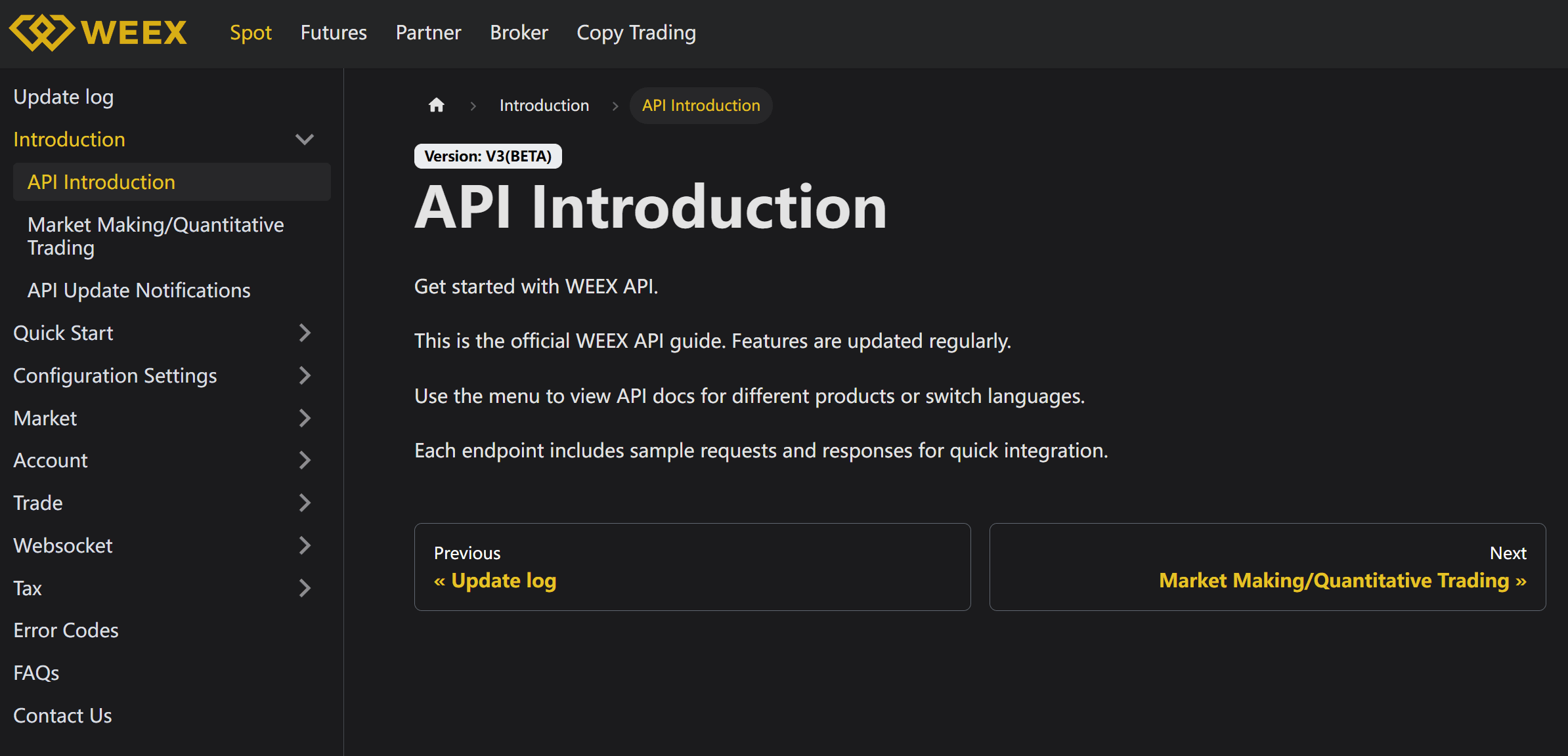
An exchange API connects the trading program to market data and order functions. For example, developers can use the WEEX API page to review available API resources and market-data interfaces.
A typical setup process is:
Review the documentation → create an API Key → connect market data → test futures orders → add error handling.
WEEX can be used as one possible execution platform for a self-built system. The API provides data and order infrastructure; it does not evaluate the strategy or guarantee results.
Spot and futures APIs may use different endpoints, parameters, and permissions. Based on the supplied WEEX materials, developers should use current symbol formats such as BTCUSDT, assign appropriate client order IDs, and confirm the latest interface rules before live deployment.
How Do Take-Profit and Stop-Loss Rules Work?
Take-profit orders close a position after a target gain is reached. Stop-loss orders attempt to reduce losses when the market moves against the position.
Common methods include:
| Method | How it works |
|---|---|
| Fixed percentage | Exits after a set gain or loss |
| Volatility-based stop | Adjusts the stop distance to market volatility |
| Trailing stop | Moves the exit level as profit increases |
| Time-based exit | Closes a position after a defined period |
| Signal-based exit | Exits when the strategy condition reverses |
A stop-loss does not guarantee a specific execution price. During sharp market moves, the actual fill may be worse than expected because of slippage or limited liquidity.
Risk control should therefore not depend on stop-loss orders alone. The system must also limit leverage, position size, and total account exposure.
For example, if a trader uses very high leverage, the liquidation price may be close to the entry price. The position could face liquidation before a wider stop-loss works as intended.
Main Risks of Futures Quantitative Trading
Futures automation introduces both market and technical risks.
Leverage and liquidation: A small price move can create a large percentage loss. Excessive leverage may cause liquidation before the strategy has time to recover.
Funding rates: Perpetual positions may pay or receive funding. A strategy that holds positions for long periods should include this cost in backtesting.
Fees and slippage: Frequent trading can generate substantial costs. A small statistical advantage may disappear after realistic execution expenses.
Strategy failure: A system built for trending markets may struggle when prices move sideways. Historical performance cannot guarantee future results.
Technical errors: Delayed data, rejected orders, partial fills, API timeouts, or duplicate requests may create unexpected positions.
API security: API permissions should follow the minimum-access principle. Enable only the functions the strategy needs, protect the Secret Key, and replace the key immediately if it may have been exposed.
Is Futures Quantitative Trading Suitable for Beginners?
Individuals can learn futures quantitative trading, but it is usually not the best first live-trading method for someone who does not understand leverage and liquidation.
A beginner should first learn how margin, funding, long and short positions, and liquidation prices work. The strategy should then be tested using historical data and simulation before any live deployment.
A safer learning sequence is:
Understand futures rules → test without or with low leverage → backtest and simulate → use limited capital → monitor continuously.
Leverage does not improve the quality of a strategy. If a system has no real advantage, leverage will usually make its losses appear faster.
Conclusion
Futures quantitative trading combines real-time market data, trading rules, leverage controls, take-profit and stop-loss settings, API execution, and ongoing monitoring.
Its advantage is consistent and automated execution. Its risks include liquidation, funding costs, fees, slippage, strategy failure, and technical errors.
Exchange interfaces such as WEEX API can connect a self-built program to market data and supported order functions. However, the final result still depends on strategy quality, realistic testing, position sizing, and risk management.
This content is provided for general informational purposes only and doesn't constitute financial, investment, legal, or tax advice. Any events, rewards, online promotions, or related information mentioned herein should not be considered a recommendation, solicitation, or invitation to purchase, sell, trade, or otherwise deal in any crypto assets. Crypto assets are highly volatile and may result in loss. The availability of WEEX services, products, and related events may vary by region. You are responsible for ensuring that your participation is in accordance with applicable local laws and regulations.
You may also like

How to Earn WXT Rewards with WEEX Trade to Earn S6 Event

How to Earn WXT Rewards with WEEX Trade to Earn S6 Futures Event

Crypto Broker vs Stock Broker: What Is the Difference and Which Do You Need

How to Use Crypto Trading APIs? A Beginner’s Guide

How to Build a Crypto Trading Bot With WEEX API: A Beginner’s Guide
Crypto Quantitative Trading Tools: How Data, Backtesting, and APIs Build Automated Strategies
How Much Money Do You Need to Start Crypto Quantitative Trading?
REST API vs WebSocket API for Crypto Trading: What’s the Difference?

How to Secure a Crypto Trading Bot? API Key Safety Guide

What Is Crypto Arbitrage Trading? How Do Arbitrage Bots Work?
What Is a Grid Trading Bot? How Does Crypto Grid Trading Work?
How High Can XST Reach? Buy, Hold, or Wait?
Best Crypto Trading Bot Strategies for Beginners
How to Backtest a Crypto Trading Strategy? A Beginner’s Guide
How to Build a Crypto Trading Bot With an Exchange API: A Beginner’s Guide

Crypto Trading Bot vs Manual Trading: Which Is Better?

Gold Price vs Bitcoin: Which Is the Better Safe Haven When AI Stocks Crash?
Can Futures Trading Bots Make Money? A Realistic Review

What Is Cysic (CYS)? ComputeFi, ZK Hardware, and AI Explained
Cysic (CYS) Coin Price Forecast 2026: AI Growth vs Token Supply Risk
Can Crypto Quantitative Trading Make Money? Risks and Reality
Bitcoin Quantitative Trading Guide: Strategies, Tools, and Risks
Is XST Coin a Scam? XSolut Risks, Dump Concerns & Price Analysis
What Is XSolut (XST) Coin? Exploring AI Infrastructure and RWA Tokenization


How to Earn WXT Rewards with WEEX Trade to Earn S6 Event
How to Earn WXT Rewards with WEEX Trade to Earn S6 Futures Event
Crypto Broker vs Stock Broker: What Is the Difference and Which Do You Need
How to Use Crypto Trading APIs? A Beginner’s Guide
How to Build a Crypto Trading Bot With WEEX API: A Beginner’s Guide
Crypto Quantitative Trading Tools: How Data, Backtesting, and APIs Build Automated Strategies
Contents
Popular coins
Latest articles





