
SK Hynix Stock in Korea: The 52% Drawdown and How to Buy It Now

 Prefer us on Google


SK Hynix stock in Korea closed at 1,422,000 won on August 7, 2026. Six weeks earlier it had touched 2,987,000 won and the company was the most valuable listed business in South Korea. The shares are now 52% below that record — and in the same window, SK Hynix reported the largest quarterly profit in its history and approved the biggest capital programme it has ever run.
That contradiction is the story. This guide covers where SK Hynix stock in Korea actually trades under ticker 000660, what caused a record-profit company to halve, a pricing gap between the Seoul shares and the new Nasdaq ADR that most coverage has not noticed, and the concrete routes a foreign investor has into the name today.
Where SK Hynix Stock in Korea Stands After the Drawdown
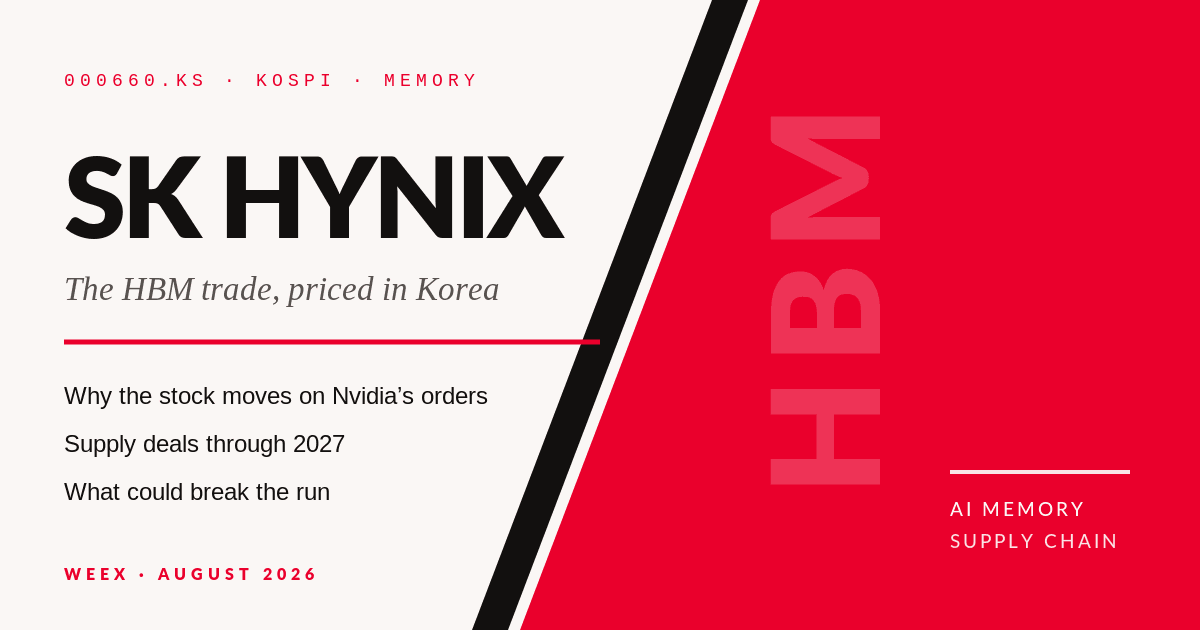
SK Hynix is a South Korean memory-chip maker and the world's largest supplier of high-bandwidth memory (HBM), the stacked DRAM that sits beside Nvidia's AI accelerators. Its home listing is the Korea Exchange, ticker 000660, quoted in Korean won.
| Key fact (Aug 7, 2026 close) | Detail |
|---|---|
| Price | 1,422,000 KRW, −4.88% on the day |
| Day range | 1,409,000 – 1,542,000 KRW |
| 52-week range | 245,000 – 2,987,000 KRW |
| Drawdown from Jun 25 record | −52.4% |
| One-year return | +450% |
| Market cap | 1,036.45 trillion KRW |
| Trailing P/E / forward P/E | 6.23 / 3.44 |
| Dividend | 3,000 KRW (0.21%), ex-date Aug 28, 2026 |
| Beta | 2.41 |
| Analyst consensus | Strong Buy, 39 analysts, target 3,164,332 KRW |
| US listing | Nasdaq ADR, SKHY, listed Jul 10, 2026 |
Source: stockanalysis.com, Aug 7, 2026 close.
Two numbers deserve to be read together. The stock has fallen by half — and it still sits 450% above where it traded a year ago. Anyone describing August 2026 as a crash is measuring from the peak; anyone describing it as cheap is measuring from a trailing P/E of 6.2 that assumes this quarter's earnings are repeatable. Both framings are selective.
Why SK Hynix Stock Fell While Profits Hit a Record
The July 29 second-quarter report was, on the raw figures, the best in company history: revenue of 79.32 trillion won, operating profit of 60.54 trillion won, a 76% operating margin, and net profit of 93.92 trillion won. Operating profit rose 557% year over year. The shares fell 9.6% on the day, because consensus had been near 84 trillion won of revenue and 64 trillion won of operating profit. A record is not a beat.
| Date (2026) | Event | Effect on the stock |
|---|---|---|
| Jun 25 | All-time high | 2,987,000 KRW |
| Jul 9 | Nasdaq ADS priced at $149; 177.9M ADS, $26.5bn raised — the largest ADS offering on record | Prices below the Seoul-implied level |
| Jul 10 | SKHY debuts, opens $170, closes $168.01 | +13% day one |
| Jul 29 | Q2 record revenue and profit, both below consensus | −9.6% |
| Aug 6 | KRX triggers a sell-side sidecar — its 37th of 2026 — as the KOSPI drops 4.6% | SK Hynix −10.4% |
| Aug 7 | Board approves 54 trillion won ($38.1bn) for the Yongin "Y2" and Cheongju "M17" fabs | −4.88%, to 1,422,000 KRW |
The proximate trigger on August 6 was not Korean at all: SanDisk's fiscal Q4 beat on revenue and earnings but guided the next quarter below expectations, and the read-through hit the entire memory complex overnight. Foreign investors — the marginal buyer through the first half of the rally — reversed hard, and 124 KOSPI names printed new lows in a single session.
The better reading of the last six weeks is that the market stopped paying for memory growth and started pricing memory supply. A 54 trillion won capex approval is bullish for SK Hynix's 2029 revenue and bearish for 2028 DRAM pricing, and on August 7 the market chose the second interpretation. That is the memory cycle behaving exactly as it always has, wearing an AI costume.
Seoul vs Nasdaq: The Gap Hiding in SK Hynix Stock Right Now
Nearly every guide to buying SK Hynix treats the Korean shares and the Nasdaq ADR as the same asset in two wrappers. On August 7 closing prices, they were not priced that way.
| Instrument | Aug 7, 2026 close | Implied value of one Korean common share |
|---|---|---|
| KRX 000660 | 1,422,000 KRW | $1,010.66 (at 1,407.04 KRW/USD) |
| Nasdaq SKHY (1 ADS = 1/10 share) | $137.91 | $1,379.10 |
| WEEX SKHYNIX/USDT perpetual | 1,019.66 USDT | 1,019.66 |
| WEEX SAMSUNG/USDT perpetual (reference) | 165.07 USDT | Samsung closed 231,500 KRW on Aug 6 ≈ $164.53 |
Run the arithmetic and the ADR was carrying roughly a one-third premium to Seoul. The WEEX SKHYNIX perpetual, at 1,019.66 USDT, sat within 1% of the Seoul-implied dollar value — as did the SAMSUNG perpetual against Samsung's Korean close, which is a useful check that this is a real spread and not a quirk of one feed.
Three caveats before anyone treats that as free money. The two sessions barely overlap: Seoul closes roughly thirteen hours before Nasdaq, so part of any gap is simply the market moving on without Korea. Korean depositary receipts have a long history of persistent premiums because local shares and ADSs are not freely convertible in both directions, which blunts the arbitrage that would otherwise close it. And SKHY faces index-driven US demand against a fixed ADS pool. The honest conclusion is not "sell the ADR" — it is that a US investor buying SKHY today is not buying the Seoul price, and should know that before deciding SK Hynix stock looks cheap on a trailing P/E of 6. Note too that SKHY at $137.91 is 7% below its own $149 offer price, so the premium has widened even as the ADR itself has lost money for day-one buyers.
How to Buy SK Hynix Stock From Outside Korea in 2026
There are now four practical routes, and the drawdown has changed which one makes sense for whom.
| Route | Ticker | Best for | Main friction |
|---|---|---|---|
| Korean shares, direct | 000660.KS | Cleanest exposure at the Seoul price | Needs a broker with KRX access; won conversion; Korean hours |
| Nasdaq ADR | SKHY | US and EU accounts wanting dollar settlement | Currently pricing well above Seoul; won-dollar risk on top |
| 2x daily leveraged ETF | SKHL | Short-horizon directional trades only | Daily reset decay; unsuitable to hold |
| Perpetual futures | SKHYNIX/USDT | Traders wanting either direction without a brokerage account | Leverage, funding costs, liquidation risk |
If the deciding factor is which wrapper tracks the Korean share price most closely, the direct Seoul route and the SKHYNIX/USDT perpetual on WEEX were the two sitting nearest the Seoul-implied dollar value on August 7. Traders who want to express a relative view between the two Korean memory names can pair it against the SAMSUNG/USDT perpetual; Samsung fell roughly 27% over the month to August 8, so the two have not moved identically. For a fuller comparison of the US-listed wrappers and how the leveraged version behaves over multi-day holds, see WEEX's breakdown of SKHY, SKHL and the Korean shares.
One trap worth naming, because Korean retail investors walked into it in July and August: leveraged single-stock and index products reset daily, and in a market that fell 10% one day and rebounded the next, that reset grinds capital away even for traders who called the direction correctly. The KRX triggering 37 sidecars in a single year is a description of exactly the choppy tape that punishes leveraged holds.
What Would Actually Break the SK Hynix Thesis
Three things, in order of how much they would matter.
Memory pricing rolls over. SK Hynix's 76% operating margin exists because HBM and conventional DRAM are both tight. Its own 54 trillion won expansion, plus Samsung's and Micron's, is the mechanism by which that tightness ends. Watch DRAM and NAND contract pricing, not the AI headlines.
Customer concentration. HBM revenue depends on a short list of AI-accelerator and hyperscale buyers. A roadmap change at Nvidia, or a competitor qualifying a rival HBM4 part, reprices the stock quickly. SK Hynix began mass shipments of HBM4 in Q2 2026, which is a lead — not a moat.
Korea-specific noise. In early August the company was weighing the sale of a majority stake in its $3bn Chongqing packaging and test plant, and a former employee was sentenced to 18 months for leaking manufacturing technology to a Chinese firm. Neither changes the earnings model. Both are reminders that this is a geopolitically exposed asset whose supply chain and IP sit on a contested map.
Is SK Hynix Stock a Buy at Six Times Earnings?
The bull case is arithmetic: 6.2x trailing earnings, 3.4x forward, an average analyst target more than double the current price, and a company that just printed a 76% operating margin. The bear case is also arithmetic: those multiples are low precisely because the market does not believe the earnings are durable, and a forward P/E of 3.4 on peak-cycle estimates is not the bargain it looks like if the estimates are wrong.
The more useful question than "is it cheap" is "what am I actually buying." SK Hynix stock in Korea at 1,422,000 won is a bet that AI memory demand outruns the industry's own capacity additions for longer than the market currently assumes. That is a real bet with a real case behind it — and it is not the same bet as "a great company got 52% cheaper." Size accordingly, and if you are buying through a US wrapper, check what you are paying relative to Seoul first.
FAQ
1. What is the ticker for SK Hynix stock in Korea?
SK Hynix trades on the Korea Exchange under ticker 000660, quoted in Korean won. Its Nasdaq ADR, listed July 10, 2026, trades as SKHY, where one ADS equals one-tenth of a Korean common share.
2. How much is SK Hynix stock trading at right now?
The Korean shares closed at 1,422,000 won on August 7, 2026, down 4.88% on the day and 52% below the record 2,987,000 won set on June 25, 2026. SKHY closed the same day at $137.91. Confirm a live quote before trading — this stock has a beta of 2.41 and moves fast.
3. Why did SK Hynix stock fall so far from its high?
Three overlapping causes: a record Q2 that still missed consensus on July 29, a sector-wide memory selloff triggered by weak SanDisk guidance that sent the KOSPI down 4.6% on August 6, and a 54 trillion won capex approval that the market read as future supply rather than future revenue.
4. Is the Nasdaq ADR the same price as the Korean shares?
Not on August 7, 2026. At 1,407.04 won to the dollar, Seoul's 1,422,000 won implied about $1,011 per common share, while SKHY at $137.91 implied about $1,379 — roughly a third higher. Limited two-way convertibility between Korean shares and ADSs, and non-overlapping trading sessions, both work against the arbitrage that would normally close that gap.
5. Can foreign investors buy SK Hynix stock directly in Korea?
Yes, through an international broker with Korea Exchange access, trading in won on Korean market hours. South Korea has also been rolling out integrated foreign-investor accounts to make direct access easier for overseas retail. The alternatives are the SKHY ADR, Korea and AI-memory ETFs, or stock-linked perpetual futures.
6. Is SK Hynix a better buy than Samsung right now?
SK Hynix leads HBM and carries the higher margin; Samsung is more diversified across memory, foundry and devices. Over the month to August 8, 2026, Samsung fell roughly 27% and SK Hynix fell further from its peak. Both carry the same underlying memory-cycle risk, so the choice is about concentration, not safety.
Risk Warning
SK Hynix stock, its Nasdaq ADR, leveraged ETFs referencing it, and any stock-linked perpetual futures are volatile and can result in partial or total loss of capital. This stock has fallen 52% from its record in six weeks and carries a beta of 2.41. Memory semiconductors are deeply cyclical, and the industry's own capacity expansion is the most likely mechanism by which today's margins compress. Specific risks include valuation compression if peak-cycle earnings estimates prove wrong, customer concentration among a small group of AI buyers, won-dollar exchange-rate risk and a persistent price gap for ADR holders, geopolitical and export-control exposure across the China supply chain, and daily-reset decay that makes leveraged products unsuitable for holding. Perpetual futures amplify both gains and losses, carry funding costs, and can be liquidated in a single volatile session. Do your own research, size positions for this stock's demonstrated volatility, and never commit funds you cannot afford to lose.
This content is provided for general informational purposes only and doesn't constitute financial, investment, legal, or tax advice. Any events, rewards, online promotions, or related information mentioned herein should not be considered a recommendation, solicitation, or invitation to purchase, sell, trade, or otherwise deal in any crypto assets. Crypto assets are highly volatile and may result in loss. The availability of WEEX services, products, and related events may vary by region. You are responsible for ensuring that your participation is in accordance with applicable local laws and regulations.
You may also like
What Is RWA Tokenization? How XSolut Is Bringing Real World Assets to Solana
XST Coin vs Render Network: Which AI Infrastructure Token Has Better Long-Term Potential
How to Buy XST Coin: A Step by Step Guide to Buying XSolut in 2026
XST Coin Price History: How XSolut Went From $0.007 to $0.020 in One Week
What Is XST Coin and Should You Buy It? A No-Nonsense Guide for Crypto Investors

Is OPEN Stock a Buy After Falling 10% on Q2 Miss? What the $5.48 Fair Value Estimate Implies
AAPL Stock Goes Ex-Dividend Today: What the $0.27 Dividend and 0.34% Yield Mean for Apple Investors
Apple Stock and CXMT: What Testing Chinese Memory Chips for iPhone Actually Means for AAPL
What Is WEEX Telegram Mini App? Features, Benefits, and How to Get Started
Opendoor Stock Falls 10% After Missing Q2 Estimates: What the EPS Surprise Actually Means
Jensen Huang Stock Advice: What He Said and What It Returned
Samsung Stock Down 38% From Its Peak: What the Selloff Means
Gold Price Today: Why Tokenized Gold Quotes a Different Number
Warren Buffett Berkshire Stock Transfer: The $147B Supply Math
KGHM Stock Forum: Copper, Silver, and the Argument the Thread Keeps Getting Backwards
Gold Forum: Where the Polish Discussion Actually Happens — and the Question It Argues About Most
JSW Stock Forum: What the Threads Are Actually Arguing About — and What They Cannot Tell You
What Is Polymarket and How Does It Work?
What Is Phantom Wallet? How to Install the Official Version Safely and Use It
What Is the Crypto Fear and Greed Index? Components, Scale and Limits
What Is Robinhood Chain? How to Add the Network to MetaMask Safely
Is Zero Knowledge Technology Actually Ready for Everyday Use?
zk-SNARK vs zk-STARK: What's the Difference?
How Zero Knowledge Proofs Are Used in Blockchain Today
What Is Zero Knowledge Proof? A Beginner's Guide
Is PGP Still Secure in 2026?
PGP vs End-to-End Encryption: What's the Difference?
Roblox Stock Price Prediction 2026-2027: Can RBLX Recover After Pulling Full-Year Guidance?
Is RBLX Stock a Buy After Falling 74% From Its All-Time High?
Roblox Stock Falls 29% on Its Worst Day Ever: What the Bookings Miss and Pulled Guidance Actually Mean
What Is RWA Tokenization? How XSolut Is Bringing Real World Assets to Solana
XST Coin vs Render Network: Which AI Infrastructure Token Has Better Long-Term Potential
How to Buy XST Coin: A Step by Step Guide to Buying XSolut in 2026
XST Coin Price History: How XSolut Went From $0.007 to $0.020 in One Week
What Is XST Coin and Should You Buy It? A No-Nonsense Guide for Crypto Investors
Is OPEN Stock a Buy After Falling 10% on Q2 Miss? What the $5.48 Fair Value Estimate Implies





