
Do You Pay Tax on Crypto? Trading, Staking and Airdrops Explained

 Prefer us on Google

 TL;DR
TL;DR
- Do you pay tax on crypto without selling? Yes, in most cases, you owe crypto tax even if you don’t cash out.
- Do you pay tax on crypto trading? Yes. Buying, selling, or swapping crypto (ETH to BTC) can trigger capital gains tax.
- How is crypto trading taxed? Profits are usually taxed as capital gains, but frequent trading or futures trading may be treated as business income.
- Is staking taxable? Yes. Crypto staking rewards are taxed as income when received, and taxed again as capital gains when sold.
- Are crypto airdrops taxable? Yes. Airdrops are taxable income at the time you receive them, even if you don’t sell.
- When do you owe crypto taxes? When you trade, earn, or receive crypto — not just when you withdraw to fiat.
- What are common crypto tax mistakes? Not tracking trades, ignoring staking rewards, and assuming no tax without withdrawal.
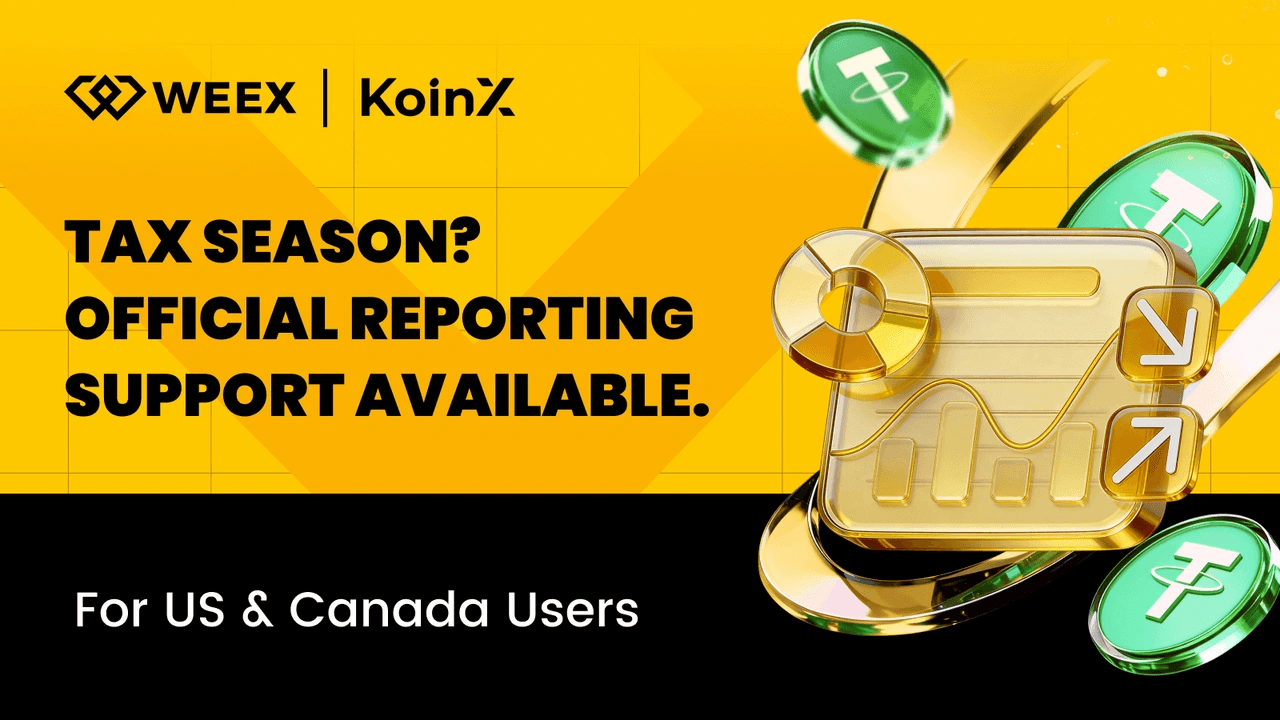
- How to report crypto taxes easily? Export your data from WEEX and use crypto tax software like KoinX to generate reports.
Most crypto users assume one thing: If you haven't withdrawn your funds, you don't owe any tax.
It sounds logical , but in most cases, it's wrong.
As crypto markets evolve, tax rules have become clearer and stricter. What matters is not whether you cash out, but how you interact with your assets. Trading, earning, or even receiving tokens can all trigger taxable events, often without you realizing it.
So when exactly do you pay tax on crypto? The answer depends on what you do.
Do You Pay Tax on Crypto Trading? Even Without Cashing Out
The most common misconception is that taxes only apply when you convert crypto into fiat.
In reality, tax authorities in many countries treat any disposal of crypto as a taxable event. This includes not only selling for cash, but also swapping one asset for another.
If you trade ETH for BTC, you may still need to calculate your gain — even though no money ever leaves the crypto ecosystem.
What matters is whether you realized a profit.
If the value of your asset increased between the time you acquired it and the time you traded or sold it, that difference is typically taxed as a gain. Losses may also be recognized, depending on local rules.
For active traders, especially those using futures or trading frequently, things can become more complex. In some cases, trading activity may even be treated as business income rather than capital gains, which can significantly change how it is taxed.
Is Staking Taxable? When and How Rewards Are Taxed
Staking is often described as passive income, but from a tax perspective, it’s rarely that simple.
In most jurisdictions, staking rewards are treated as income at the moment you receive them, based on their market value at that time.
This means you may owe tax even if you never sell your rewards.
And that’s only the first layer.
If you later sell those tokens at a higher price, the additional profit is taxed again — this time as a capital gain.
This dual structure — income first, gains later — is one of the most commonly misunderstood aspects of crypto taxation, and a frequent source of reporting errors.
Are Crypto Airdrops Taxable? What Counts as Income
Airdrops feel like free money. From a tax perspective, they usually aren’t.
In many cases, airdropped tokens are treated as income once you have control over them and they have a measurable market value.
That means the moment you can claim or access the tokens, their value may already be taxable — regardless of whether you sell them.
If you later sell at a higher price, the difference is taxed again as a gain.
Like staking, airdrops often create two separate tax events:
one when you receive the tokens, and another when you dispose of them.
-- Price
Crypto Tax Mistakes That Can Cost You Money
The rules themselves are not always complicated — but applying them correctly can be.
Many users assume that staying within crypto avoids tax, overlook income from staking or airdrops, or fail to track the original cost of their assets across multiple trades.
As activity increases, especially across different assets and strategies, keeping accurate records becomes significantly harder. Without proper tracking, it’s easy to either underreport — or overpay.
When Do You Actually Owe Crypto Taxes? Key Takeaways
Crypto taxation is not just about how much you earn. It’s about when and how those earnings are realized.
Trading, staking, and airdrops are taxed in different ways, often at different points in time. And in many cases, tax obligations arise long before any funds are withdrawn.
The key takeaway is simple:
If you are actively participating in the crypto market, you are very likely generating taxable events — whether you notice them or not.
Understanding this early makes it easier to stay compliant, avoid costly mistakes, and make better decisions as your trading activity grows.
How to Report Crypto Taxes on WEEX: A Simple Step-by-Step Guide
Understanding how crypto is taxed is only half the process — reporting it correctly is where it gets more complex.
As your activity grows, especially across trading, staking, and rewards, keeping track of every transaction manually can quickly become overwhelming. Using a platform where your trading history is organized and easily exportable can make a meaningful difference when it comes to filing.
For a step-by-step guide on how to track and report your crypto taxes, read the full tutorial here:
WEEX Crypto Tax Guide: How to Export Trading Data and Generate a Tax Report with KoinX
About WEEX
Founded in 2018, WEEX has developed into a global crypto exchange with over 6.2 million users across more than 150 countries. The platform emphasizes security, liquidity, and usability, providing over 1,200 spot trading pairs and offering up to 400x leverage in crypto futures trading. In addition to the traditional spot and derivatives markets, WEEX is expanding rapidly in the AI era — delivering real-time AI news, empowering users with AI trading tools, and exploring innovative trade-to-earn models that make intelligent trading more accessible to everyone. Its 1,000 BTC Protection Fund further strengthens asset safety and transparency, while features such as copy trading and advanced trading tools allow users to follow professional traders and experience a more efficient, intelligent trading journey.
Follow WEEX on social media:
· Instagram: @WEEX Exchange
· X: @WEEX_Official
· Tiktok: @weex_global
· Youtube: @WEEX_Global
· Discord: WEEX Community
· Telegram: WeexGlobal Group
This content is provided for general informational purposes only and doesn't constitute financial, investment, legal, or tax advice. Any events, rewards, online promotions, or related information mentioned herein should not be considered a recommendation, solicitation, or invitation to purchase, sell, trade, or otherwise deal in any crypto assets. Crypto assets are highly volatile and may result in loss. The availability of WEEX services, products, and related events may vary by region. You are responsible for ensuring that your participation is in accordance with applicable local laws and regulations.
You may also like
What is Nomina (NOM) Coin?
What is DoubleZero (2Z) Coin?

What is Winternomics TV (WNTV) Coin: A Comprehensive Guide

What is BINANCELIFE (BINANCELIFE) Coin?
What is KEFUXIAOHE (KEFUXIAOHE) Coin?
What is CAIWUZIYOU (CAIWUZIYOU) Coin?
What is Hajimi (HAJIMI) Coin?
What is KGeN (KGEN) Coin?
What is ZERO (ZEROBSC) Coin?
What is Palu (PALU) Coin?
What is Klink Finance (KLINK) Coin?
What is Binancians (BINANCIANS) Coin
What is 1BSC (1BSC) Coin?
Buy Crypto with AirTM on WEEX P2P – 0 Fee & Fast USD Trades
Buy Crypto with SEPA Instant on WEEX P2P – 0 Fee & Ultra-Fast EUR Trades
How to Trade Crypto: Best Tips for Beginners 2026
Buy Crypto with BCA on WEEX P2P – 0 Fee & 24/7 IDR Merchants
Buy Crypto with GoPay on WEEX P2P – 0 Fee & 24/7 IDR Ads
Buy Crypto with Mercadopago on WEEX P2P – 0 Fee & 24/7 ARS Merchants
Buy Crypto with Pix on WEEX P2P – 0 Fee & 24/7 BRL Ads
Buy ETH with Monobank on WEEX P2P – 0 Fee & 24/7 UAH Ads
Buy ETH with PUMB on WEEX P2P – 0 Fee & Fast UAH Trades
Buy ETH with UPI on WEEX P2P – 0 Fee & 24/7 INR Ads
Buy ETH with Google Pay (GPay) on WEEX P2P – 0 Fee & Ultra-Fast INR Trades
Buy ETH with Easypaisa on WEEX P2P – 0 Fee & 24/7 PKR Ads
Buy ETH with SadaPay on WEEX P2P – 0 Fee & 24/7 PKR Merchants
Buy ETH with NayaPay on WEEX P2P – 0 Fee & 24/7 PKR Ads
Buy ETH with MoMo on WEEX P2P – 0 Fee & 24/7 VND Merchants
Buy ETH with Zalo on WEEX P2P – 0 Fee & 24/7 VND Ads
Buy ETH with Raast on WEEX P2P – 0 Fee & 24/7 PKR Ads


